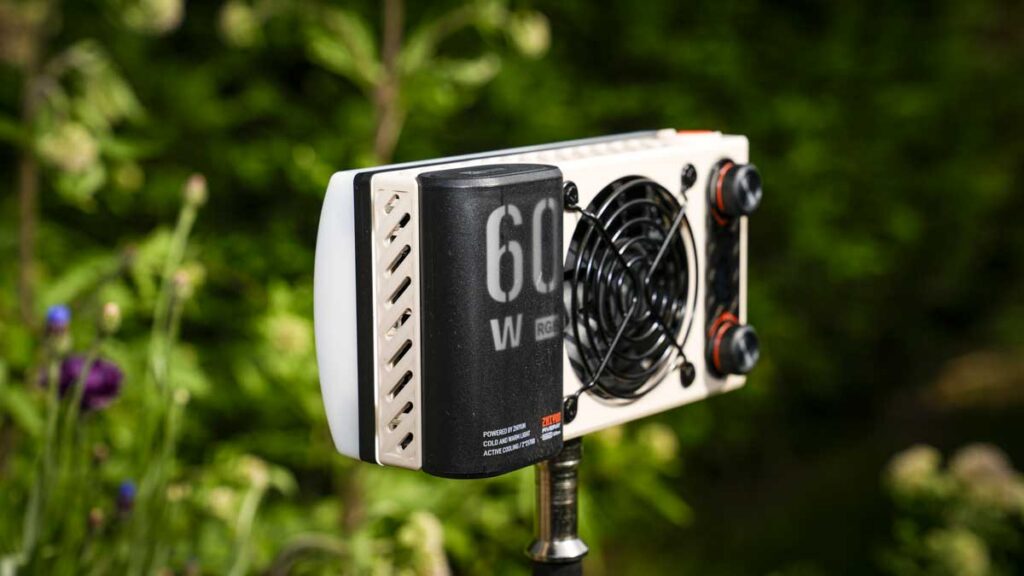

The Zhiyun M60 Ultra packs 60W of interview power into a pocket light for £129
Our Verdict
Zhiyun FiveRay M60 Ultra Verdict
What is the Zhiyun FiveRay M60 Ultra?
The Zhiyun FiveRay M60 Ultra is a 60W RGB pocket panel light designed for solo creators, videographers and photographers who need serious output in a compact form factor. If the light looks a little familiar, that will be because the design builds on the FiveRay M40 I reviewed back in 2023. That light was also extremely handy, offering 40W bi-colour option, and now the M60 adds a full RGB system, increased output and a wider 2,500–10,000K colour temperature range in a body that remains postcard-sized at 150 × 80 × 37.3mm and 430g.
Check out the official webpage for the Zhiyun FiveRay M60 Ultra
The Zhiyun FicveRay M60 Ultra is aimed at content creators, documentary shooters, solo photographers and small production teams who need a versatile, portable main or fill light without the bulk of a larger panel. If you’re shooting professionally, then this is a great on-camera light, perfect for close-up work and interviews.
Inside is a moderately sized 4,500mAh battery, a good balance between performance, weight and size. There are also quite a few advanced features, such as Bluetooth Mesh connectivity for multi-light grouping, although with just one light, I was unable to test this. 15 creative effects and a full-colour display set it apart from simpler pocket lights at this price.
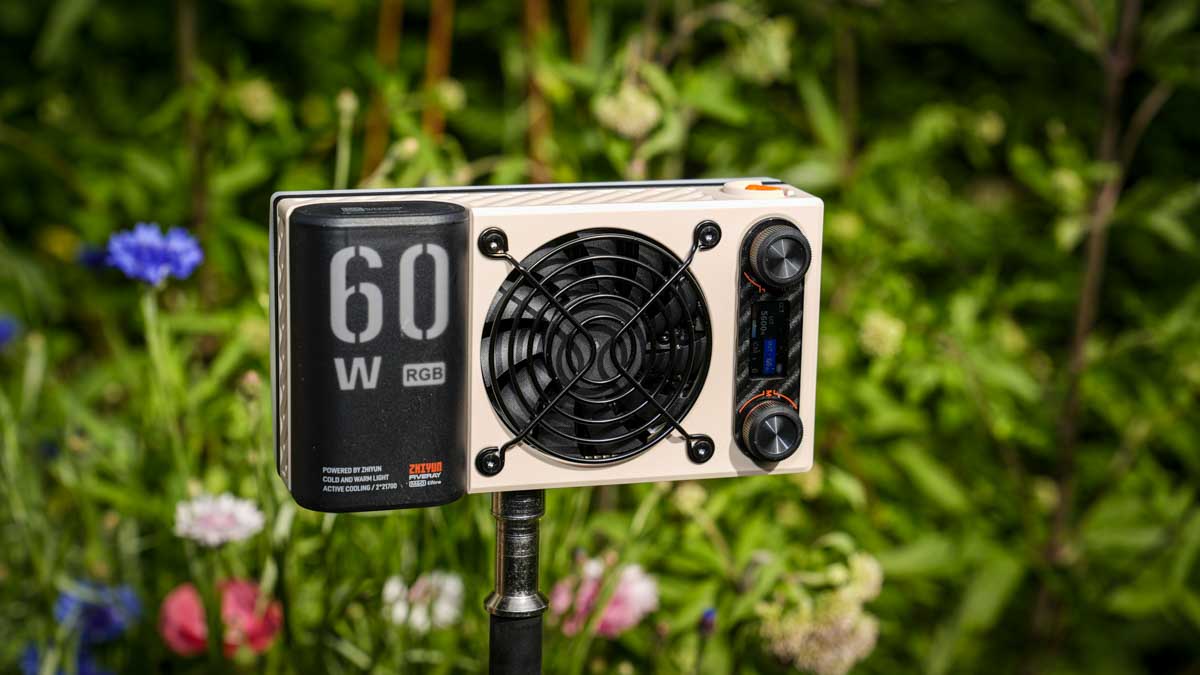
The USP is the combination of 60W output and a built-in battery in a pocketable form factor. The nearest comparable panel with similar output and RGB, the Amaran Pano 60C, costs more and does not include a battery.
Specification
Output: 60W
Peak illuminance: 6,490 lux at 1m (6500K, bare COB, 100% brightness)
Colour temperature: 2,500–10,000K
CRI: ≥95 / TLCI: ≥97
RGB: Full-colour with hue and saturation control
Creative effects: 15
Battery: 4,500mAh (160 minutes at 20% brightness / ~28 minutes at 100%)
Charging: PD + QC fast charging, USB-C
Connectivity: Bluetooth Mesh
Mounting: 1/4″ threaded holes (offset for balance)
Accessories included: Magnetic diffuser, magnetic honeycomb grid, 60W USB-C cable
Weight: 430g
Dimensions: 150 × 80 × 37.3mm
Price: £129
Peak illuminance: 6,490 lux at 1m (6500K, bare COB, 100% brightness)
Colour temperature: 2,500–10,000K
CRI: ≥95 / TLCI: ≥97
RGB: Full-colour with hue and saturation control
Creative effects: 15
Battery: 4,500mAh (160 minutes at 20% brightness / ~28 minutes at 100%)
Charging: PD + QC fast charging, USB-C
Connectivity: Bluetooth Mesh
Mounting: 1/4″ threaded holes (offset for balance)
Accessories included: Magnetic diffuser, magnetic honeycomb grid, 60W USB-C cable
Weight: 430g
Dimensions: 150 × 80 × 37.3mm
Price: £129
Build and Handling
The M60 Ultra is slightly larger than other lights in this style I have tested, but the trade-off is immediately obvious: 60W of output in a body you can fit in a camera backpack side pocket and that additional brightness is a different proposition from the 30W and 40W alternatives.
The build quality of the compact panel reflects the price fairly well: the chassis feels solid enough, although it is toughened plastic rather than metal; still, for regular location use, it held up well over a month of shoots and being thrown around on site. My main issue through the test is the front diffuser, which is fine as long as you’re gentle with it, but will inevitably detach when moved or handled without taking care.
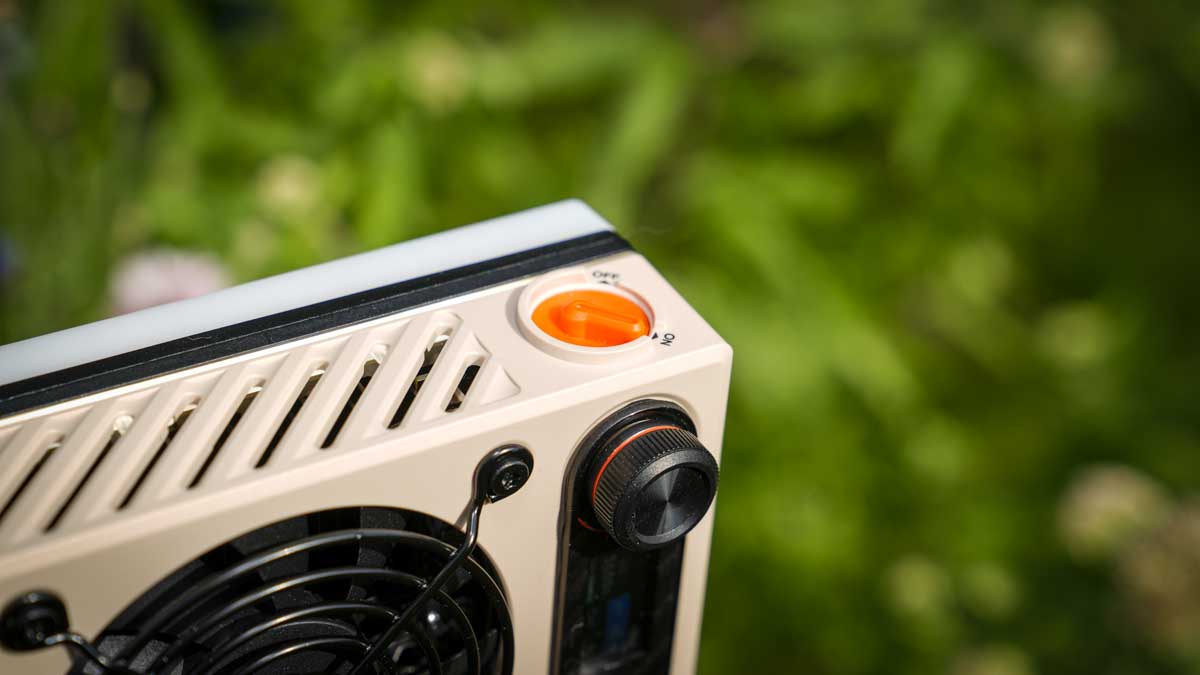
On the back is the small control interface, and this is slightly different from most panel lights I have used, and better for it. There is a physical on/off button, no double-pressing or holding to start, and the light boots up in about six seconds, which is a little on the slow side.
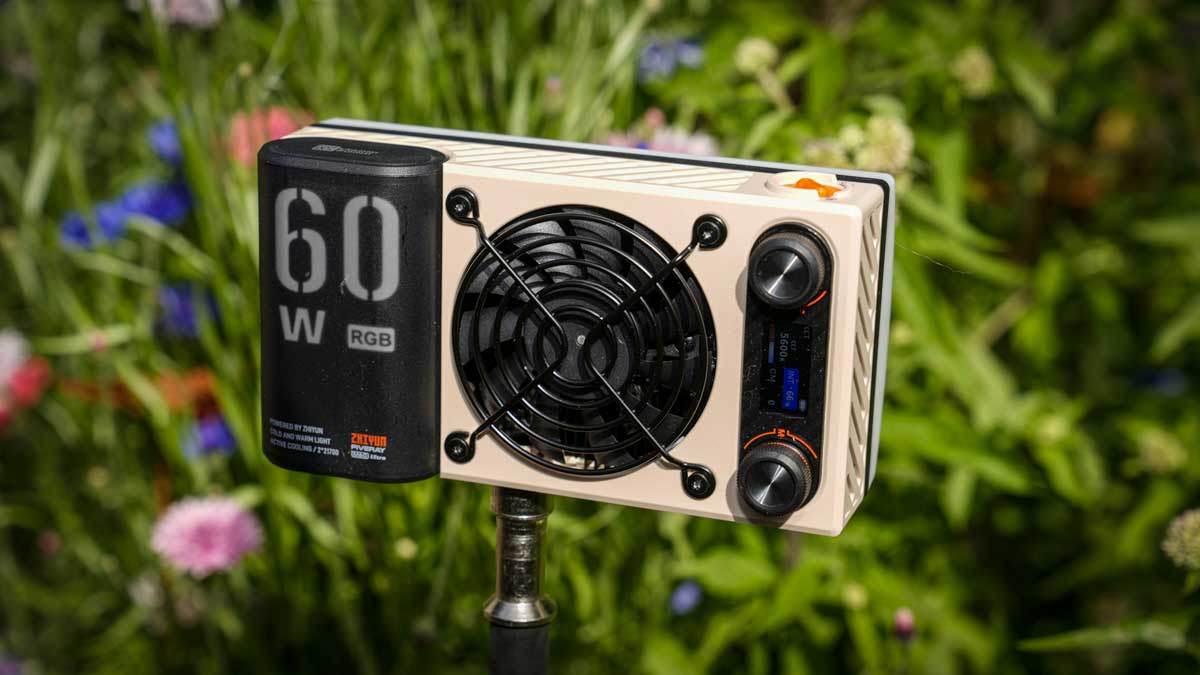
In order to navigate through settings, there are two analogue dials that handle all navigation, mode and settings selection. The top dial adjusts the value of the currently selected parameter; pushing it steps through presets. The bottom dial steps through modes: CCT, HSI, RGB and FX. It takes a short time to internalise the logic, but once you have it, the controls are faster than most menu-driven panel lights. I have a mix of familiarity with similar systems from manufacturers through years of testing, and this one is one of the easiest to recall.
Helping with the option selection is a small colour display that is clear and readable in most outdoor conditions. Knowing your current CCT value, brightness percentage, or RGB setting at a glance, rather than estimating, is useful when you are adjusting on the fly and also when mixing in with other lighting sources.
Getting the light into the shot is also relatively easy with a 1/4″ thread on the base, and this was easy enough to screw into a 3 Legged Thing Luna lightweight stand, which made a practical partner for location use.
The thread on the base is slightly offset from the physical centre of the light; Zhiyun has positioned it at the actual centre of gravity, which means the light sits level rather than tipping when mounted. Hot-shoe mounting is possible, but at 430g, a cage mount or a friction arm is more comfortable for extended shooting.
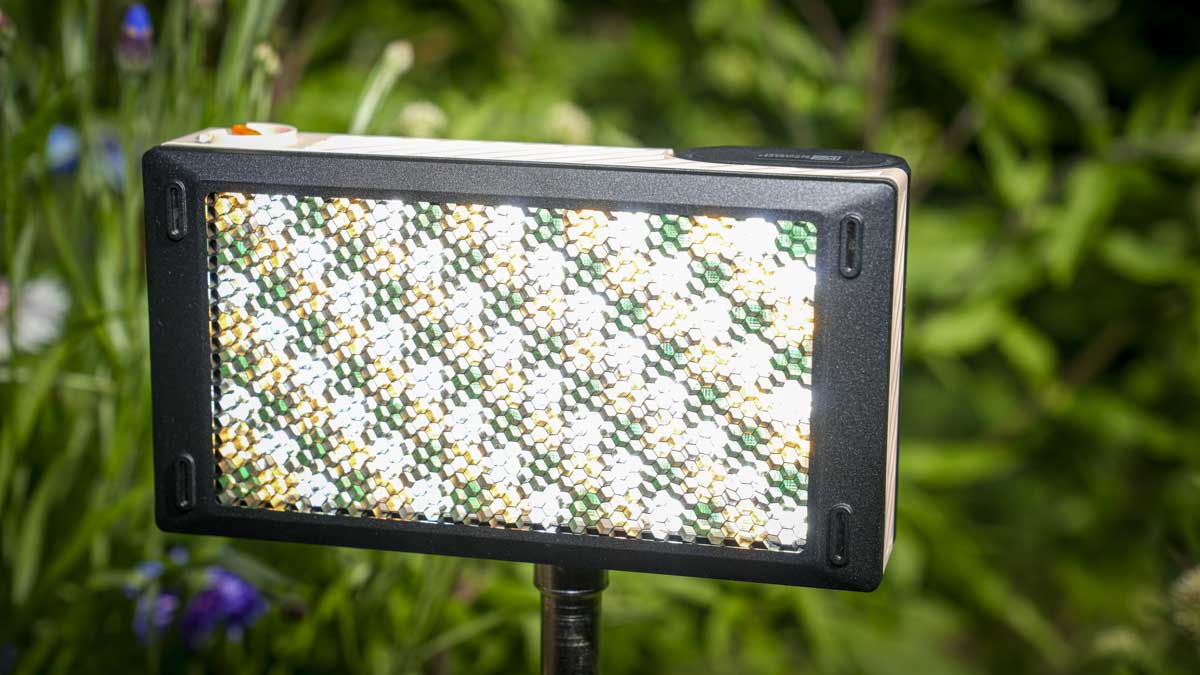
The magnetic diffuser and honeycomb grid snap on quickly, which is the best thing about them. The magnets are weaker than on previous lights I have used, and I would say that the Godox Litemons C30R‘s magnetic hold is stronger. I did find, in use, when being moved around, the diffuser came loose a couple of times when the light was bumped or repositioned. The hold is sufficient with careful handling, but stronger magnets would have been preferable for me. Or maybe I just need to be more delicate.
Features
The 60W output, peaking at 6,490 lux, is the headline feature, and having a light of this size that delivers that brightness really does make a difference. Used at 1.5–2m as a main interview light, the M60 Ultra provides enough illumination to balance a subject against most interior backgrounds at 30–50% output, leaving plenty of headroom for adjustment. The ability to match colour temperature to ambient for warmer for indoor tungsten, cooler for overcast exteriors, is fast with the top dial once the workflow is familiar. I used the DataColor Light meter to check that everything is in order.
Colour accuracy is good, with skin tones rendering naturally during interviews with the Canon EOS R5 C and Sony A7 IV. There is a slight colour shift in mixed lighting, as there always is at this size and price, but for a 430g pocket light at £129, the CRI ≥95 and TLCI ≥97 figures are reflected in real-world results.
The RGB mode is most useful for background and product lighting rather than portrait fill, unless you need someone to look green, red or blue! Used to add colour interest in the background, it works incredibly well.
The wide panel spread, especially with the diffuser fitted, throws a clean, single-colour wash across a background or still-life subject without hot spots. Although do remember that while this is powerful, it is still a small light and that spread while good isn’t a replacement for larger panels, it’s just lighter and more convenient.
It’s also not a directional light; there is no snoot or barn door option, only the diffuser and honeycomb — so for anything requiring focused, shaped light, a larger modifier system is needed.
The 15 creative effects cover the most common practical scenarios, TV flicker, which I’ve used a surprising amount, police, welding, paparazzi, lightning and so on. Several are genuinely useful for low-budget narrative work, where a practical-effect light might otherwise need to be sourced separately. The CCT breathing and colour cycle modes are more novel than of any practical use, but have been the ones I go to when showing people how the light works.
Alongside the light is the App that gives you complete control. The ZHIYUN/TK app is one of those features that, once you start to use it, you realise just how handy it is, especially if you’re a solo shooter. Being able to adjust brightness and colour temperature from behind the camera without walking to the light and back makes a big difference. The Bluetooth connection was stable throughout the test. Having reviewed lights that dropped app support over time, it is worth noting that the experience here was decent with the adjustments registering quickly, and the interface being well laid out so that it was easy to find everything I needed.
One of the big features is the Bluetooth Mesh, and this enables easy multi-light grouping, although I was unable to test this as only one unit was available.
Performance
Through the test,, I tried out a variety of lighting scenarios, from interviews to still life, and even at direct-to-camera pieces. Through the test, I found that around the 30% brightbess at 1.5-2m was the best range and gave the light enough room to offer a decent spread of light.
I also found that the small, thin honeycomb filter had quite a dramatic effect on the spread of light, so if you want a more contrasty effect, then leave the grid in place, softer than just using the diffuser.
I started with some basic tests to just see how the light performed when it came to endurance, starting with setting the light to 100% brightnesssee how long it would last. The M60 Ultra lasted 28 minutes on a full charge in a timed test, which is not bad, but far from a full day’s shoot.
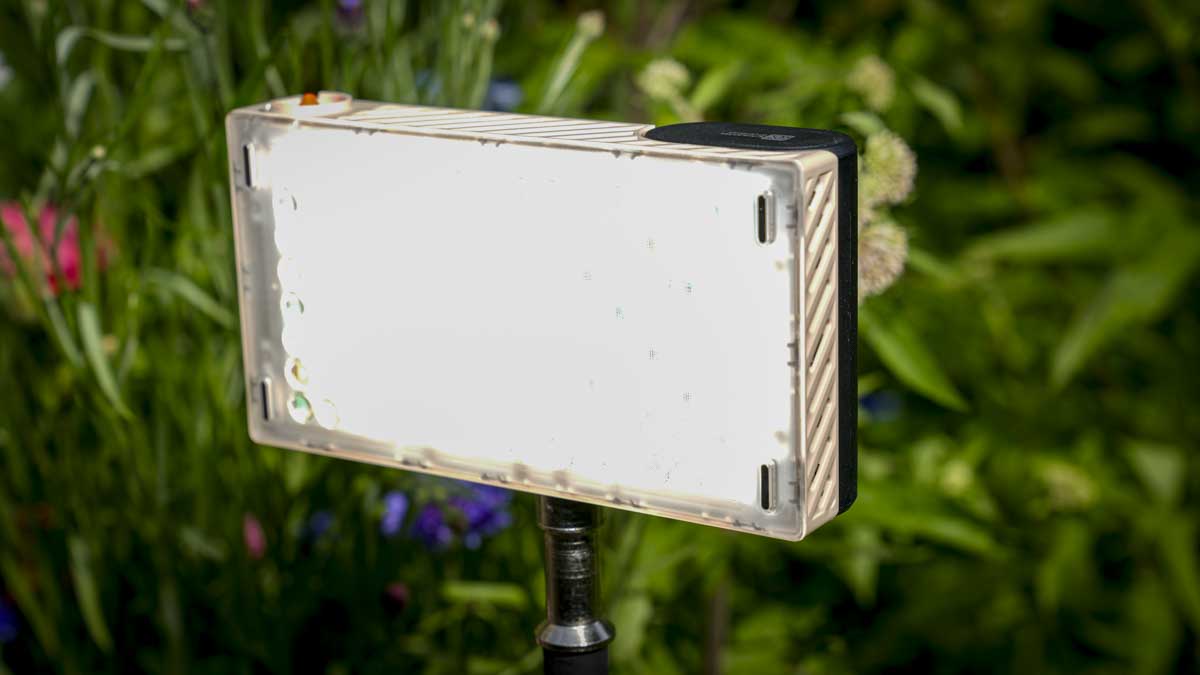
In practice, 28 minutes is limiting as a standalone battery-powered main light at full power, though it comfortably covers most interview setups. At 30% brightness, the runtime extended well beyond an hour, and 30% is more than sufficient to illuminate a subject at 1.5–2m, which is what I found was more realistic when I started to use this as part of my main kit on a couple of shoots.
I did, however, find a solution, and during a test shoot, I found that running the light from a USB-C power source was an ideal solution. As I had the BLUETTI Elite 300 in for review at the same time, I connected this via USB-C, and the M60 Ultra ran continuously between takes. Pass-through charging while the light is in use also worked without issue. Obviously, a smaller station could be used, with the max input being 17W, and using a smaller powerbank, it topped out at 6W.
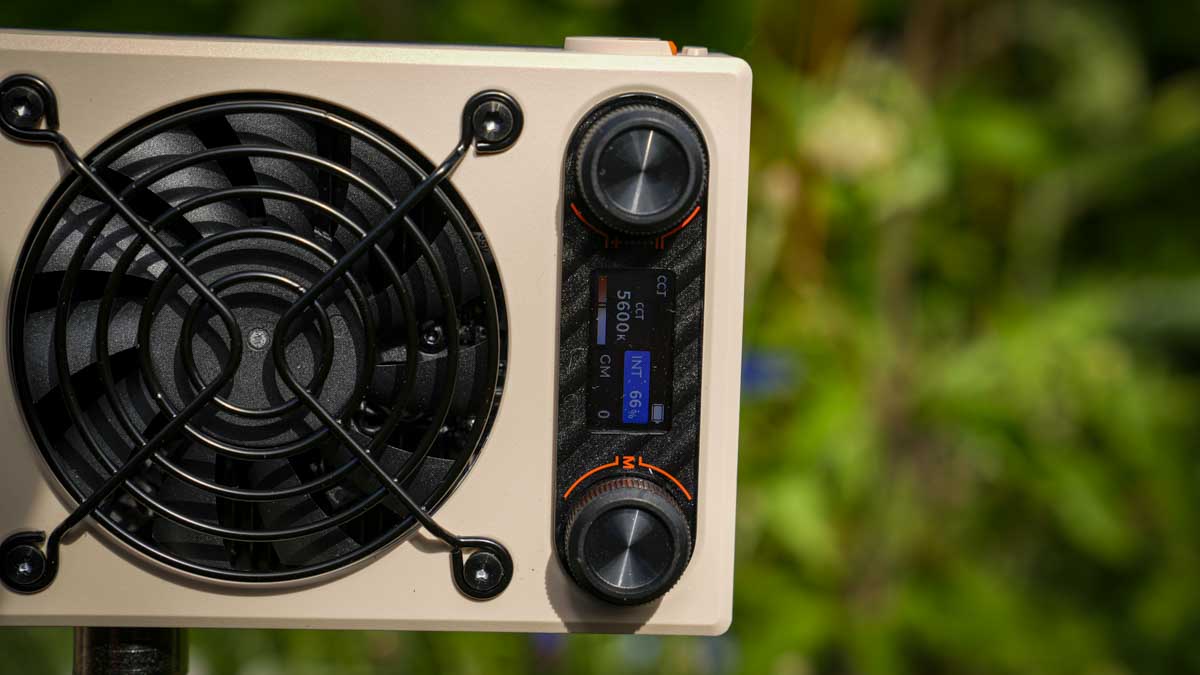
The fan noise was surprisingly good or low, which, with the large fan on the back, I wasn’t expecting. It’s actually the quietest light at this power level and form factor I have used. In interview situations, the fan is not a concern for audio; it sits comfortably below the threshold where it would be picked up by a directional microphone at a normal interview distance.
Heat was kept in check, and I found that after 30–40 minutes at full power, the body is warm but still handleable. The front panel gets hot without the diffuser, as expected , but with the diffuser fitted, the working temperature is manageable.
Final Verdict
The Zhiyun FiveRay M60 Ultra is a different kind of pocket light from the Godox Litemons C30R, heavier and slightly larger, but brighter and with a more analogue and user-friendly control system. The C30R is the lighter carry; the M60 Ultra is the one to reach for when you need to know the light will get the job done.
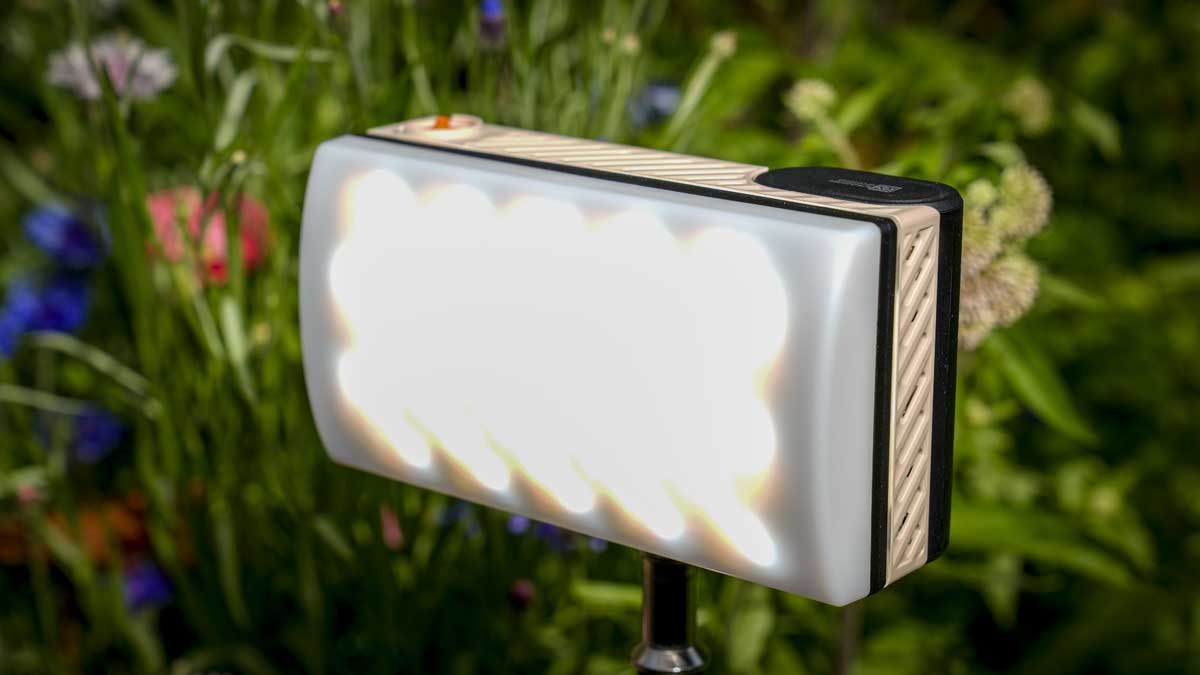
The M60 Ultra is for photographers and videographers who want a single, genuinely capable portable light that covers interviews, product work, fill and creative effects without a second bag.
At £129, the only serious criticism is the diffuser’s magnetic hold. Everything else from the output, the colour accuracy, the app control, and particularly the quiet fan, justifies the price.