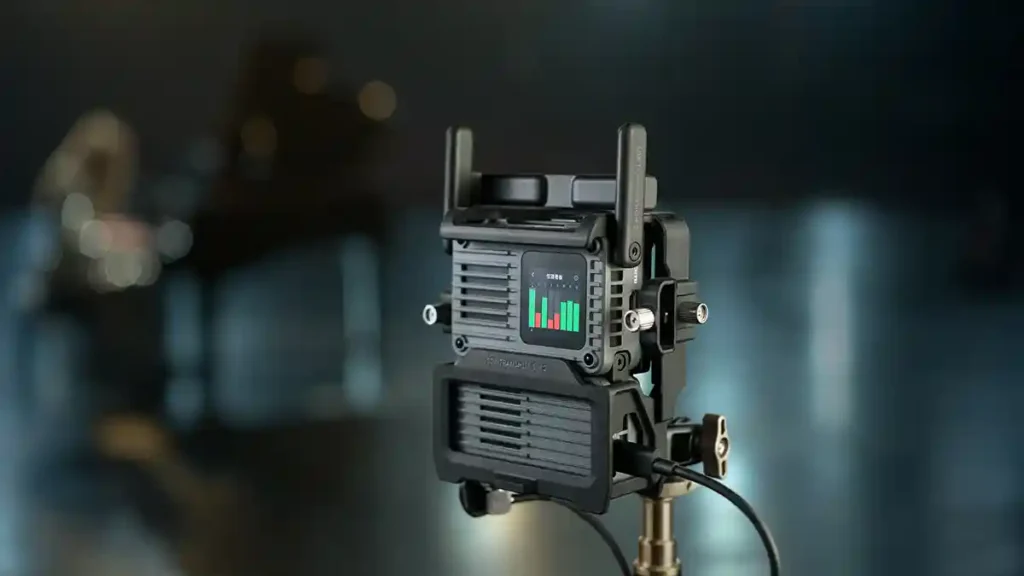

DJI has introduced the SDR Transmission 2, the next generation of its compact wireless video system for small and medium-sized production teams, and this time the biggest change is that every unit can work as either a transmitter or receiver.
You can check out our full review of the DJI SDR Transmission 2 here
That switchable TX/RX design immediately makes the system more flexible on a busy set. Rather than buying dedicated transmitters and receivers and then discovering you have the wrong balance for a particular production, each 136g transceiver can be assigned to whichever role is needed. DJI is positioning the system for commercials, documentaries, short dramas, feature films and multi-camera live streaming.
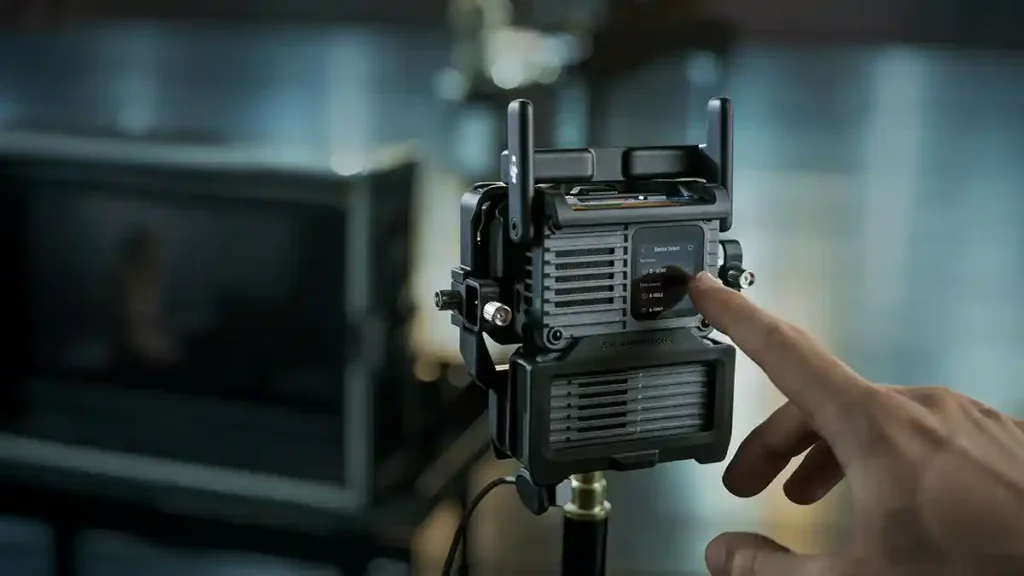
The scale has increased substantially too. One transmitter can now send its feed to as many as eight receivers, with control available at each receiver. DJI says several groups can work in the same location, with configurations extending to five transmitters and 40 receivers, although it recommends running no more than five transmitters simultaneously for the best communication experience.
That should be particularly useful for productions where the director, DoP, gaffer, focus puller and client all need access to camera feeds. It builds considerably on the system we tested in our DJI SDR Transmission Combo review, where I found the original particularly appealing because it could start as a relatively straightforward camera-to-monitor link and then expand as a production grew.
Image quality is one of the headline upgrades. DJI SDR Transmission 2 supports DCI 4K at 60fps, 10-bit HDR transmission over HDMI or DP, using H.265 encoding at up to 50Mbps. The original system topped out at 1080p/60 with a 20Mbps SDR bitrate, so this is a significant increase in the amount of image information available to the monitoring side of the production. DJI’s official product listing confirms DCI 4K/60fps HDR, a maximum encoding bitrate of 50Mbps and a claimed transmission distance of up to 4km under CE test conditions.
Latency remains impressively low on paper, with DJI quoting 35ms at both 1080p/60 and 4K/60. That figure excludes camera and display latency, but it should still make the system suitable for situations where operators need a responsive picture for gimbal moves and remote camera operation.
DJI has also introduced Auto Channel 2.0. When the system is placed in Auto mode, transceivers can recognise other units, coordinate channel allocation and perform seamless frequency hopping when interference appears. It can also diagnose channel conflicts in multi-camera setups and provide information about other units on the network, including battery state and connected-device numbers.
Another practical change is pairing-free feed switching. A receiver scans for available transmitters rather than requiring the pairing process used by the previous Control mode. Custom transmitter names can be searched, while a four-digit verification code provides an option for restricting access. I can see that being particularly useful at events or multi-camera productions where one operator needs to move rapidly between several camera feeds.
There is, however, an important difference from the original SDR Transmission: the comparison information supplied by DJI lists Wi-Fi as unsupported on SDR Transmission 2. Instead, smartphones and tablets can be connected to a receiver over USB-C for monitoring through the DJI Ronin app. That app still provides tools including LUT support, focus peaking, waveform and false colour, as well as local recording and playback. Camera control can include aperture, shutter and ISO adjustment on supported models. This is worth noting if you’ve read our first-generation DJI SDR Transmission review, because direct Wi-Fi monitoring was one of the useful options available with that system.
The Ronin integration has also expanded. SDR Transmission 2 supports the DJI RS 5, RS 4, RS 4 Pro, RS 3 Pro, Ronin 2 and Master Wheels. Gimbals can be controlled wirelessly through the Ronin app using functions such as Force Mobile, Virtual Joystick and recentering, while compatible camera setups can also be remotely triggered. If you’re already building around DJI’s current stabiliser ecosystem, our DJI RS 5 review and DJI RS 4 Pro review give a good idea of how far that ecosystem now extends beyond basic stabilisation.

Connectivity on the main transceiver includes HDMI and USB-C with DP/UVC support. An optional 105g Expansion Plate adds 3G-SDI, another HDMI connection and additional USB-C interfaces, making the system better suited to larger production cameras and professional monitors. The supplied brief also highlights car shoots, stadiums, large outdoor productions, forest locations and FPV drone work as potential applications for the longer-range transmission.
For me, the strongest aspect of SDR Transmission 2 isn’t simply the jump to 4K. It’s the combination of interchangeable TX/RX units, eight-receiver control, automatic frequency management and broader Ronin integration. Those additions make it look less like a simple wireless monitor accessory and more like the centre of a scalable on-set monitoring and control system.
DJI SDR Transmission 2 specifications
Product type: switchable TX/RX wireless video transmission system.
Maximum connections: one transmitter to eight receivers with control, with up to five transmitters and 40 receivers supported across multiple groups.
Maximum video resolution: DCI 4K 4096 × 2160 at 60fps with 10-bit HDR over HDMI or DP.
Maximum wireless bitrate: 50Mbps using H.265 encoding.
Transmission range: up to 4km under DJI’s stated CE test conditions.
Latency: 35ms at 1080p/60 or 4K/60, excluding camera and display latency.
Weight: approximately 136g for the transceiver and 105g for the Expansion Plate.
Dimensions: DJI’s brief lists 61 × 53 × 25mm for the transceiver, while its comparison table lists 76 × 53 × 25mm.
Video interfaces: HDMI and USB-C DP/UVC on the transceiver, with 3G-SDI, HDMI and additional USB-C connectivity available through the optional Expansion Plate.
Power: USB-C PD or NP-F battery, with compatible Ronin ecosystem power integration.
DJI SDR Transmission 2 price and availability
DJI has not currently published official UK, US or Euro pricing for DJI SDR Transmission 2 on its corresponding regional online stores, so verified prices in £, $ and € are not available at the time of writing. DJI’s official Hong Kong store lists one DJI SDR Transmission 2 transceiver at HKD $2,399, the DJI SDR Transmission 2 Combo at HKD $4,099 and the Expansion Accessory Kit at HKD $1,159. The product is available to order in Hong Kong. Please keep an eye on the official DJI SDR Transmission 2 website for more details.