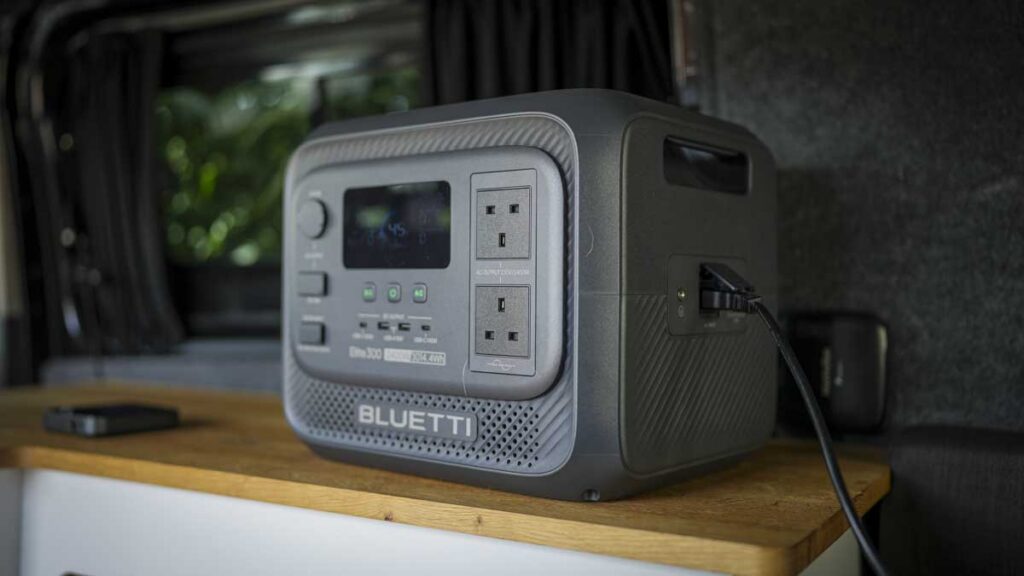

The BLUETTI Elite 300 delivers 3kWh for location shoots without rationing power or running out of power.
Our Verdict
BLUETTI Elite 300 verdict
What is the BLUETTI Elite 300?
The BLUETTI Elite 300 is a 3,014.4Wh portable power station that uses the latest LiFePO₄ (Lithium Iron Phosphate) battery technology. This technology has gained pace and is a firm favourite with the van life community for which it was partly designed.
These power stations are also becoming a staple in the video and photography sector for location work, home backup and off-grid use.
What’s interesting here is that the Bluetti site highlights the Elite 300 as the world’s smallest 3kWh portable power station, claiming 21% less weight and up to 58.9% less volume than the competition at this capacity.
As photographers and videographers, we find that this power station,, with its capacity boost and substantial max output, makes it a perfect option for location power. The 2,400W continuous AC output with 4,800W surge means it can power lighting, laptops, camera charging, and most other production kits simultaneously.
Then, when the battery does run flat after a day or two, it takes only 1 hour and 36 minutes to charge from a standard AC wall socket, making it fast to charge in the evenings before the next day’s shoot, if needed.
Specification
Capacity: 3,014.4Wh (LiFePO₄)
AC output: 2,400W continuous / 4,800W surge (230V)
DC output: 12V/30A
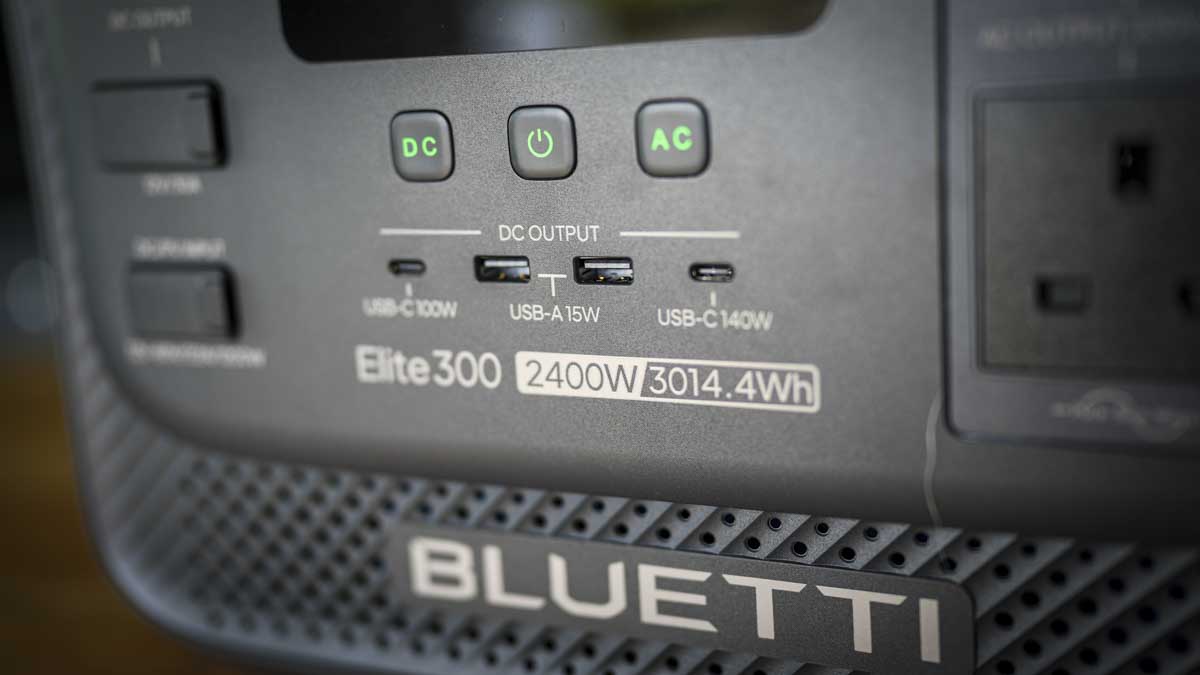
USB-C: 140W + 100W
USB-A: 2 × 15W
Cigarette lighter port: 120W max
AC input: 2,300W (full charge in ~1.6 hours)
Solar input: 1,200W max (full charge in ~4.1 hours)
UPS switching time: ≤10ms
App: BLUETTI app, Bluetooth + Wi-Fi
Weight: 26.3kg
Dimensions: 366 × 305 × 297.5mm
Cycle life: 6,000+ cycles to 80% capacity
Warranty: 5 years
AC output: 2,400W continuous / 4,800W surge (230V)
DC output: 12V/30A
USB-C: 140W + 100W
USB-A: 2 × 15W
Cigarette lighter port: 120W max
AC input: 2,300W (full charge in ~1.6 hours)
Solar input: 1,200W max (full charge in ~4.1 hours)
UPS switching time: ≤10ms
App: BLUETTI app, Bluetooth + Wi-Fi
Weight: 26.3kg
Dimensions: 366 × 305 × 297.5mm
Cycle life: 6,000+ cycles to 80% capacity
Warranty: 5 years
Build and Handling
The Elite 300 shows just how far these power stations have developed, especially since I last looked at the AC200P. That power station has been living in my van for a couple of years, and as I compared the two, the first thing that stood out was just how much smaller this new unit is, with nearly a thousand watt-hours more of capacity.
The AC200P is bulky and heavy, definitely a two-person carry for any distance. The Elite 300 is still 26.3kg, so it’s not light by any measure, but it’s significantly more compact than the AC200P, making it far more manoeuvrable on site.
Helping with the manoeuvrability are two large carry handles, which make it easy enough for me to move it over the short distance between the van and a location setup.
For the first month of the test, the power station sat loose in the back of the van with the rest of the kit, easy to shift onto a trolley when I arrived on location. In the second month, I bolted it into one of the van cupboards to create a more integrated system, with a charging cable permanently connected so I can top it up wherever power is available.
The smaller footprint of the Elite 3000 compared to the AC200 made a real difference when it was in place, and the additional space meant that I was able to reinstall a top shelf in the cupboard that the AD200P’s size had made impossible for the last couple of years.
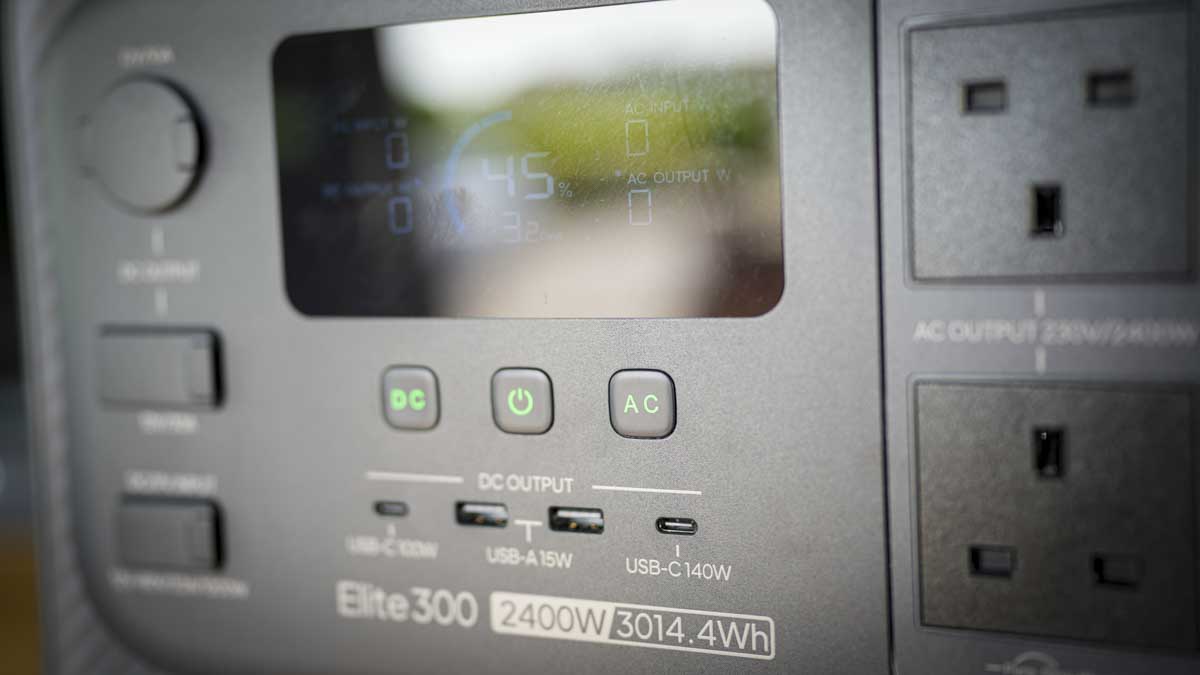
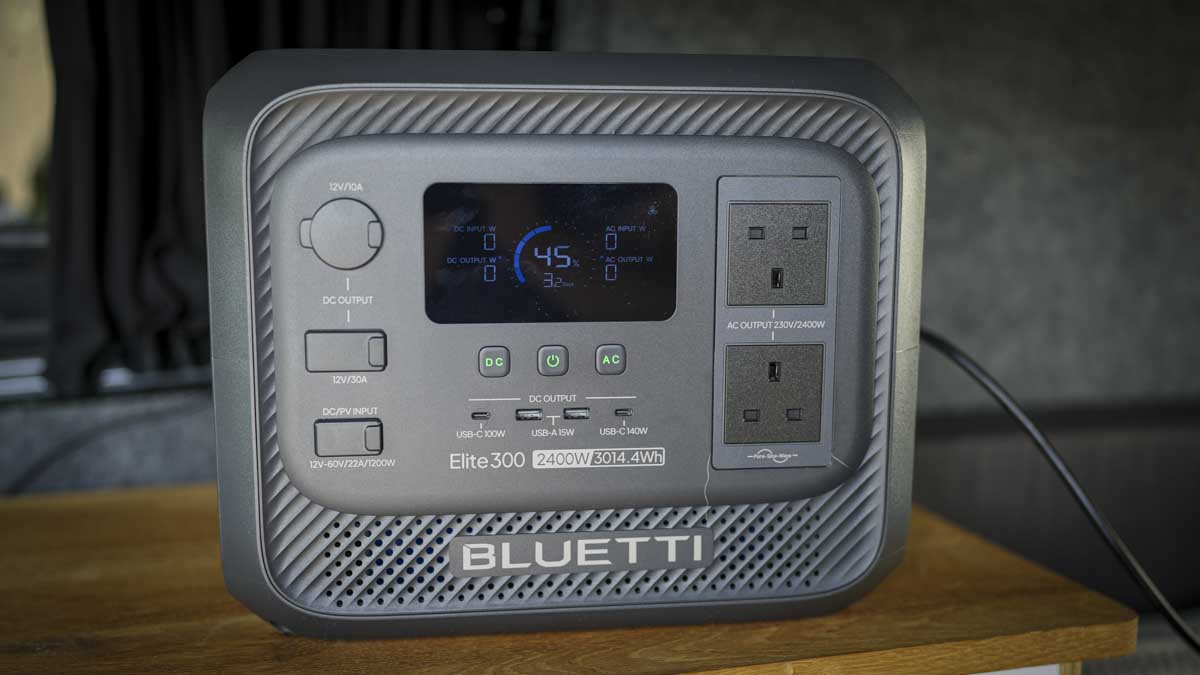
Checking out the front panel, once again, like the AC200 and Bluetti’s other power stations, the screen, socket, and port layout is clean and well laid out for ease of use.
Getting started with the unit is simple enough: after charging to 100%, just press the power button to turn it on, then use the AC or DC buttons to select the output you want.
On the small screen, you can check out the power stations’ inputs, outputs, and settings, and in the van, the display is clear; even outside in the sun, it remains clearly readable. This screen shows the charge level, current draw, and estimated remaining runtime. If you want a little more detail, the BLUETTI app is generally well designed.
What makes these power stations so useful is that they enable a standard 240V output in a portable unit. Even in a van with heavy-duty batteries, the output is limited to 12 V, so this is a major upgrade.
While Van lifers are used to 12v, most of the rest of us are more used to 240v. When it comes to a charging kit for camera gear, a 240V charger with a standard AC plug is exactly what you need.
The Elite 300 features a good range of ports on the front, with two AC outlets, 140W and 100W USB-C, two USB-A 15W, a 12V/30A DC port and a cigarette lighter socket.
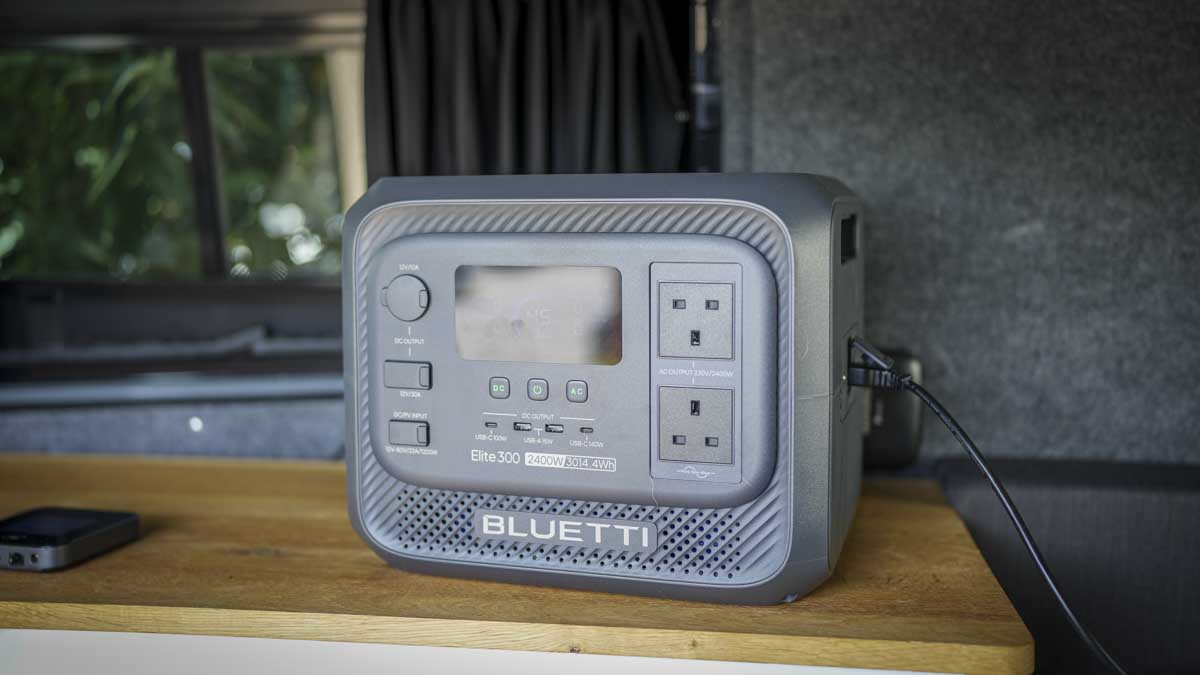
If you’re a solo shooter or a two-person crew, as we usually are, this capacity usually covers it. On the days when a third person is needed, there’s enough capacity for that additional charging. I needed to plug a four-way extension into one of the AC outlets, but even with more devices plugged in, there was still enough output to cover the additional load. Then, since most kits charge via USB-C or A, there are a couple of each port to charge directly as well.
Features
The big feature for the Bluetti Elite 300 is the 3,014.4Wh capacity, and what this means in real-world use is that power management is no longer a thought, or to be honest, a worry about not having enough on a shooting day.
Over a five-day production, the Elite 300 was used to power the Godox UP150R at full output for five 30-minute interview sessions each day, and to charge a MacBook Pro M1 Max, an ASUS PX13, and a third PC all at the same time, with plenty of capacity left over for more.
I also kept a full set of V-Lock batteries for the Canon EOS R5 C topped up throughout, and did not need its first recharge until the end of day two. Two people, full kit, no rationing.
Because my van is a works van rather than a purpose-built campervan, the interior is wired for 240V rather than 12V. The one exception is the small fridge that keeps 35mm and 120 film, milk, and food cool. The fridge runs on 12V directly from the Elite 300’s dedicated DC port, which keeps the film at a consistent temperature regardless of the weather outside, even at the 30ºC we experienced during the recent mini heatwave.
One of my most important bits of kit is the Godox UP150R. Do check out the review, and this is ideal for interview lighting. At 180W full output, I could ruin it in 15 hours of use from a full Elite 300. In practice, with the light cycling between interview setups rather than running non-stop, the real-world figure across the five-day shoot was about right. I did need to recharge the battery each evening, but we really did hammer the output. The important point is that I never once needed to reduce the output level to conserve power, even with plenty on and charging, in use for a day’s shoot. 3 kW is actually a substantial amount of power.
The capacity is impressive, but in the past, these larger-scale power stations have been slow to charge. Here, however, with the AC (Wall socket) it can deliver a full charge in just 96 minutes.
In the past, I would usually charge a 1kWh power station at lunch if a mains socket was available. With the Elite 300, that thought simply wasn’t necessary, as it was much longer than the whole day.
Arriving home from a shoot, plugging in, then spending an hour unloading, downloading, and swapping batteries meant the Elite 300 was fully charged before the kit prep for the next day was generally complete.
Solar charging is another major feature. At home, I was able to plug into two 400W panels, which, on a sunny, partly cloudy day, delivered around 500W per hour.
In the UK, supplementing the charge with a panel helps keep the battery topped up, but the number of panels you need makes this a little restrictive for most. However, with a maximum input of 1200W, solar power is a realistic option. Especially in home studios that may not have mains power.
The use of the power station as a UPS supply with the UPS function was tested with 3D printers in the workshop, and with the main NAS, effectively connecting to the mains through the Elite 300. When the mains were cut, there was no interruption to the printers’ power supply. I also connected studio desktop equipment, a NAS, and peripherals through the Elite 300 as passive power-cut protection for the workshop and studio, and pass-through charging worked well with no voltage issues.
Performance
Throughout the test, I tried to use the power station in as many different environments as possible. Of those scenarios, the most demanding was using it with the Godox FL150R, using it to power the light across multiple interview sessions without switching it off between takes. Through the test, I found that I was running the light continuously for several hours at a time, and was pleased to see that the light and the power station both handled this without issue, and the combined noise from each fan was entirely manageable when it came to the noise being picked up by the DJI Mics.
Of course, one of the features I really wanted to test was how close I could get to the 2,400W upper limit, and I discovered that this takes some effort. The 1,700W Ninja Crispy portable air fryer was the most power-hungry device used in the test, and even that sat well within the output limit. A full-size kettle is the quickest way to approach the output limit; at that point, the Elite 300 gives an initial warning before the failsafe cuts the power. The more interesting discovery is that it is possible to cook a proper hot lunch on site when the power station is in the van. It sounds like a minor thing, but as I was able to have a hot meal on a cold wet spring day, it has now become a permanent part of the setup.
By the end of a typical full shooting day, the Elite 300 showed around 20% remaining capacity, really dependent on what kit we were using and what needed charging. One of the older PC laptops also devours power, which is usually an issue, but with 3 kW of capacity, this is no longer the problem it has been in the past. The lowest it reached across the entire two-month test was 10%, on a day involving kettles, lighting, multiple laptops and sustained charging of equipment.
In most situations, the power station remained relatively quiet and in the background, supplying much-needed power while blending into the sea of kit. The only time the cooling fan was notably noisy was during a couple of the interviews when the temperature was around 30ºC, but even then, it was noticeably quieter than other power stations I have used. In the interview sessions, the unit was kept just outside the recording space, and the low-level fan hum it contributed to the background audio was straightforward to remove in post. In close-mic situations, the power station was generally far enough away from the subject that it was not noticeable.
Throughout the test, performance was consistent over the full two months, regardless of the outside temperature. The one notable acceleration in power depletion occurred during a week of near-30 °C heat, driven entirely by the small fridge working harder to maintain temperature in a hot van rather than by any change in the Elite 300’s own abilities.
Final Thoughts
The BLUETTI Elite 300 is an ideal addition to my video and photography setup, providing true location power to keep you and others topped up with charge for all the kit during a multi-day shoot.
Having 3kWh in the van means the production day is no longer built around rationing electricity or planning around charge cycles, or just buying more batteries. Two people, a full kit, lighting, hot drinks, and a cooked lunch (To a degree) can all happen without checking the capacity percentage.
For a solo shooter, the 3kWh might feel like more than is needed, and a 1kWh option is easier to carry. But the freedom of knowing the power will simply be there, day after day, for two to three days before a recharge is needed, just frees you up and definitely takes some of the worry away about running out of batteries.
At £1,399, the Elite 300 is exceptionally well-priced for its capacity. The size, compared with other power stations of this capacity and with the AC200P, just makes it easier to transport, and while heavy, it is just about possible to lug it to the location you need, unlike the older AC200P, which is incredibly heavy and cumbersome, although still a great piece of kit.
If you’re a photographer or videographer working on-site and without direct access to Power, then the Elite 300 is a must-have.