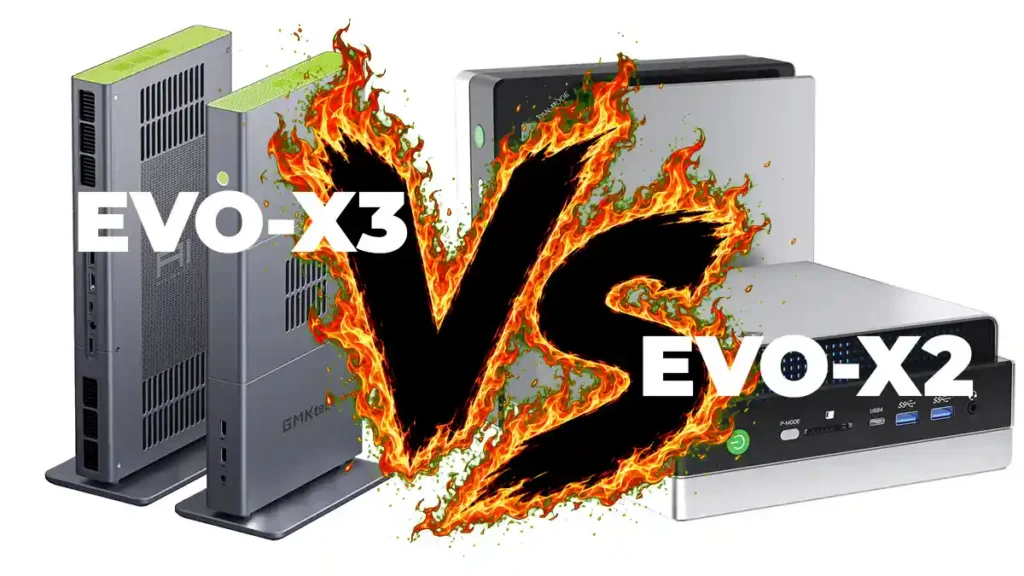

With GMKtec’s new EVO-X3 sitting alongside the EVO-X2 in the same line-up, photographers and video editors eyeing one of these compact AI mini PCs face an obvious question: which one? The short answer is that they share almost all of their DNA, and the decision comes down to a single headline feature, some extra cooling, and a considerable price gap. You’ll find both on GMKtec’s store — the EVO-X2 and the EVO-X3.
First, what’s identical. Both run AMD’s Ryzen AI Max+ 395 (16 cores, 32 threads) with the Radeon 8060S integrated GPU, both carry 128GB of soldered LPDDR5X-8000 with up to 96GB assignable as GPU memory, both offer dual M.2 PCIe 4.0 storage up to 16TB, and both deliver the same 126 TOPS of AI performance with a 50 TOPS NPU. For core editing — Lightroom Classic’s AI Denoise, Photoshop’s heavy files, Premiere Pro timelines, and running large AI models locally — the two are, to all intents and purposes, the same machine. Both also share the same networking: 2.5GbE, rather than the 10GbE some rivals offer, so neither is the pick if your priority is editing 4K straight off a NAS.
So what does the extra money on the EVO-X3 actually buy? Chiefly, OCuLink. This is the EVO-X3’s key upgrade and it’s genuinely missing from the EVO-X2: a dedicated PCIe 4.0 x4 port for an external graphics card, delivering far more bandwidth than the USB4-based eGPU route the EVO-X2 is limited to. For the most GPU-hungry work — DaVinci Resolve grading and noise reduction, DxO PhotoLab’s DeepPRIME denoising, heavy Premiere Pro exports — that means you can bolt on a full desktop GPU later and get much closer to tower-class performance. The EVO-X3 also gains a taller (but slimmer) chassis with a triple-heat-pipe, dual-fan cooling system, which should help it sustain performance for longer during demanding renders.
GMKtec EVO-X2 vs EVO-X3: at a glance
| EVO-X2 | EVO-X3 | |
|---|---|---|
| Processor | Ryzen AI Max+ 395 (16C/32T) | Ryzen AI Max+ 395 (16C/32T) |
| Graphics | Radeon 8060S (40 CU) | Radeon 8060S (40 CU) |
| AI performance | 126 TOPS (50 TOPS NPU) | 126 TOPS (50 TOPS NPU) |
| Memory | 128GB LPDDR5X-8000 (soldered) | 128GB LPDDR5X-8000 (soldered) |
| Storage | Dual M.2 PCIe 4.0, up to 16TB | Dual M.2 PCIe 4.0 x4, up to 16TB |
| External GPU | USB4 only | USB4 + OCuLink (PCIe 4.0 x4) |
| Networking | 2.5GbE, Wi-Fi 7 | 2.5GbE, Wi-Fi 7 |
| Display | Dual output | Dual 8K output (HDMI 2.1 + USB4) |
| Cooling / chassis | Compact | Taller, triple heat-pipe, dual-fan |
| Price (UK) | £1,569.99 | £2,939.99 |
Which should you buy?
For most photographers and hybrid shooters, the EVO-X2 is the smarter value. You get identical CPU, GPU, memory and AI performance for well under half the EVO-X3’s outlay, and the integrated Radeon 8060S is genuinely capable for stills work and mainstream video editing. Unless you’re certain you’ll want to expand, it does everything the X3 does day to day.
The EVO-X3 earns its premium in one scenario: if you want a compact machine now but expect to need serious, desktop-class GPU power later. Its OCuLink port is the proper way to add an external graphics card without the bandwidth compromise of USB4, and the beefier cooling suits sustained Resolve renders and long export sessions. Heavy colourists, 3D artists and video editors who lean on the GPU are the natural audience. It’s also worth knowing that GMKtec has signalled a future EVO-X3 configuration with the Ryzen AI Max+ 495 and up to 192GB of memory — one to watch if you run the very largest local AI models.
In short: buy the EVO-X2 for the best value in a fixed setup, and the EVO-X3 if OCuLink external-GPU expansion and stronger cooling are worth the extra to you.