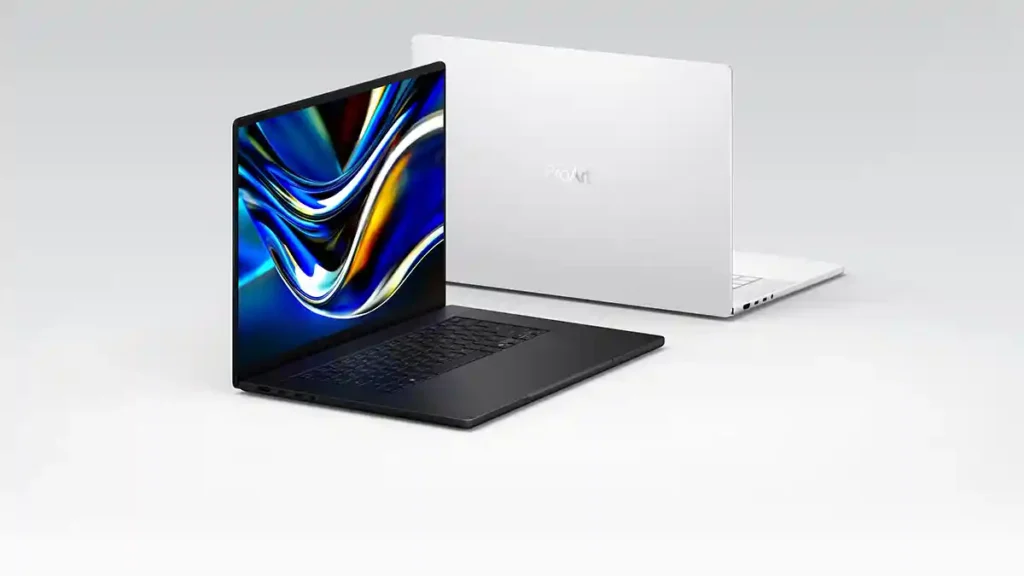

Of everything shown at IFA 2026, ASUS’s ProArt announcements are the most directly aimed at photographers. The ProArt P16 and P14 laptops and the GR1X mini PC all run NVIDIA’s new RTX Spark platform, and the displays carry the colour credentials that make ProArt worth taking seriously. Full details are on the ASUS ProArt P16 page.
The displays are the reason to care
ASUS calls them Lumina Pro OLED, and the specification is genuinely colour-critical rather than marketing-critical. Both laptops are factory calibrated to Delta E under 1, cover 100% of DCI-P3, and are Pantone Validated.
Delta E under 1 is the threshold at which colour differences become imperceptible to the human eye, which is what you need if the screen is deciding what gets printed or delivered. The P16 runs 4K at 120Hz with variable refresh and G-SYNC at 283 pixels per inch, while the P14 offers 3K. Peak brightness reaches 1,600 nits, and an anti-reflection coating cuts reflections by up to 65% — useful if you edit anywhere near a window.
The P16 is also remarkably thin for a 16-inch creator machine at 12.9mm and 1.77kg, which ASUS says is 14% thinner and 9% lighter than the previous generation, with a 99Wh battery. The P14 is the lightest ProArt yet at 1.48kg with a 90Wh pack. Both come in Nano Black and Neo White with haptic touchpads.
What RTX Spark adds
Underneath sits NVIDIA’s new platform: a 20-core Grace CPU joined to a Blackwell RTX GPU with 6,144 CUDA cores and fifth-generation Tensor Cores over an NVLink-C2C interconnect, delivering up to 1 petaflop of FP4 AI performance and up to 128GB of unified memory shared dynamically between CPU and GPU.
ASUS quotes support for 120-billion-parameter language models, 3D scenes above 90GB, and 4K AI video generation. Crucially it brings the full CUDA ecosystem — DLSS, TensorRT, OptiX, G-SYNC — which is where a great deal of creative and AI software performs best. ASUS bundles its own StoryCube and MuseTree apps and promises agentic workflow integration through ComfyUI.
The caveat almost nobody is mentioning
Here is the thing to check before spending anything: the Grace CPU is Arm-based. These are Windows-on-Arm machines, not x86.
That matters more than it might sound. Adobe’s main applications now run natively on Windows on Arm, and the situation has improved enormously — but the ecosystem around them has not caught up evenly. Third-party plugins, older utilities, tethering software, RAW converters, calibration tools and codec packs are exactly the sort of software that either runs through emulation with a performance penalty or does not run at all.
If your workflow is Lightroom and Photoshop, you will probably be fine. If it involves Capture One, a particular tethering tool, DxO, a favourite Nik plugin, or hardware that needs a specific driver, check compatibility before you commit. That is not a reason to avoid these machines — it is a reason to do ten minutes of homework first, and it is the question most coverage of RTX Spark is skipping entirely.
One other point on the displays: OLED panels manage brightness dynamically, and full-screen white content is typically dimmer than a small highlight. For colour work that is generally fine, but it is worth knowing if you are used to a conventional IPS panel’s consistency.
Also announced
The ProArt GR1X mini PC brings the same platform to the desktop with up to 1 petaflop and 128GB unified memory in a compact chassis.
More interesting for a studio is the ProArt Display 6K PA32QCV, a 31.5-inch monitor running 6016 x 3384 on an IPS panel, with 98% DCI-P3 coverage and Calman Verified Delta E under 2. It has dual Thunderbolt 4 ports with 96W power delivery and Mac-optimised colour modes — that last detail matters if you run a MacBook Pro and want a single-cable connection that charges the laptop and drives a 6K display correctly.
ASUS also showed a ProArt DIY build around the Z890-CREATOR WIFI motherboard with a ProArt GeForce RTX 5070 Ti, plus a new Zenbook 14 and an ExpertBook Ultra with a 14-inch 3K tandem OLED touchscreen at 1,400 nits.
Worth noting these were first shown at Computex in May, so IFA is a European showcase rather than a first announcement. ASUS has not published pricing or firm availability, and RTX Spark machines are expected from October.
ASUS ProArt P16 and P14: Specifications
Platform: NVIDIA RTX Spark — 20-core Grace CPU (Arm-based), Blackwell RTX GPU with 6,144 CUDA cores and fifth-generation Tensor Cores, NVLink-C2C interconnect. AI performance: up to 1 petaflop FP4. Memory: up to 128GB unified, dynamically allocated between CPU and GPU. Display: ASUS Lumina Pro OLED, Delta E under 1, 100% DCI-P3, Pantone Validated, up to 1,600 nits peak, anti-reflection coating reducing reflections by up to 65%. ProArt P16 (H7607): up to 4K at 120Hz with VRR and NVIDIA G-SYNC, 283ppi; 12.9mm thin, 1.77kg; 99Wh battery. ProArt P14 (H7407): up to 3K; 1.48kg; 90Wh battery. Finishes: Nano Black and Neo White with anti-smudge coating. Other: haptic touchpad, StoryCube and MuseTree apps, ComfyUI integration. Note: Windows on Arm — check software and plugin compatibility.
ASUS ProArt Display 6K PA32QCV: Specifications
Size: 31.5-inch IPS. Resolution: 6016 x 3384. Colour: 98% DCI-P3, Calman Verified Delta E under 2. Connectivity: dual Thunderbolt 4 with up to 96W power delivery. Other: Mac-optimised colour modes.
Price and availability
ASUS has not announced pricing or firm availability for the ProArt P16, P14 or GR1X. RTX Spark devices are expected from October 2026. We will update this story once details are confirmed.