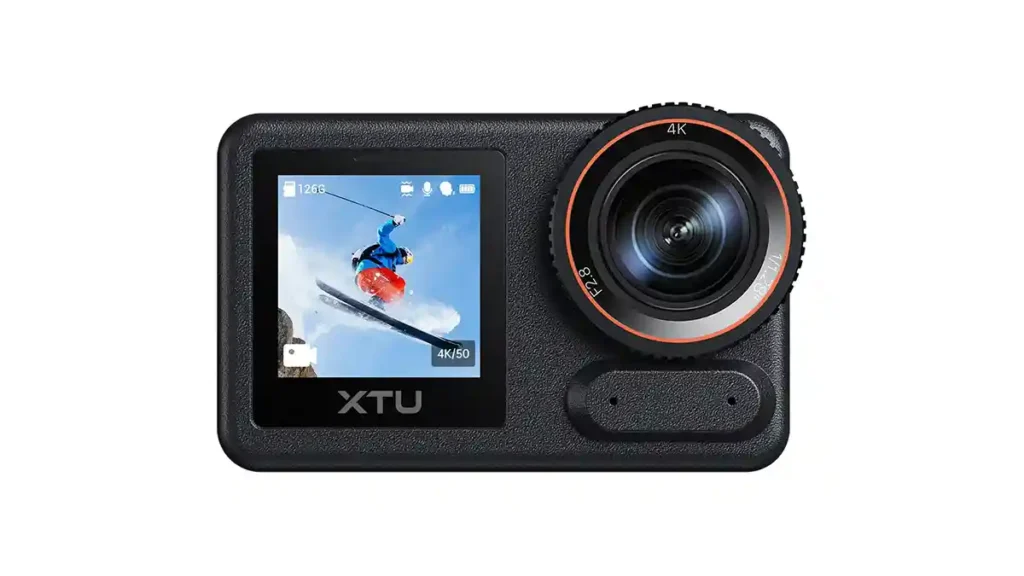

Action camera specifications usually go one way: pay more, get a bigger sensor. XTU has just inverted that. The forthcoming S7 Pro Max carries a 1/1.28-inch sensor — substantially larger than the 1/2-inch chip in the S7 Pro that sits above it in the range — while costing less, at $139.99 against the S7 Pro’s $159.99. Details are on the official XTU S7 Pro Max product page.
To put that sensor in context: it is the same size class as the 1/1.3-inch chip in DJI’s flagship Osmo Action 5 Pro, and meaningfully larger than the 1/1.9-inch sensor in the GoPro HERO13 Black. For a camera at roughly a quarter of the price of either, that is a claim worth interrogating rather than simply repeating.
The RYYB sensor is the part worth understanding
The specification that actually explains XTU’s low-light claims is one most coverage will skip past: this is an RYYB sensor rather than a conventional one.
Almost every camera you have owned uses a Bayer array, where the colour filter over the sensor follows an RGGB pattern — one red, two green, one blue. RYYB swaps those two green filters for yellow. Because yellow passes both red and green wavelengths, considerably more light reaches the sensor: the approach was pioneered by Huawei in its phones, where it was credited with roughly 40% greater light-gathering than an equivalent Bayer sensor.
For an action camera that is a sensible choice. These cameras have small sensors and fixed apertures, and low light is where they visibly fall apart — dusk rides, woodland trails, indoor skateparks. Gathering more light at the hardware level tackles that at source rather than relying on noise reduction to clean up afterwards.
There is a well-documented catch, though. Because the sensor is no longer measuring green directly, green has to be reconstructed computationally from the yellow data, and RYYB implementations have historically been prone to colour casts — typically a yellowish or greenish shift, most visible in foliage and skin tones. That is precisely why XTU pairs it with an AI ISP: the processing is doing real work to correct what the filter array gives up. Whether it succeeds is exactly what a review needs to establish, and it is the first thing we would test.
What else is on the spec sheet
Video runs to 4K at 50fps in HDR, with a claimed 14 stops of dynamic range, and there is 4K/30 HDR aimed specifically at night scenes. Stills are 50MP. Stabilisation is XTU’s Super EIS 5.0 with 360-degree horizon lock, and the field of view is 158 degrees.
Practical features are well covered: dual screens with a 2.29-inch rear touchscreen and 1.4-inch front display, native 4K vertical shooting for social, 4K pre-recording, voice control, Wi-Fi 6, a magnetic quick-release mount, a replaceable 1800mAh battery and support for microSD cards up to 512GB. At 134g it is light.
Two things to be aware of
First, and most significantly for an action camera: the body is not waterproof on its own. XTU rates it to 30 metres only when fitted in the supplied waterproof case. That is a real step down from the competition, where the HERO13 Black and Osmo Action 5 Pro are both waterproof natively to 10 and 20 metres respectively. If you shoot in the rain, in surf or on a bike in British weather, that changes how you would use it.
Second, the quoted battery life of around 200 minutes is measured at 1080p/30 — the least demanding mode available. Real-world runtime while recording 4K/50 HDR will be considerably shorter, as it is on every camera in this class. The replaceable battery matters more than the headline figure.
We would also treat the 14-stop dynamic range claim as unverified until tested. Manufacturer dynamic range figures are measured in ways that rarely survive contact with a real scene.
Still, the proposition is an interesting one, and it follows a pattern we have seen before with budget challengers — as our Akaso 360 review found, the gap between cheap and flagship action cameras is narrower than the price difference suggests. A larger, cleverer sensor at this price is a genuine attempt to compete rather than simply undercut, and we hope to test one shortly.
XTU S7 Pro Max: Specifications
Sensor: 1/1.28-inch RYYB CMOS.
Processing: AI ISP.
Stills: 50MP.
Video: 4K 50fps HDR; 4K 30fps HDR night mode; native 4K vertical shooting; 4K pre-recording.
Dynamic range: 14 stops (manufacturer claim).
Stabilisation: Super EIS 5.0 with 360° horizon lock.
Field of view: 158°.
Displays: 2.29-inch rear touchscreen and 1.4-inch front display.
Connectivity: Wi-Fi 6; voice control.
Mounting: magnetic quick release.
Battery: 1800mAh replaceable, up to approximately 200 minutes at 1080p/30fps.
Storage: microSD up to 512GB.
Weight: 134g.
Waterproofing: not waterproof as standard; rated to 30 metres when fitted in the waterproof case.
XTU S7 Pro Max: Price and availability
XTU lists the S7 Pro Max as coming soon, priced at $139.99 with a launch offer at $129.99. UK pricing has yet to be confirmed — for reference, the existing S7 Pro launched at £159.99. We will update this story once UK pricing and an on-sale date are announced.