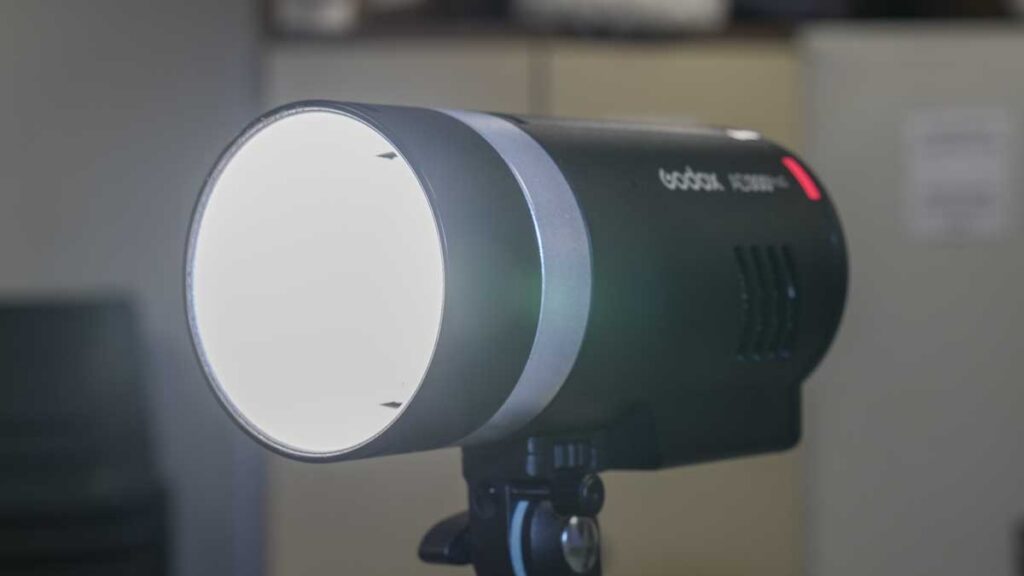

The Godox AD300Pro II is a refined and powerful portable flash that delivers exceptional performance out in the field on location.
Our Verdict
Godox AD300 Pro II verdict
What is the Godox AD300Pro II?
The Godox AD300Pro II is a battery-powered, all-in-one outdoor flash that’s capable of producing a huge 300Ws of output. It sits between Godox’s AD200 Pro and the larger AD400 Pro in the Witstro series, offering a compact and portable solution if you need a serious amount of flash power on location and away from any mains power.
The Godox AD300 Pro II is a standalone flash head with an integrated battery, colour TFT display and full wireless control via Godox’s 2.4GHz X system that’s fully compatible with the rest of the Wistro series.
While the flash has been designed primarily for stills photography, portrait, editorial, commercial and still life, and supports all major TTL systems including Canon, Nikon, Sony, Fujifilm, OM System, Panasonic, Leica, and Pentax, the 12W LED modelling light kicks out enough illumination to be used as a subtle constant or video light if needed.
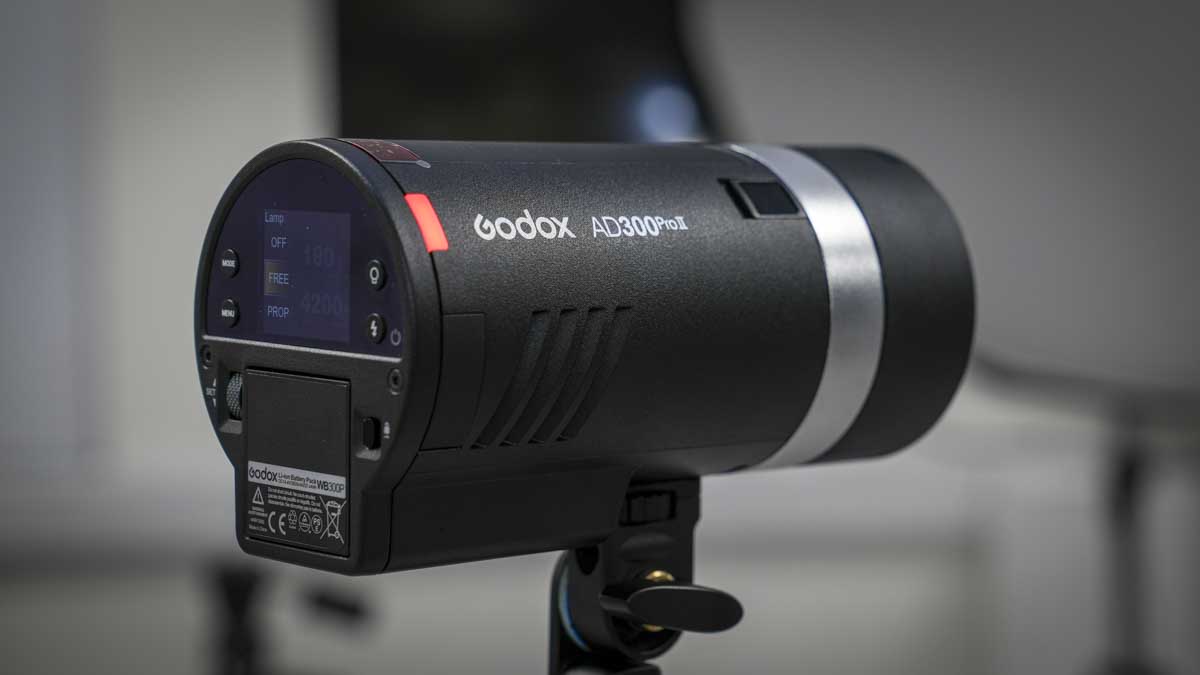
The Godox AD300 Pro II is aimed at enthusiasts and professional photographers who shoot on location or in a home studio and want portable, battery-powered flash power that has a bit more power than a hotshoe flash.
What makes this flash interesting are some of the additional features, such as freeze and HSS. Freeze cuts the flash duration but still adheres to the 1/200 flash sync speed while HSS. (High Speed Sync) enables you to sync the flash with shutter speeds up to 1/8000 of a second. HSS support makes it viable for outdoor natural-light fill and daylight overpowering. These features make the AD300 Pro II an ideal solution for portrait, editorial, commercial, still life and location work.
The feature set positions the flash at the enthusiast and professional level; however, while that feature set is impressive, Pros usually like a location flash that starts with a power output of 500W, although at this price point, it will be tempting. For beginners and enthusiasts, this will be a step up from a hotshoe or the superb AD200, and the interface is incredibly easy to understand and navigate.
A few of the key features that really stood out to me prior to the test were the combination of one-tap wireless sync, colour-stable output, a genuinely useful 12W bi-colour LED modelling lamp, and 10-stop power range, all in a sub-1.2kg body, at a price well below similar-sized but more powerful offerings from Profoto and Broncolor.
Specification
Output: 300Ws
Power range: 1/512 to 1/1 (10 stops), ±0.1-stop increments
Recycle time: 0.01–1.5s (full power)
Battery: 14.4V / 2600mAh Li-ion, approx. 350 full-power flashes
Colour temperature: 5800K ±200K; colour-stable mode ±100K
Flash duration (normal): 1/220–1/14,920s
Flash duration (freeze mode): 1/2310–1/24,390s
Modelling light: 12W bi-colour LED, 2800–6000K, CRI 97 / TLCI 98
Wireless: Godox 2.4GHz X system, 32 channels, 16 groups, 99 IDs, 328ft range
One-tap sync: X3Pro / X3 trigger only
TTL: Canon, Nikon, Sony, Fujifilm, OM System, Panasonic, Leica, Pentax
HSS: Up to 1/8000s
Modes: TTL, Manual, Multi/Stroboscopic, Freeze, Colour-Stable
Mount: Native Godox mount; Bowens via optional S3 bracket; Broncolor/Profoto/Elinchrom via optional AD-AB adapter
Display: Colour TFT screen with metal control dial
Group indicators: 16 colour-coded
Sync port: 3.5mm; USB-C for optional FR433 433MHz receiver
Weight: 1.2kg / 2.6lbs (with battery)
Dimensions: 18.7 x 10 x 9cm
Warranty: 2 years
In box: Flash unit, battery, USB-C charging cable, charging dock, protective head cover, carrying case
Price: £496.99
Power range: 1/512 to 1/1 (10 stops), ±0.1-stop increments
Recycle time: 0.01–1.5s (full power)
Battery: 14.4V / 2600mAh Li-ion, approx. 350 full-power flashes
Colour temperature: 5800K ±200K; colour-stable mode ±100K
Flash duration (normal): 1/220–1/14,920s
Flash duration (freeze mode): 1/2310–1/24,390s
Modelling light: 12W bi-colour LED, 2800–6000K, CRI 97 / TLCI 98
Wireless: Godox 2.4GHz X system, 32 channels, 16 groups, 99 IDs, 328ft range
One-tap sync: X3Pro / X3 trigger only
TTL: Canon, Nikon, Sony, Fujifilm, OM System, Panasonic, Leica, Pentax
HSS: Up to 1/8000s
Modes: TTL, Manual, Multi/Stroboscopic, Freeze, Colour-Stable
Mount: Native Godox mount; Bowens via optional S3 bracket; Broncolor/Profoto/Elinchrom via optional AD-AB adapter
Display: Colour TFT screen with metal control dial
Group indicators: 16 colour-coded
Sync port: 3.5mm; USB-C for optional FR433 433MHz receiver
Weight: 1.2kg / 2.6lbs (with battery)
Dimensions: 18.7 x 10 x 9cm
Warranty: 2 years
In box: Flash unit, battery, USB-C charging cable, charging dock, protective head cover, carrying case
Price: £496.99
Build and Handling
Godox has come a long way from its relatively entry-level roots, and the AD300Pro II is yet again a testament to this and, along with the other products from this range, shows that Godox means business when it comes to attracting not just enthusiast photographers but pros as well.
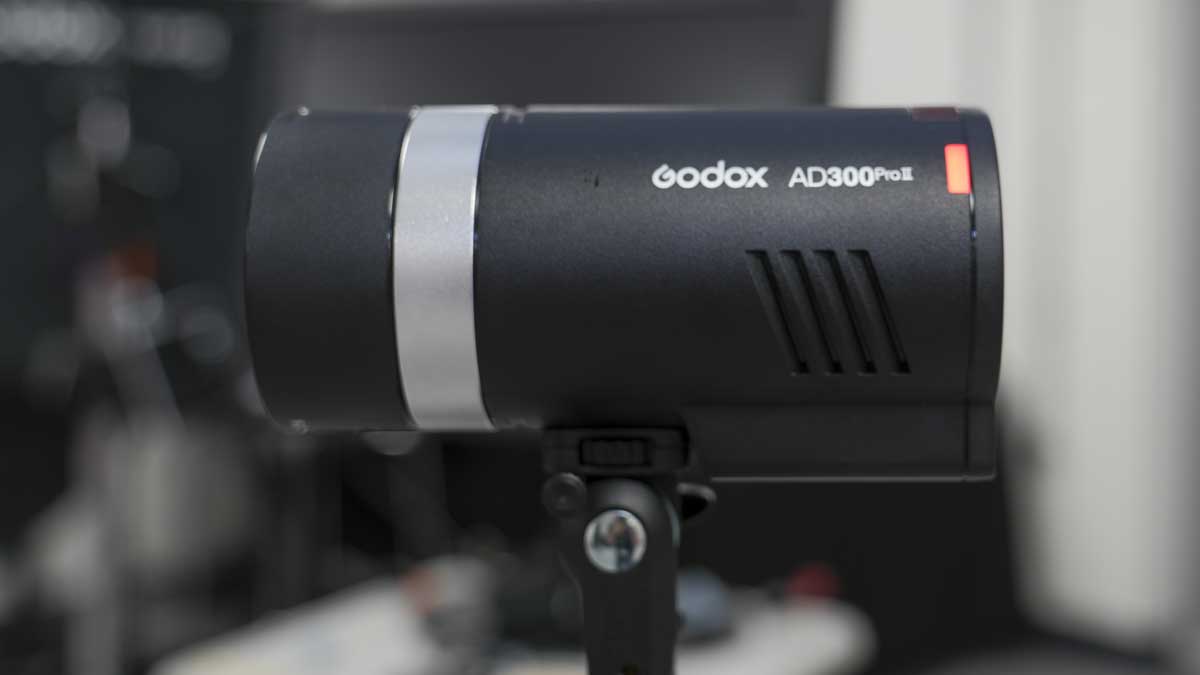
The body of the flash has a solid, premium feel; there’s nothing plasticy about the build, and while it doesn’t quite match the likes of Profoto and Broncolor, the difference in the design and build quality is rapidly reducing. The mix of materials that the designers have opted to use keeps the weight impressively low at 1.2kg without feeling flimsy or hollow.
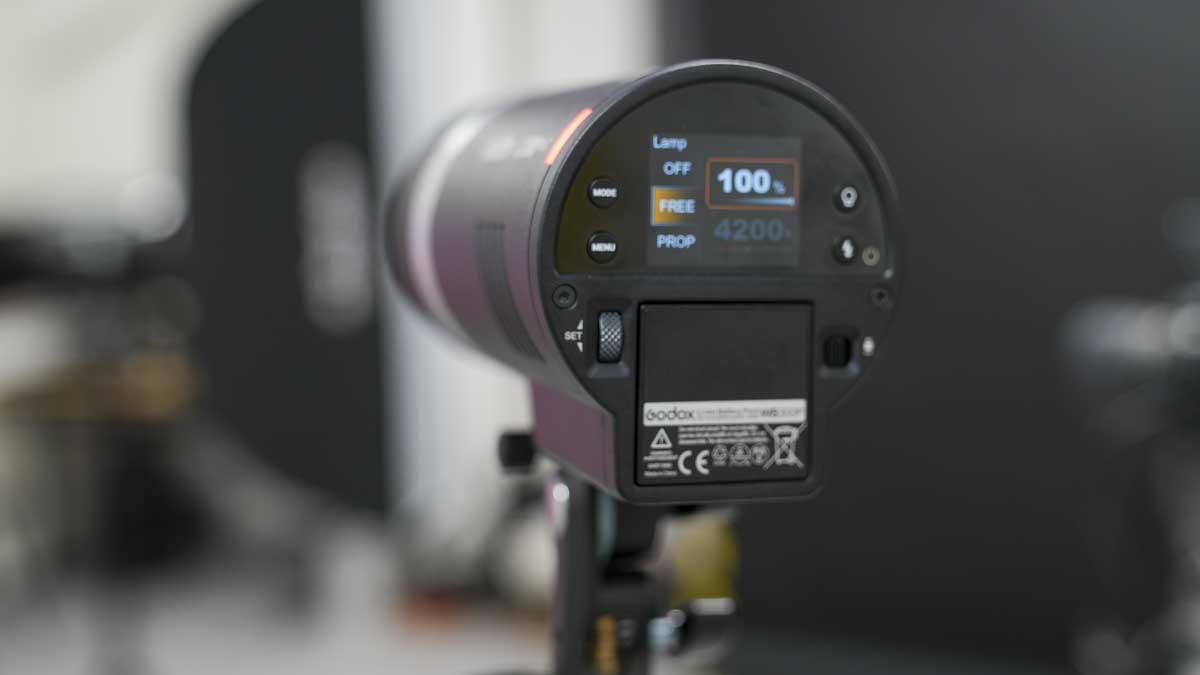
On the back of the head is the redesigned colour TFT screen, and while they haven’t taken the full leap to touch screen, the updated UI is a real step forward and in line with the quality seen on the V100 and X3 trigger range. This interface has a clean, readable display that’s fast to navigate. What I liked about the screen is that it’s easy to navigate the settings, and selecting your options is all controlled via a dual-function metal dial, scroll to navigate, push to confirm, and this is a system that feels positive and deliberate in use. In the lower light of the studio, the screen’s clear layout makes it easy to use, and once familiar with the interface, it’s also easy enough to direct others through the options if needed.
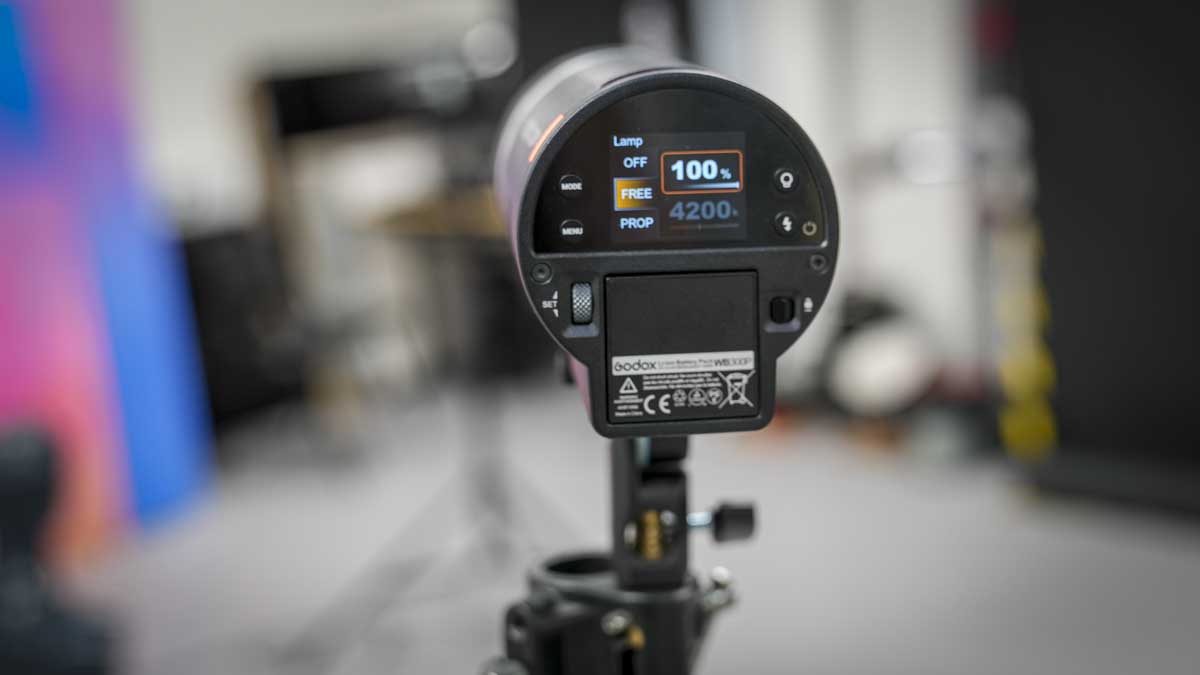
One update to the control is the small dial that enables you to scroll through options; this in itself is a huge improvement over the original’s controls, and the overall menu layout is consistent with other recent Godox products, such as the RS60, although that’s a constant light, making it immediately familiar to existing users.
The battery removal mechanism uses a deliberate locking release, which means accidental ejection mid-shoot is not an issue. USB-C charging of the battery is handled via a port on the side, and a charging dock is included in the box, a welcome addition if you do purchase additional cells.
Through the test, I mounted the light on a 3 Legged Thing Luna light stand, and even with a larger modifier attached, the balance of the light was good. One minor criticism is that the lighting mount bracket is slightly compact, which can make fine-level adjustments a little fiddly, although this is the trade-off for the unit’s compact overall footprint.
Features
The headline features of the AD300Pro II are its one-tap wireless sync, 10-stop power range, freeze mode and colour-stable mode, all new to this generation. The one-tap sync with the X3 or X3Pro trigger works incredibly well once the flash is set to 2.4GHz wireless mode; from there, a quick pair via the trigger connects in a couple of seconds with no manual channel or group configuration needed. It is not quite as frictionless as Godox suggests if you are unfamiliar with the process, but once understood, it’s genuinley a quick process.
One of the other features that I liked was the 16 colour-coded group indicators, which are a great addition for multi-light setups, although I don’t often have the need, unless running workshops. I will say that the colours are a nice asthetic although photographers who label their groups with the standard A, B, C designations will find them a convenient visual reference rather than an essential.
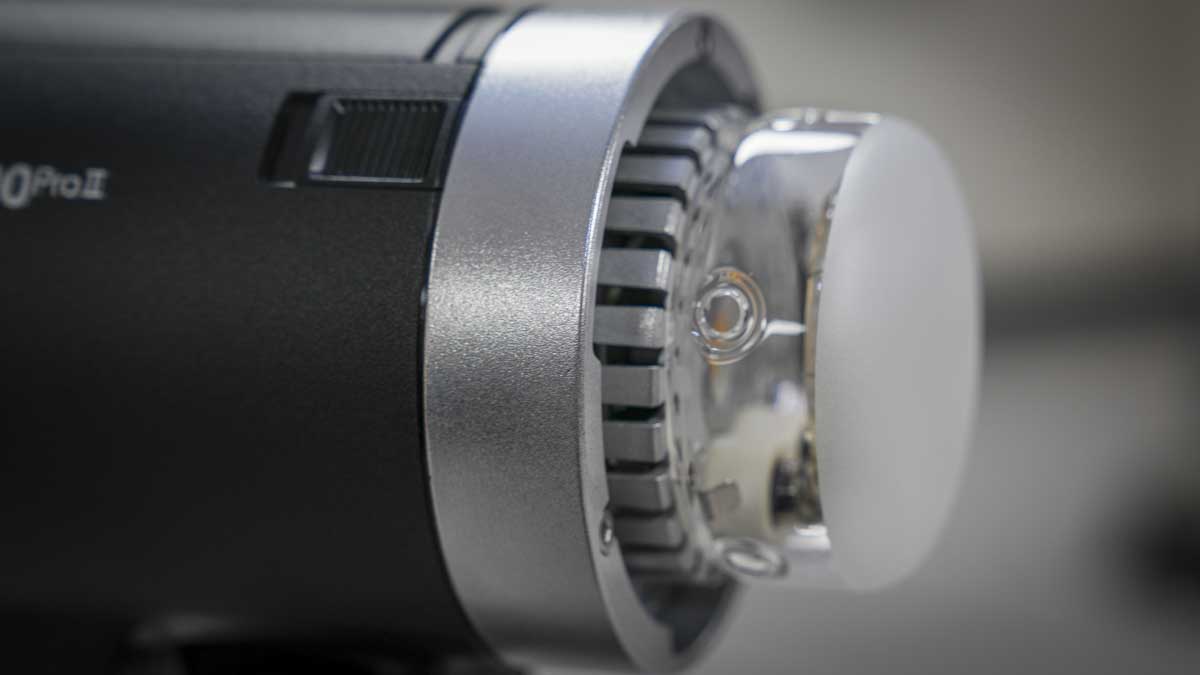
One surprise on the feature is the 12W bi-colour LED modelling lamp is a more significant upgrade: it outputs around 1,200 lux at one metre with a diffuser, which is bright enough to shoot as a continuous light source if required, not just for composition reference. The colour temperature is adjustable from 2800K to 6000K, a range that covers warm interior light through to outdoor daylight, and the CRI 97 / TLCI 98 ratings mean colour accuracy is excellent.
Back to the flash options and there’s the Freeze mode, accessed through the menu, cuts flash duration down to as short as 1/24,390s by limiting the capacitor charge, trading output for speed, a useful tool for action, splashes or fast-moving subjects. Colour-stable mode, which holds colour temperature within ±100K across the full power range, proved highly consistent in testing, even with the head warmed through extended use.
Performance
In studio use, 300Ws is a substantial amount of power; during testing, the flash was typically run at around 200Ws, at which level recycle times were just under 1 second. At full power, recycles were comfortably under two seconds, which is more than fast enough to keep pace with a natural shooting rhythm.
Battery performance comfortably met and slightly exceeded Godox’s claim: a full-power endurance test reached 362 consistent exposures, while working at reduced power produced well in excess of 400 frames.
Another point here is that while many flash units of this size also give you the option to be mains powered for use in the studio, the AD300 Pro II is battery only, so an additional battery would be a good idea. In this test, around 400 shots per outing were more than enough, especially without the head being used at full power.
Through the test, I used a Sony A7 IV and Godox X3 Pro as the flash trigger, which enabled me to control the power and flash mode from the camera, and gave a good professional feel to the workflow.
One of the issues with some cheaper flashes in the past has been colour consistency; however, here that colour temperature did seem consistent, and for any pro, it will be one of the most important features.
Having allowed the unit to acclimatise to the studio environment and warmed the light through with a series of initial test frames, colour temperature remained stable throughout the session. For me, this is of particular importance, especially when shooting fashion or product for books, as you need that consistency of colour, and in the past, this meant the expense of a Profoto or Broncolor head.
TTL metering performed well in balanced studio conditions, though, as with any TTL system, scenes with complex or contrasty content required manual compensation. HSS functioned as expected, enabling synchronisation at shutter speeds up to 1/8000s.
Outdoors, 300Ws at close proximity is more than sufficient to make a visible impact on the scene, especially with the rather grey and overcast weather conditions that we have been experiencing so far in 2026. With these slightly subdued illuminations, the modelling lamp proved to be not only a reliable guide for lighting positioning before switching to flash, but also as a video light.
On the front holding the light modifiers to the flash is the Godox mount, which works well with native modifiers, and the optional Bowens adapter opens access to a wide range of third-party light shapers, though it is worth noting this is a separate purchase and not included in the box, which is a shame.
Ignoring the price, this flash is able to compete with some of the best on the market, and the build quality and durability have taken a massive leap forward. When you do start to consider the price, you realise what exceptional value this head is, and for someone who has, for the past five years, used Profoto lighting gear and the superb B10S, these units offer a very viable, cheaper alternative, and I can buy three for the price of one of the latest B20S.
Final Thoughts
The Godox AD300Pro II builds on the updates I have seen across the rest of the Godox ranges, and the build quality and illumination are superb, closing the gap between these cheaper flash solutions and premium models. The AD300 Pro II is now one of the most feature-packed portable flash units on the market, and what makes it even more attractive is the complete compatibility with the rest of the range.
Godox has addressed the areas where the original fell short with the original AD300, most notably the interface, colour stability and feature depth, and they’ve done this without compromising the compact, lightweight form factor that made it so useful in the first place.
At £497, it isn’t the only flash solution of this power or price in the market and acrioss the board many manufacturers have boosted both the quality and features of their offerings at this price point. As this is the hotly conteneded enthusiast market the products have to be robust and easy to use and on that front Godox has absolutley hit the mark.
However, what makes this unit stand out from the crowd is the fact that it’s so easy to use, and the colour consistency is, most importantly, excellent, and should meet the demands of most pro photographers in light to mid-weight studios. You still need to let these heads take a breather every now and again to avoid overheating, but few photographers will push them that hard.
The Bowens adapter is a minor inconvenience, and if you are thinking of kitting out with one, two or three of these then I would definitely budget in the small added expense for the adapter. The other accessory is the X3 or X3Pro trigger, and once you have everything, you have a location lighting kit that is genuinely hard to fault at this price.