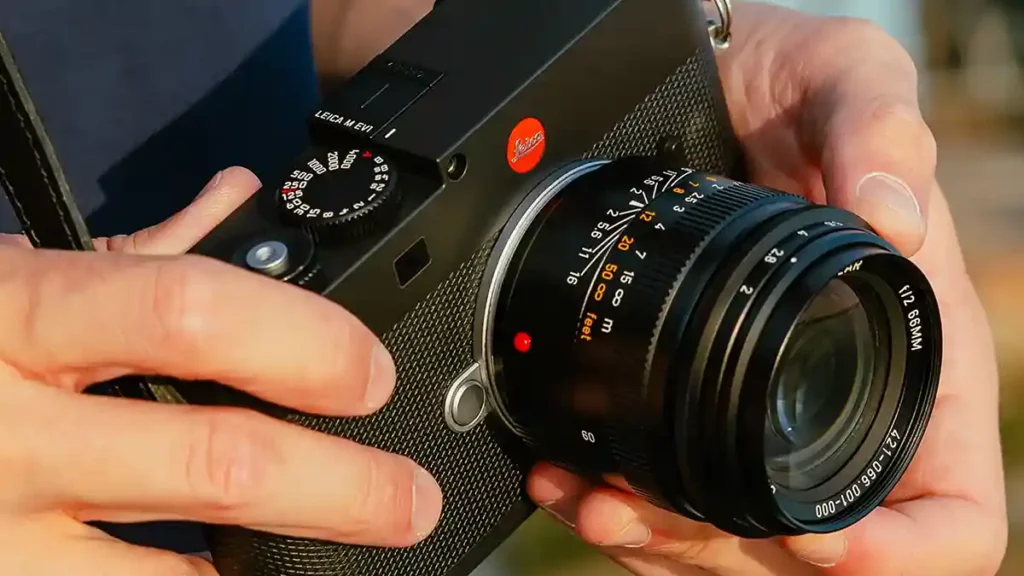

Every lens Leica has made in the past century, someone somewhere can buy. The Elcan 66mm f/2 is the exception — a lens built for the US Navy in the late 1960s, never sold publicly, of which only around 200 were ever made. Leica has now recreated it as the Summicron-M 66 f/2, and it arrives with a backstory that is genuinely remarkable. Details are on the Leica Camera site.
The lens that came with instructions for destroying it
The original was designed by Dr Walter Mandler at Ernst Leitz Canada, commissioned by the US Naval Intelligence Service for covert reconnaissance photography. The brief, as Mandler described it, was a lens that looked like any other but delivered an unparalleled level of resolution — which explains the unusual focal length. Sixty-six millimetres was not a marketing decision but the point at which maximum resolution, contrast rendition and compact size balanced.
Leica notes a detail that says everything about what these were for: the original sets shipped with an instruction manual explaining how to destroy the camera and lens in the event of capture.
With roughly 200 made and almost none reaching the open market, it became one of the rarest and most sought-after lenses in the M system, changing hands at prices that make the new one look reasonable.
Faithful to the original, including the awkward parts
What is interesting about the reinterpretation is how much Leica has kept rather than fixed.
The aperture ring turns the wrong way. On a standard M lens you twist right to stop down; here you twist left, exactly as the Elcan did. The distance scale follows military specification rather than Leica’s usual arrangement. Both are quirks a modern designer would iron out, and Leica has deliberately preserved them.
Optically it runs six elements in five groups with a nine-blade aperture, focusing from one metre to infinity with a maximum magnification of 1:13.4 and a 36.3-degree angle of view. Leica describes distinctive rendering at f/2 with soft bokeh and high contrast, resolving finest detail when stopped down. The click-stop diaphragm has half-increment lock settings, there is an E49 filter thread, and — unusually for a premium Leica — a screw-on hood rather than an integrated one. It weighs 456g and measures around 60mm long.
The practical problem nobody is mentioning
Here is the thing worth knowing before anyone reaches for a credit card: 66mm has no corresponding frameline on any Leica M body.
M rangefinders display framelines for 28, 35, 50, 75, 90 and 135mm. A 66mm lens falls between 50 and 75, so you are either composing loosely inside the 50mm frame or accepting that the 75mm lines show less than you will capture. On a digital M with live view you can work around it; on a film M you are estimating.
That is not a criticism so much as a description of what this lens is. Sixty-six millimetres sits neatly between a standard 50 and a short portrait lens, offering natural perspective with a little compression, and in use it should be lovely. But the framing question is real, and it tells you this is aimed at people who will enjoy solving it rather than those who need a working portrait lens.
Collector’s piece first, working lens second
Leica is making 660 of them, each with its serial number engraved on the front ring, as part of its Classic Collection. Number 001 will be auctioned at the Leitz Photographica Auction in Wetzlar.
At £8,410 this is not a lens anyone buys on optical merit alone — Leica’s own APO-Summicron primes cost less and will outresolve it. What you are buying is a piece of photographic history that was previously impossible to own at any price, made properly rather than as a badge-engineered special edition.
Worth noting that Leitz Cine already sells the Hugo 66mm T2.1, also based on the Elcan, for PL and L mount — so the optical formula has been quietly available to filmmakers for a while. This is the first time M shooters have had a route to it.
Leica Summicron-M 66 f/2: Specifications
Mount: Leica M. Focal length: 66mm. Maximum aperture: f/2. Optical design: 6 elements in 5 groups. Aperture: 9 blades; click-stop diaphragm with half-increment lock settings; ring rotates opposite to standard M lenses. Angle of view: 36.3°. Minimum focus: 1m. Maximum magnification: 1:13.4. Filter thread: E49. Hood: screw-on. Weight: 456g. Length: approximately 60mm. Distance scale: military specification. Edition: limited to 660 units, each engraved with its serial number on the front ring; part of the Leica Classic Collection. Note: there is no 66mm frameline on Leica M bodies.
Leica Summicron-M 66 f/2: Price and availability
The Summicron-M 66 f/2 is available worldwide from 3 September 2026 through Leica Stores and authorised dealers, priced at £8,410 (€9,850 / $10,900). The lens bearing serial number 001 will be auctioned at the Leitz Photographica Auction in Wetzlar.