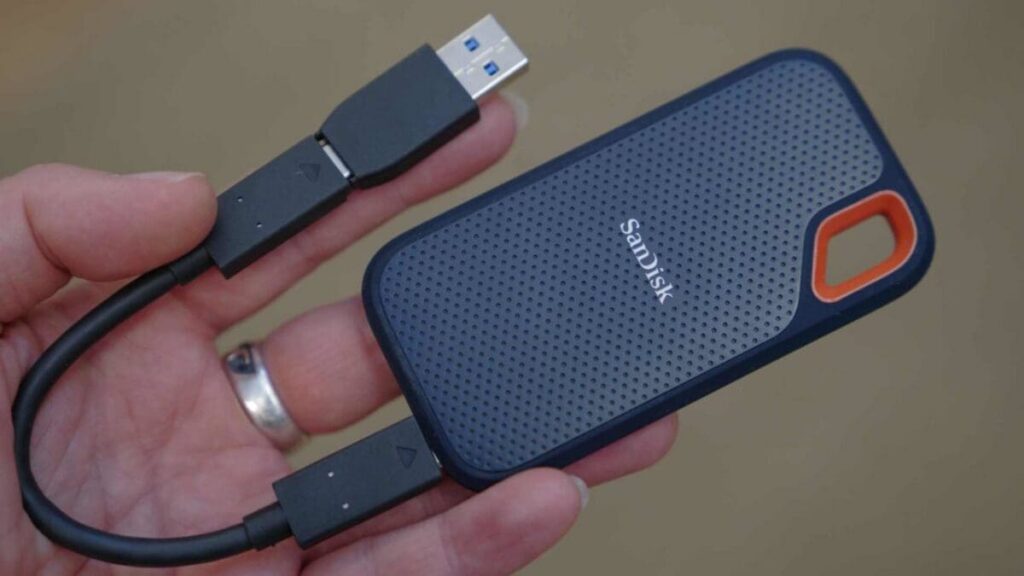

The best portable SSD is one that gives a photographer peace of mind that your files are safe, and quickly to hand when you need them. Solid State Drives have become the new norm for photographers who need to back up their files quickly and safely.
Portable SSDs lack the moving parts that would sometimes break in older hard drive technology. However, this new technology comes at a price.
The best portable SSDs are more expensive than traditional portable hard drives. But for your money you are getting much faster data transfer speeds, a smaller, lighter body design and a more durable construction inside the drive.
It’s also worth noting that most portable SSDs require no drivers. So you can just connect your drive to your Mac or PC and start using it without reformatting.
Where once portable hard drives were the norm, solid-state storage drives like those on our list of the best portable SSDs are becoming more common. More photographers are willing to pay the extra price for their speed and endurance.
However, the cost of a good portable SSD is no longer as expensive as it once was. As the technology has developed, price tags have down quite a bit. Even SSDs with storage at capacities up to 1TB are now accessible for most consumers.
HDD vs SSD: what is the difference?
A Hard Disk Drive (HDD) or Solid State Drive (SSD)? This is the question many photographers ask themselves. An HDD is typically much cheaper than an SSD, but the SSD is a lot faster.
In short, an HDD is older technology and uses moving parts to record your data. Specifically, it employs a number of mechanical parts in the form of spinning wheels and arms and magnetic tape to record your data.
An SSD is smaller, lighter and much faster than an HDD. This is because SSDs use flash chips to read and write your data simultaneously across their many cells. This makes them faster, but that speed comes at a cost. SSDs are typically a lot more expensive per gigabyte than HDDs.
Also, those flash cells wear out over time, meaning it’s good to have a backup of your backup.
SSD or HDD: which is best?
If all you’re doing is storing an archive of images for posterity, an HDD is probably the best solution for you. The mechanical parts are vulnerable to wear and damage over time, but if it’s simply for storing your archive of images, the wear should be minimal. But HDDs are susceptible to shock.
If you back up regularly and use your external drive as part of your daily or weekly workflow, you’ll probably want the size and read and write speeds of an SSD.
What’s more, as technology continues to develop, SSDs are poised to become the more developed and dominant device. This will also help push their price down.
External or portable storage: what is the difference?
There are really two types of external drive, ignoring the SSD, HDD, and that’s external and portable.
External are generally self-powered, large storage devices used for backup at home. The drives sit externally to your computer and generally contain optical discs. USB external drives are now very slow in comparison with newer USB-C and Thunderbolt drives so are best used for storage, they’re also super cheap for the capacities so well worth buying to keep everything backed up at home.
If you need an external as a working drive then look for a newer device with USB-C connectivity or Thunderbolt 3.0 especially if you’re editing video.
Portable drives are powered by the machine that they’re being used with. It’s really important that you get one with a sensible connector, USB-C is ideal otherwise older USB but try to avoid USB 3.0 – most portables that break are due the crappy connector.
Also make sure that the format of the drive matches your system. Most drives will come formatted at ExFat as this will work on both Mac and PC systems. The issue is that although the system is good, if you accidentally disconnect a drive without ejecting, especially on a Mac, you’re very likely to loose the partition and it can be a right royal pain in the ass to get the partition back if at all. I have two disks I’m trying to recover at present for the guys at Salisbury LCE.
When it comes to portable also think about the type of use. If you just need storage then an optical drive should be suitable, do consider that as it will be thrown into a camera bag it will only have limited life when compared to an SSD. HDD are better for big storage than SSD but not so great when used as working drives, in general terms.
SSDs are great but there’s quite a bit of misselling at the moment. You get cheap SSDs that utilise standard USB including USB 3.0. They may be SSD but you’re not getting a great deal of added performance over an HDD.
Then there are SSDs on USB-C which are pretty good and great for image editing and Full HD video. And then you have Thunderbolt 3 drives like the Samsung X5 which rock on speed.
So which portable SSD is best for your photography workflow? These are some of our favourites that we’ve tested over the years.
The best portable SSDs for photographers
SSD technology is constantly improving. Drives get faster every year, while offering even more storage capacity. Below are our picks for the best portable SSDs you can buy today.