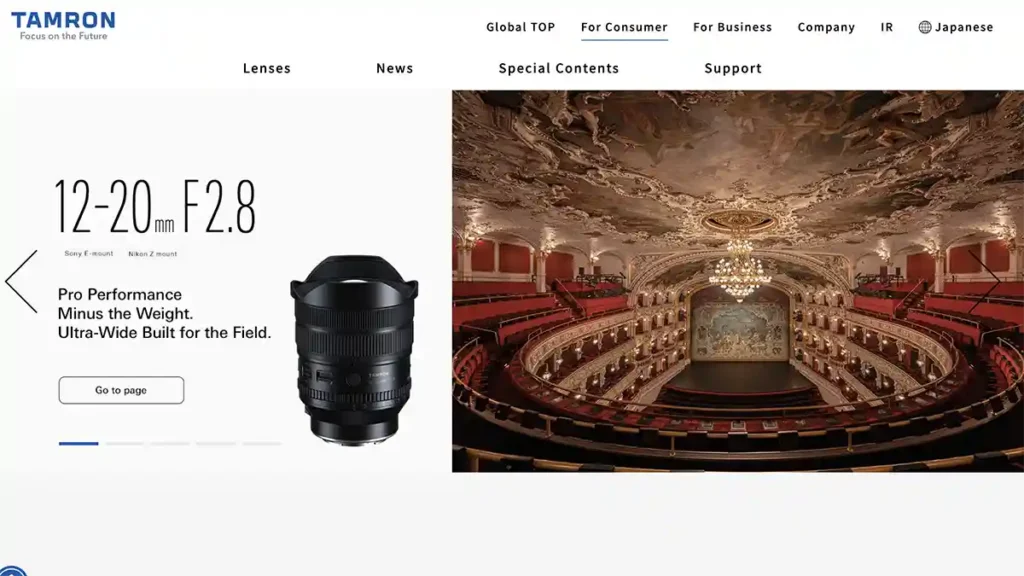

The biggest story in the camera industry this year is no longer a rumour. Tamron has officially confirmed that Sony has made a non-binding proposal to acquire the company outright, turning the third-party lens maker into a wholly owned subsidiary of Sony Group. Tamron has established a Special Committee to review the proposal, and Sony’s own chief financial officer has now publicly addressed it. Tamron’s statements are published on its investor relations pages.
The sequence matters. Japanese business publication Diamond Online reported the proposal on 29 July, citing a figure around ¥200 billion (roughly £916 million / $1.2 billion). Tamron responded the following day, confirming the proposal exists while pointedly noting that the original report did not come from the company. Then, at Sony’s investor meeting, chief financial officer Lin Tao confirmed Sony has proposed making Tamron a wholly owned subsidiary, saying the thinking is that the proposal would create optimal value.
None of this is a done deal. A non-binding proposal is exactly that, the Special Committee has yet to report, and no financial terms have been disclosed by either party. Deals of this size collapse regularly.
Why Sony wants Tamron
Sony has held a significant stake in Tamron for years — reported at 15.35% as of December — so this is a move from partial to total ownership rather than a bolt from the blue. There is also a shareholder dimension: activist fund Effissimo Capital Management holds a large stake of its own, reported at 17.38%, and has a track record of pushing for value maximisation. Making a formal bid arguably lets Sony get ahead of that dynamic rather than react to it.
The strategic logic is straightforward. Third-party lens availability has been one of E-mount’s genuine advantages over rival systems, and Tamron supplies a large share of it. Tamron’s lenses consistently launch to E-mount first, and for many photographers a Tamron at half the price of a G Master gets them most of the way there. Buying Tamron lets Sony absorb that business rather than compete with it.
What it could mean for Nikon, Canon and Fujifilm shooters
This is the part that should concern photographers outside the Sony system. Tamron makes lenses for Nikon Z, Canon RF and Fujifilm X, and for X-mount in particular Tamron is one of the more important third-party suppliers. If Sony took full ownership, there is an obvious question about whether development for competing mounts would continue, slow, or stop.
Our honest read is that nobody knows, including probably Sony. Tamron’s revenue depends on serving all of its mounts, so cutting them off would destroy value Sony has just paid for — but strategic priorities change after an acquisition, and “we have no plans to change anything” is what every acquirer says on day one. If you have been considering a Tamron lens for a Fujifilm or Nikon body, buying sooner rather than later is not an unreasonable hedge.
There is also a regulatory hurdle. Sony holds roughly 43% of the global image sensor market, and combining that with ownership of the most prolific third-party lens maker supplying its own competitors invites scrutiny under Japan’s antimonopoly laws, and potentially in the EU and US too. That process alone could take many months.
Separately, and relatedly, Sony has for the first time published a list of which manufacturers hold an official E-mount licence with access to its basic specifications — a useful piece of transparency that tells photographers which third-party lenses are built on shared data rather than reverse engineering.
Sony’s proposal for Tamron: what we know
Status: Sony has made a non-binding proposal to acquire all shares in Tamron, making it a wholly owned subsidiary. Confirmation: officially confirmed by Tamron, which has established a Special Committee to review the proposal; Sony CFO Lin Tao has publicly confirmed the proposal at an investor meeting. Reported value: approximately ¥200 billion (around £916 million / $1.2 billion), per Diamond Online — not confirmed by either company. Existing holding: Sony reported as holding around 15.35% of Tamron; activist fund Effissimo Capital Management holds a reported 17.38%. Regulatory position: any deal would require review under Japanese antimonopoly law, with possible EU and US scrutiny. Open questions: no agreed terms, no timetable, and no statement on the future of Tamron’s Nikon Z, Canon RF and Fujifilm X lens development.