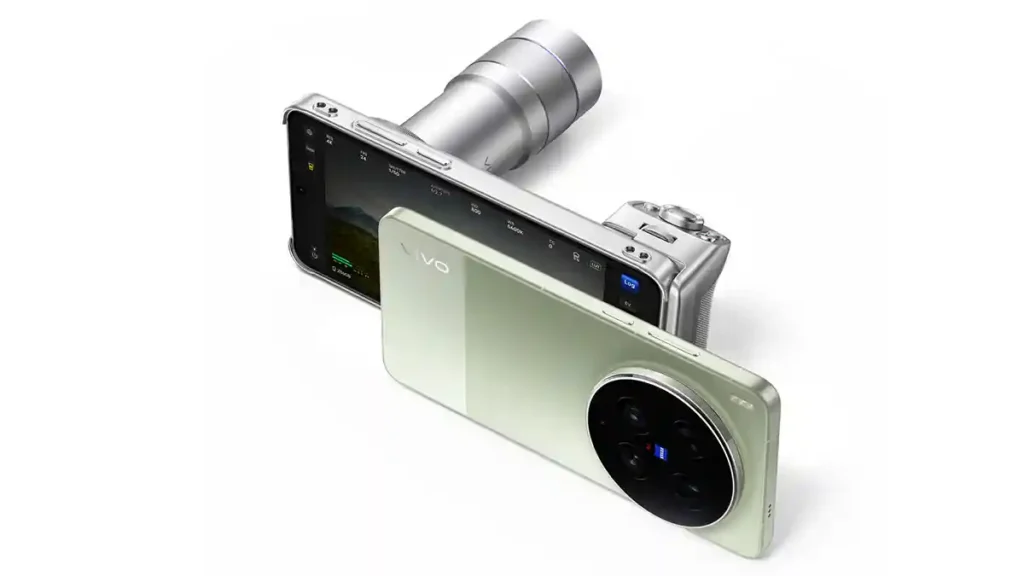

Vivo has launched its X500 series, and while these are phones rather than cameras, there’s one detail worth a photographer’s attention: the whole range, from the standard X500 up to the Pro and Pro Max, shares the same Zeiss co-engineered camera system. That’s an unusual decision, and it says something about where computational imaging is heading. Details are on Vivo’s site.
The one thing they have in common
Normally a phone maker reserves its best camera for the most expensive model, and the cheaper versions in a range make do with lesser sensors. Vivo has gone the other way with the X500 series: the standard X500, the X500 Pro and the X500 Pro Max all carry the same Zeiss-branded imaging system, so you’re not paying the top price purely to get the good camera.
The X500 Pro’s specification is serious for a phone. The main camera pairs a 50MP 1/1.28-inch Sony LYT-910 sensor with an f/1.57 aperture, alongside a 64MP Zeiss APO periscope telephoto (85mm, 3x optical zoom, with telephoto macro) and a 50MP ultra-wide, all finished with Zeiss T* coating to control flare and reflections. That 1/1.28-inch main sensor is genuinely large by phone standards, closing in on the 1-inch sensors the very top flagships use.
Why a camera site should care
Two reasons this matters beyond the phone world.
First, the Zeiss partnership is the interesting part. Zeiss lends its optical expertise and colour science to Vivo’s cameras, much as Leica does with Xiaomi and Hasselblad does with OnePlus, and the results have made Vivo’s recent flagships some of the most capable camera phones you can buy. The 85mm periscope telephoto with a proper APO design is exactly the sort of focal length a portrait photographer reaches for, and having it respond like a real short telephoto rather than a cropped digital zoom is the point.
Second, and more broadly, this is another data point in the steady rise of the phone as a genuine second camera. For a lot of photographers the phone is now the camera that’s always in a pocket, and a 1/1.28-inch sensor behind Zeiss glass narrows the gap to a compact camera considerably. It’s the same conversation the iPhone 18 Pro’s variable aperture opened up earlier this month.
Worth knowing
The usual caveats apply. Vivo’s flagships have historically had limited or delayed Western availability, so UK buyers may struggle to get one easily, and pricing for our market isn’t confirmed. And as ever with phone cameras, the sensor and the Zeiss badge are only half the story — how the computational pipeline handles that hardware is what actually decides the pictures, and that’s something only real-world shooting reveals.
Still, for anyone who takes phone photography seriously, or who’s curious about where the Zeiss and Leica phone partnerships are pushing image quality, the X500 series is a notable release — not least because Vivo has put its best camera in every model rather than just the priciest.
Vivo X500 Pro: Specifications
Main camera: 50MP 1/1.28-inch Sony LYT-910, f/1.57. Telephoto: 64MP Zeiss APO periscope (Sony LYTIA 610), 85mm, 3x Main camera: 50MP 1/1.28-inch Sony LYT-910, f/1.57
Telephoto: 64MP Zeiss APO periscope (Sony LYTIA 610), 85mm, 3x optical zoom, telephoto macro, CIPA 7.0 stabilisation
Ultra-wide: 50MP
Front camera: 50MP
Optics: Zeiss T* coating; Zeiss co-engineered system shared across the X500, X500 Pro and X500 Pro Max
Display: 6.36-inch 1.5K 144Hz LTPO AMOLED
Processor: MediaTek Dimensity 9600 Pro (2nm)
Storage: 256GB / 512GB / 1TB
Note: UK availability and pricing not confirmed
Vivo X500 series: Price and availability
Vivo has announced the X500, X500 Pro and X500 Pro Max. UK pricing and availability had not been confirmed at the time of writing — Vivo flagships often see limited or delayed Western release, so check current listings before purchase.