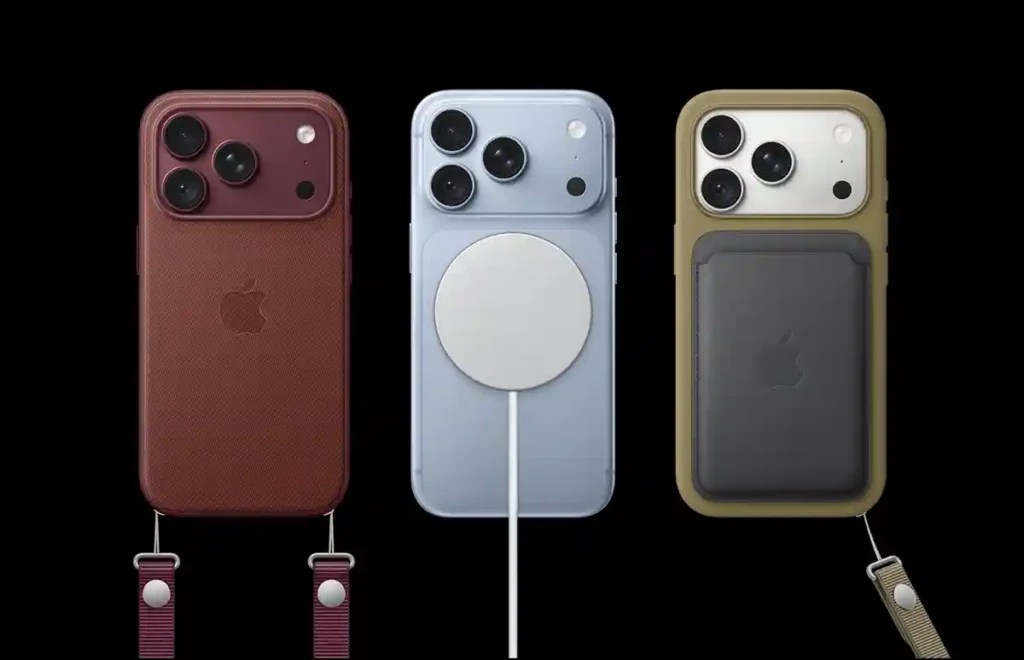

Apple has announced the iPhone 18 Pro and iPhone 18 Pro Max, and for once the camera headline is not a bigger number. It is a mechanical one: the main camera now has a variable aperture, physically stopping down from f/1.48 to f/4. That is a first for iPhone, and it is the most photographically meaningful change Apple has made to its camera system in years. Full details are on Apple’s site.
Why variable aperture matters
Every iPhone until now has had a fixed aperture. Depth of field was therefore fixed too, and the only way to blur a background was Portrait mode — which is software estimating depth and applying blur, with the tell-tale errors around hair and glasses that give it away.
A physically variable aperture changes the optics rather than the processing. At f/1.48 you get genuinely shallow depth of field and considerably more light reaching the sensor. At f/4 you get real depth of field — useful for a group where you need three rows of faces sharp, for architectural interiors, or for landscapes where you want the foreground and the hills both holding detail.
The intermediate stops of f/1.8 and f/2.8 give you what any photographer recognises as aperture control. That is a different proposition from choosing a blur strength on a slider afterwards.
There is a second benefit that will matter to video shooters. Being able to stop down means controlling exposure optically rather than pushing the shutter speed up, so you can hold a sensible 180-degree shutter angle in bright light without an ND filter. That has been a perennial irritation of filming on a phone.
The rest of the camera system
Apple calls it the 48MP Pro Fusion system, and all three rear cameras are now 48-megapixel.
The Fusion Main covers 24mm and 48mm (1x and 2x) with the variable aperture and sensor-shift stabilisation, using 2.44μm quad-pixels or 1.22μm individual pixels. The Fusion Ultra Wide sits at 13mm (0.5x and macro) at f/2.2. The Fusion Telephoto is a periscope design covering 100mm and 200mm — 4x and 8x — at f/2.8.
That gives five optical-quality zoom positions: 0.5x, 1x, 2x, 4x and 8x. Two hundred millimetres from a phone is a genuinely long reach, though as ever the 8x is a crop from the periscope’s native 4x rather than a separate optical arrangement.
The front camera stays at 18MP Center Stage with autofocus, automatic reframing, stabilised video and Dual Capture — which records front and rear simultaneously, useful for anyone doing pieces to camera alongside their main footage.
The Pro controls are the other significant addition
Alongside the hardware, Apple has expanded manual control: aperture, shutter speed, white balance and a live histogram.
A histogram on a phone camera is a small thing that says a lot. It signals Apple is now designing for people who expose deliberately rather than trusting the meter, and combined with genuine aperture control it means the phone can be operated the way a camera is operated.
Stills capture in both 24MP and 48MP, and there is something Apple calls Apple Reference Image — worth investigating properly, as the detail on it is thin at this stage.
Video
Dolby Vision recording runs to 4K at 120fps, with smart focus tracking and what Apple describes as improved low-light performance. Battery life is quoted at up to 36 hours of video playback on the Pro and 45 hours on the Pro Max — the latter carrying a 5,567mAh cell.
Both models keep the Action button and Camera Control, in an aluminium unibody, with 6.3-inch and 6.9-inch Super Retina XDR displays. Colours are Burgundy, Glacier Silver and Black.
Our take
Phone camera announcements have become an exercise in incremental numbers, so a physically variable aperture is a genuine change of direction — it addresses a limitation that no amount of computational photography properly solved.
Whether it holds up in practice is the question. Variable aperture mechanisms in phones have historically offered two stops rather than a continuous range, and how Apple’s implementation behaves at each setting, particularly for diffraction at f/4 on a sensor this size, is exactly what needs testing. Small sensors hit diffraction early, and f/4 on a 1/1.28-inch sensor is not equivalent to f/4 on full frame.
But the direction is right. Combined with a histogram and manual shutter control, this is the first iPhone that lets you make optical decisions rather than choosing between processed outcomes — and for anyone using a phone as a second camera, that matters.
One practical note: accessory makers have moved quickly. SmallRig already has cage ecosystems and cinema kits for both models, so the rigging options are there from day one if you shoot seriously on a phone.
iPhone 18 Pro and Pro Max: camera specifications
System: 48MP Pro Fusion, three rear cameras.
Fusion Main: 48MP, 24mm and 48mm (1x / 2x), variable aperture f/1.48, f/1.8, f/2.8 and f/4, sensor-shift optical stabilisation, 2.44μm quad-pixel / 1.22μm individual.
Fusion Ultra Wide: 48MP, 13mm (0.5x and macro), f/2.2, 1.4μm quad-pixel / 0.7μm individual.
Fusion Telephoto: 48MP periscope, 100mm and 200mm (4x / 8x), f/2.8, 1.4μm quad-pixel / 0.7μm individual.
Optical zoom positions: 0.5x, 1x, 2x, 4x, 8x.
Front camera: 18MP Center Stage with autofocus, automatic reframing, stabilised video and Dual Capture.
Photo formats: 24MP and 48MP; Apple Reference Image.
Pro controls: aperture, shutter speed, white balance, histogram.
Video: Dolby Vision up to 4K 120fps, smart focus tracking.
Chip: A20 Pro with C2 modem.
Displays: 6.3-inch (Pro) and 6.9-inch (Pro Max) Super Retina XDR with ProMotion and Always-On.
Body: aluminium unibody with Action button and Camera Control.
Battery: up to 36 hours video playback (Pro), 45 hours (Pro Max).
Colours: Burgundy, Glacier Silver, Black.
Price and availability
Apple announced the iPhone 18 Pro and iPhone 18 Pro Max on 9 September 2026. Check Apple’s UK site for current pricing, configurations and availability.