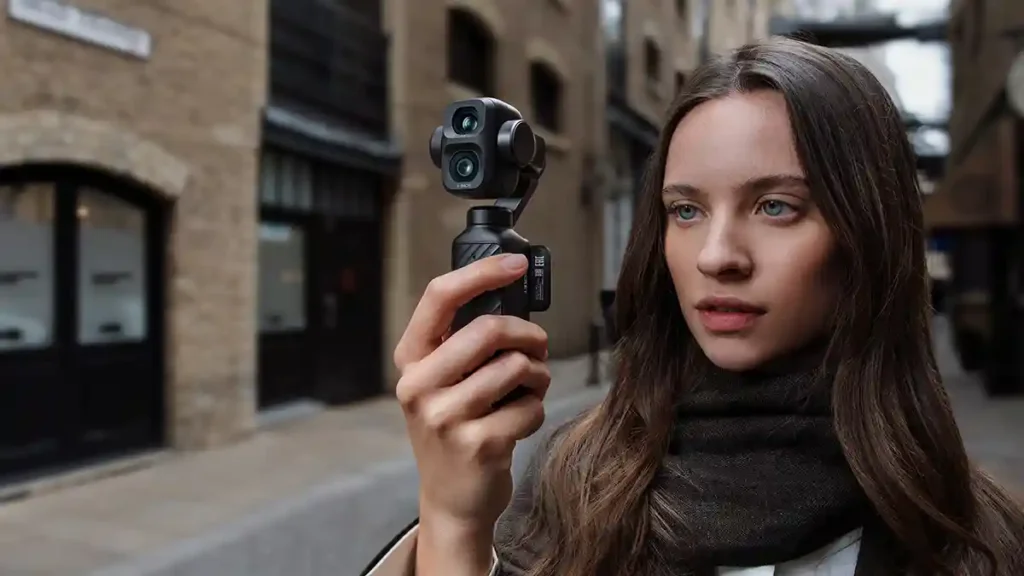

DJI has officially launched the Osmo Pocket 4P, and it’s the most significant change to the pocket gimbal camera since DJI created the category in 2018: this is the first Osmo Pocket with two lenses. Alongside an all-new 1-inch sensor claiming 17 stops of dynamic range and a new 10-bit D-Log 2 colour profile, it adds a dedicated 60mm f/1.8 medium-telephoto for portraits. Full details are on DJI’s official product page.
We’ve already had one in for testing, so if you want our verdict rather than the specifications, head straight to our full Osmo Pocket 4P review. What follows is the complete specification, which until today was the one thing DJI hadn’t made public.
Two lenses, and one detail worth knowing
The headline change is the dual-camera design. The primary wide-angle lens pairs an all-new 1-inch CMOS sensor with a 20mm-equivalent field of view at f/2.0, focusing from 0.2m to infinity. The second is a 60mm-equivalent medium-telephoto at f/1.8, focusing from 0.3m, which DJI describes as the portrait sweet spot — and with an f/6.3-equivalent depth of field it compresses backgrounds in a way no single-lens pocket camera has managed. It offers 3x optical zoom and up to 12x digitally, with a new physical zoom button for switching between 20mm and 120mm.
Here’s the detail the marketing doesn’t dwell on, and which we think matters: the two lenses do not share a sensor. The wide-angle uses the 1-inch chip, but the medium-telephoto sits on a smaller 1/1.28-inch sensor. That’s still a respectable size for a device this small, but it means the two focal lengths aren’t optically equivalent — the tele also has a lower ISO ceiling (50-12,800 versus 100-25,600 on the wide) and tops out at 4K/200fps rather than 240fps. Worth knowing before you plan a shoot around cutting between them.
Dynamic range, D-Log 2 and slow motion
DJI’s boldest claim is 17 stops of dynamic range from the new 1-inch sensor, achieved through LOFIC technology, which the company positions as outperforming Sony’s S-Log3 and approaching ARRI cinema territory. That’s DJI’s own testing rather than an independent measurement, so treat the headline figure with the usual caution — but the accompanying 10-bit D-Log 2 profile is genuinely notable, capturing over a billion colours and shipping with two dedicated LUTs (to Rec.709 and to LogC4) for grading.
On the wide-angle lens, 4K slow motion runs to 240fps, which DJI bills as a first for a consumer camera and which typically demands a cinema body costing many times as much. There’s also a Slow Shutter Video mode for deliberate motion blur and light trails.
Stabilisation and tracking
The 3-axis mechanical gimbal is rated to an angular vibration range of ±0.005° with a maximum controllable speed of 180°/s, all inside a 230g body. ActiveTrack 8.0 now works on the telephoto lens, tracking people, vehicles, pets and irregularly shaped subjects out to 12x zoom, with auto framing that can centre multiple subjects or prioritise a registered one.
DJI Osmo Pocket 4P: Specifications
General: Dimensions 159.5 × 63.3 × 33.5mm; weight 230g; three microphones; 2.0-inch touchscreen (556 × 314, 1,000 nits); 103GB built-in storage, expandable via microSD up to 1TB; exFAT file system. Colours: classic black and pearl white.
Cameras: Wide-angle — 1-inch CMOS, 20mm equivalent, f/2.0, focus 0.2m to ∞. Medium-telephoto — 1/1.28-inch CMOS, 60mm equivalent, f/1.8, focus 0.3m to ∞. ISO: wide 100-25,600 (low-light video to 51,200); tele 50-12,800 (low-light video to 25,600). Electronic shutter: photo 1/16,000-4s; video (manual) 1/16,000-1/4s.
Stills: Approx. 37MP single shot; maximum image size 7,680 × 4,320 (16:9) or 6,144 × 6,144 (1:1); panorama 180° and 3×3; 4K Live Photo (1.5-second clips); JPEG, DNG or JPEG+DNG.
Video: 4K (16:9) 3840×2160 at 24/25/30/48/50/60fps; 3K vertical (9:16) 1728×3072 at up to 60fps; 1080p in both orientations. Slow motion — wide-angle 4K at 100/120/200/240fps, tele 4K at 100/120/200fps, 1080p to 240fps. Low-light video 4K to 30fps. Hyperlapse, Timelapse and Motionlapse at 4K/3K/1080p. Maximum bitrate 180Mbps; MP4 (HEVC); 10-bit D-Log 2, D-Log; audio 48kHz 16-bit AAC.
Zoom: 3x optical on the tele; digital to 9x for photos and 12x for video. Note that digital zoom is unavailable in low-light, slow motion and timelapse modes, where you’re limited to the 1x or 3x optical focal lengths.
Gimbal: Controllable range — pan -235° to 58°, tilt -125° to 58°, roll -45° to 45°. Mechanical range — pan -240° to 90°, tilt -130° to 90°, roll -85° to 62°. Maximum controllable speed 180°/s; angular vibration range ±0.005°.
Battery: 1,545mAh Li-ion (11.95Wh, 7.74V); up to 210 minutes operating time (tested at 25°C, 1080p/24fps, Wi-Fi and screen off); charging 18 minutes to 80% and 32 minutes to 100% using DJI’s 65W charger, sold separately. Operating temperature 0-40°C.
Connectivity: Wi-Fi 802.11 a/b/g/n/ac/ax on 2.4GHz and 5GHz; Bluetooth BLE 5.4 with BR/EDR; USB 3.1 supporting wired transfer up to 800MB/s, or up to 90MB/s wirelessly.
Handling features: Instant Recording (rotate the touchscreen to power on and record); gesture control (open palm for ActiveTrack, a “V” sign to start recording); in-camera skin softening and film tones.
Ecosystem: Compatible with the Osmo Pocket 4 Fill Light, Osmo Pocket 4P Black Mist Filter, Osmo Pocket 4P ND Filters Set, Osmo FrameTap, Osmo Pocket 4 Battery Handle, Osmo Pocket 4P Wide-Angle Lens, Osmo Mini Tripod and OsmoAudio microphones (sold separately or bundled in select combos).
How it compares to the Osmo Pocket 4
Against the single-lens Osmo Pocket 4, the 4P upgrades the sensor’s dynamic range from 14 stops to a claimed 17, adds the 60mm f/1.8 tele, moves from 10-bit D-Log to D-Log 2, and steps up from ActiveTrack 7.0 to 8.0 with telephoto and multi-person tracking. Zoom improves from 2x lossless to 3x optical and 12x digital. The trade-offs are modest: it’s heavier at 230g versus 190.5g, and built-in storage drops slightly from 107GB to 103GB. Battery capacity is unchanged at 1,545mAh.
DJI Osmo Pocket 4P: Price and availability
The Osmo Pocket 4P is available from today through store.dji.com and authorised retail partners. The Standard Combo is £529 (from €599 / AU$959) and the Vlog Combo £605 (from €689 / AU$1,099). DJI Care Refresh is available, offering up to two replacements on the one-year plan or four on the two-year plan.
One significant caveat: DJI confirms the Osmo Pocket 4P will not be available in the United States, as its application for authorisation remains pending — a consequence of the regulatory situation that has stalled recent DJI hardware launches there.
For our hands-on verdict on how all of this performs in practice, read the full Osmo Pocket 4P review.