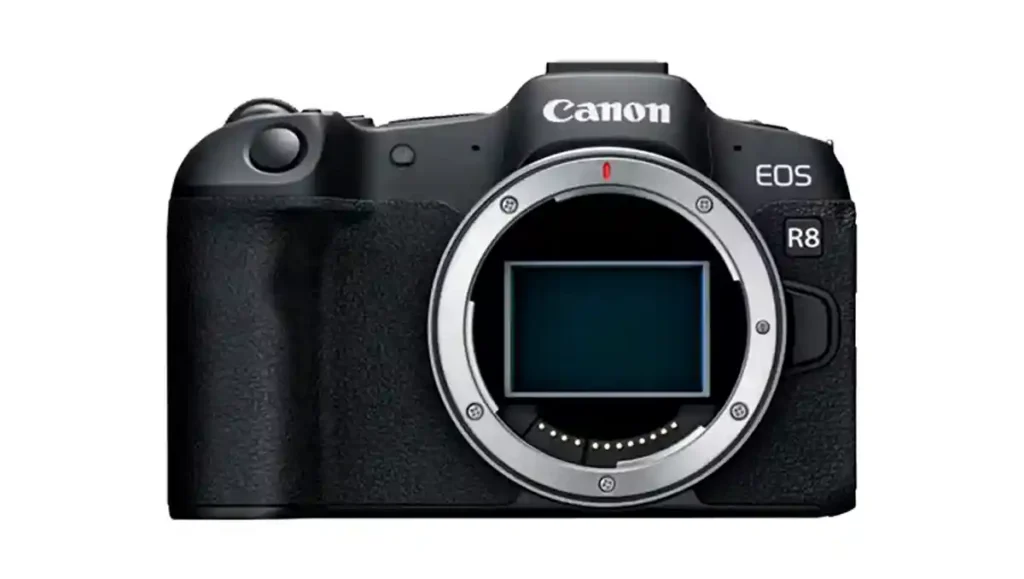

Opinion. The Canon EOS R8 Mark II has not been announced. Everything about it below comes from Canon Rumors and remains unconfirmed until Canon says otherwise — currently expected in early September.
Every so often a camera arrives that quietly does more for photography than any flagship. The Canon EOS R8 was one of them: full-frame, 461g, and now hovering around £1,200 new. It took the sensor and autofocus from a camera costing twice as much and dropped them into a body you could genuinely carry all day. Three years on, a Mark II is rumoured for early September, and the interesting question isn’t what’s in it, but whether Canon has the nerve to make it the camera this market now demands.
Who the EOS R8 is actually for
The R8 occupies a very specific and rather crowded piece of ground. It is the camera for the enthusiast stepping up from an EOS 90D or a Rebel who wants full-frame image quality without R6 money. It is the travel and street photographer who has decided that weight matters more than a spec sheet. It is the hybrid shooter on a budget, and it is the second body for someone whose main camera is far more expensive.
What unites that audience is that they are knowledgeable buyers on a constrained budget. They read reviews. They know exactly which corners have been cut and why. And crucially, they are not brand-loyal in the way professionals often are, at this price, switching systems is still an affordable decision. That is what makes this launch riskier for Canon than it looks.
Canon EOS R8: the major features
The original R8 pairs a 24.2MP full-frame CMOS sensor, lifted from the EOS R6 Mark II, with the DIGIC X processor and Dual Pixel CMOS AF II, with subject detection for people, animals and vehicles. It shoots up to 40fps with the electronic shutter, records uncropped 4K at up to 60fps oversampled from 6K, offers Full HD at 180fps, and runs to ISO 102,400 (expandable to 204,800). There’s a 2.36-million-dot OLED viewfinder at 0.70x, a 3.0-inch 1.62-million-dot vari-angle touchscreen, and in-camera compositing modes. All in a body weighing 461g.
The compromises are equally well known, and they are the reason a Mark II matters. There is no in-body image stabilisation. There is a single SD card slot. There is no true mechanical shutter, only electronic first curtain, which caps mechanical-equivalent bursts at a modest 6fps and can produce odd results at very fast shutter speeds with fast glass. And the small LP-E17 battery means spares are not optional. None of these were accidents. They were segmentation, drawn precisely to keep the R8 from embarrassing the R6 Mark II sitting £1,000 above it.
Where it sits in Canon’s line-up
Below the R8 there is really only the ageing EOS RP, a 26.2MP body managing around 5fps that survives largely as a used bargain. Above it sits the EOS R6 Mark III, launched in November 2025 with a 32.5MP sensor at around $2,799, joined by the video-focused EOS R6 V, and above those the EOS R5 Mark II and the flagship EOS R1.
That gap is the whole story. Between roughly £1,200 and £2,400 Canon currently has nothing, while its rivals have spent three years filling exactly that space.
The competition has moved, and Canon hasn’t
The Nikon Z5 II is the problem. At around £1,599 it offers a 24.5MP sensor with Nikon’s flagship EXPEED 7 processing, 7.5 stops of in-body stabilisation, dual card slots and a genuinely superb 3,000-nit viewfinder. Amateur Photographer currently rates it the best full-frame mirrorless camera overall, not the best budget one, the best one. That is a remarkable position for a camera at this price, and it exists because Nikon chose not to cripple it.
Sony’s A7C II sits higher at around £2,199 but brings 33 megapixels, 759 AF points, uncropped 4K60 and, significantly, a dedicated AI processing unit. Panasonic’s S5 II remains the value pick for video with its 10-bit codecs. Against that, the R8’s lack of IBIS and single card slot look less like sensible segmentation and more like a camera fighting with one hand tied.
What the rumours suggest — and why they’re encouraging
If Canon Rumors is right, Canon has noticed. The R8 Mark II is said to bring the same 32.5MP sensor found in the R6 Mark III and R6 V, in-body stabilisation, dual SD card slots and 40fps electronic shooting, wrapped in a retro-inspired body reportedly quite unlike anything else in the EOS R range. There is said to be no mechanical shutter.
Read that list again, because it is genuinely surprising. IBIS and dual slots are the two complaints that have followed the R8 since launch, and the same sensor as a camera costing twice as much is not the behaviour of a company protecting its mid-range. If accurate, this is Canon abandoning its habitual caution, and the retro styling suggests it has finally noticed that Nikon’s Zf and Fujifilm’s entire business model prove people will pay for a camera that has some character.
The question nobody’s answering: where’s the AI?
Here is where we’d sound a note of caution. In 2026, a camera at this price is judged partly on intelligence, not just specification. Sony’s A7C II already has a dedicated AI processing unit. Canon’s own R6 V uses AI-based human pose estimation to hold focus on a subject’s body and head, not merely their eyes, and to make more reliable white balance judgements. Rivals are shipping in-camera denoise, pre-capture buffering and automatic subject recognition that genuinely changes hit rates.
The rumours say nothing about a dedicated AI chip in the R8 Mark II. If it ships without one, it will have solved the complaints of 2023 while missing the expectations of 2026, a camera that finally has stabilisation, in a market that has moved on to asking what the processor can think. Canon’s reserved approach has served it well for decades. We don’t believe it will cut it here.
The price problem is the real one
And then there is the awkward arithmetic. The R8 sells new for around £1,200. Used examples still fetch roughly £1,000, a remarkably strong residual that tells you how good the camera is, but which creates an uncomfortable problem for its successor. Whatever Canon charges, the Mark II must justify itself against an excellent camera available for a grand.
Our view is that £1,499 to £1,699 is the only sensible window. At £1,599 it lands directly on the Nikon Z5 II with matching stabilisation and card slots, plus eight more megapixels and Canon’s autofocus, a genuinely competitive proposition. Push beyond £1,799 and the maths collapses: buyers will simply take the used R8 at £1,000, pocket the difference for a lens, and Canon will have built a superb camera nobody upgrades to. Anything approaching £2,000 hands the segment to Nikon outright.
The temptation, of course, will be to protect the R6 Mark III by pricing the R8 II high. That would be the traditional Canon move, and it would be the wrong one. The R8 succeeded precisely because it was almost too generous for its price. Its successor arrives into a market where Nikon has stopped holding back, Sony is shipping AI silicon at this level, and the second-hand market is a genuine competitor. Reserved won’t do it this time.
We’ll find out in September.