
Planning your next getaway and wondering which camera to pack? It’s a common dilemma. While smartphones have transformed everyday photography, a dedicated camera can truly shine on those once-in-a-lifetime trips or adventures to exotic destinations. Offering superior versatility, enhanced image quality, and features designed to capture stunning travel shots, they’re often worth the extra space in your bag.
Compact cameras now boast impressive zoom ranges and advanced features, making them an attractive choice. Meanwhile, mirrorless models strike an excellent balance between portability and high performance, offering DSLR-like quality in a smaller package. Even some DSLRs have slimmed down enough to join the travel party.
Bridge cameras, with their staggering zoom ranges, remain a favourite for all-in-one convenience, while action cameras are unmatched for rugged, go-anywhere versatility.
With so many options, finding the perfect travel camera can be daunting. That’s why we’ve curated a list of the top travel cameras for every type of traveller. From compact powerhouses to versatile hybrids, here are our top picks for capturing your holiday memories.
The best travel cameras you can buy today
The Best Travel Cameras You Can Buy Today
Our selection of the best travel cameras is based on hands-on testing and real-world experience. Each model has been evaluated for performance, portability, and suitability for travel photography. If you’d like to explore the wide range of camera types and features in more detail, be sure to check out our comprehensive camera buying guides for further insights.
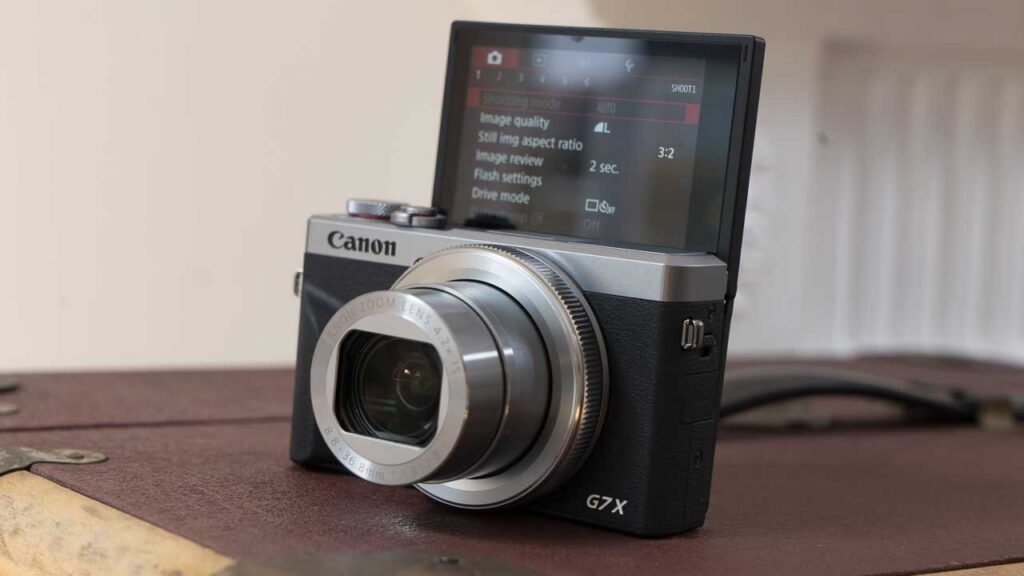
PowerShot G7 X Mark III
Specification
- Camera type: Compact
- Sensor: 20.1Mp 1-inch type Stacked CMOS
- Lens: 24-100mm (35mm equivalent) f/1.8 – f/2.8
- Viewfinder: 0.39-inch type 2,360,000-dot OLED
- Screen: 3-inch 1,040,000-dot tilting touchscreen
- Autofocus system: AiAF (31-point, Face Detection or Touch AF with Object and Face Select and Track), 1-point AF (any position or fixed centre)
- Sensitivity range: ISO 125-12,800 expandable to ISO 25,600
- Dimensions (W x H x D): 105.5 x 60.9 x 41.4mm
- Weight: 304g with battery and memory card
The PowerShot G7 X Mark III has a 20.1Mp 1-inch type stacked CMOS sensor. This is a new sensor design for Canon and combined with the Canon Digic 8 processing engine, it enables very fast continuous shooting rates, which is great for travel photographers shooting busy city scenes.
The G7 X III can shoot at up to 30fps (frames per second) in RAW Burst Mode for up to 70 images. Alternatively, it can shoot at 20fps for up to 89 C-RAW files, 55 RAW images or 118 Jpegs.
This sensor is fronted by an 8.8 – 36.8mm f/1.8-2.8 stabilised lens which has a 35mm focal length equivalence of 24 – 100mm. The 24mm end is a good option for arm’s-length video when looking at the screen flipped-up above the camera. The large aperture also enables the background to be blurred a little.
Canon has also added 4K video and live streaming capability to the Mark II, making it a worthy upgrade.
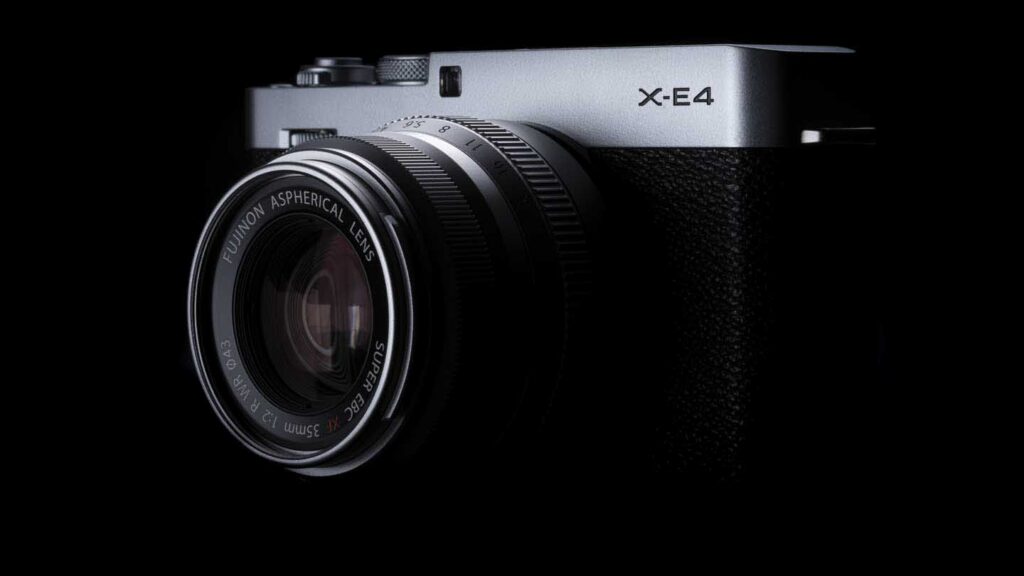
Fujifilm X-E4
- Camera type: Mirrorless
- Announced: 27th January 2021
- Sensor: 26.1Mp X-Trans CMOS 4 APS-C sensor
- Processing engine: X-Processor 4
- Lens mount: X
- Sensitivity range: ISO 160-12,800 expandable to ISO 80-51,200
- Viewfinder: 0.39-inch 2.36million-dot OLED with 100% coverage, 0.62x magnification 100fps
- Screen: 180° Tilting 3.0-inch 1,620,000-dot touchscreen LCD
- Autofocus system: Intelligent hybrid with up to 425 selectable AF points with Face & Eye AF
- Continuous shooting: Mechanical shutter: 8fps, Electronic shutter: 10fps or 30fps with 1.25x crop blackout-free
- Max video resolution: DCI 4K (4096 x 2160) at 29.97/25/24/23.98fps, 4K/30p 4:2:0 8-bit, 4K/30p 4:2:2 10-bit video via the HDMI, Full-HD at up to 240p
- Mic and headphone port: 3.5mm and USB-C
- Film Simulation modes: 18 modes: Provia/Standard, Velvia/Vivid, Astia/Soft, Classic Chrome, Pro Neg.Hi, Pro Neg.Std, Black & White, Black & White+Ye Filter, Black & White+R Filter, Black & White+G Filter, Sepia, Acros, AcrosS+Ye Filter, Acros+R Filter, Acros+G Filter, Eterna/Cinema, Classic Neg, Eterna Bleach Bypass
The Fujifilm X-E4 is the replacement for the Fuji X-E3, and it’s the smallest Fujifilm interchangeable lens camera with the 26.1MP X-Trans CMOS 4 APS-C format sensor and X-Processor 4 processing engine. When paired with the new Fujifilm Fujinon XF 27mm F2.8 R WR, which is sold separately or as a kit with the camera, the X-E4 is quite similar to the Fujifilm X100V (but with a removable lens).
As it has the same sensor and processing engine as the superb Fujifilm X-T4, the X-E4 can capture the same quality images. However, as it has a rectangular, rangefinder-like design and a smaller body, the X-E4 is best suited for use with Fujifilm’s prime lenses. Of course, as it has the Fujifilm X mount it can be used with any of Fujifilm’s X-series optics, but if you plan to use zoom lenses you might want to invest in the optional Thumb Rest(£59/$69.99) that slips into the camera’s hotshoe and the Metal Hand Grip (£79/$89.99) that adds a grip to the front.
Fujifilm has given the X-E4 a tilting screen that can be tipped up through 180° for viewing from in front of the camera. This is a bonus for selfies and vlogging but there’s a problem when the screen is tilted for viewing from behind below head-height as the image flips upside down when anything is detected in the eye sensor. Fujifilm is aware of this issue and it’s likely to be resolved with a firmware update.
The Fujifilm X-E4 is a great little camera that makes a good choice for carrying everywhere.
The Fujifilm X-E4 is available from Amazon UK and Amazon US.
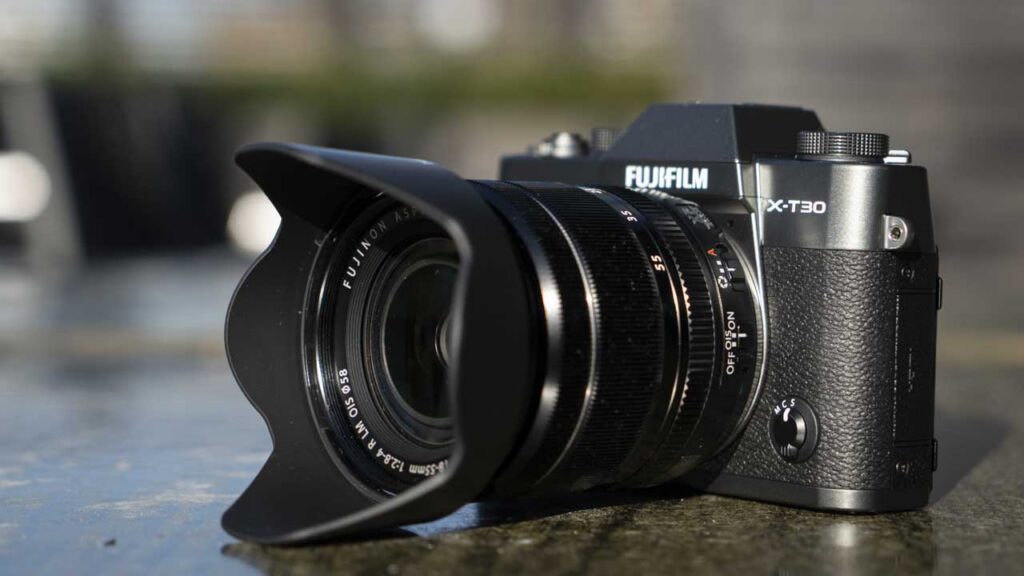
Fujifilm X-T30 II
Specification
- Camera type: APS-C format mirrorless
- Sensor: 26.1Mp APS-C (23.5mm×15.6mm) X-Trans CMOS 4
- Processor: X Processor 4
- Lens mount: Fujifilm X
- Sensitivity: Stills: ISO 160- 12800 expandable to ISO 80-51,200, Video: ISO 160- 12800 expandable to ISO 80-25,600
- Autofocus system: Intelligent Hybrid AF (TTL contrast AF / TTL phase detection AF) with up to 425 points in a 25×17 grid
- Viewfinder: Electronic 0.39 inch approx. 2.36 million dots OLED Colour
- Screen: 3.0-inch 1.62 million dots touchscreen with 100% coverage
- Key video specifications: DCI 4K (17:9) (4096 x 2160) at 29.97p/25p/24p/23.98p 200Mbps/100Mbps up to approx. 30min, 4K(16:9) (3840 x 2160) at 29.97p/25p/24p/23.98p 200Mbps/100Mbps up to approx. 30min, Full HD(17:9) (2048 x 1080) at 59.94p/50p/29.97p/25p/24p/23.98p 200Mbps/100Mbps up to approx. 30min.
- Maximum continuous shooting: Electronic shutter: 20fps for JPEG: 79 frames, Compressed RAW: 20 frames, Lossless compression RAW: 17 frames, Uncompressed RAW: 17 frames, Mechanical shutter: 8fps for JPEG: 105 frames, Compressed RAW: 23 frames, Lossless compression RAW: 18 frames, Uncompressed RAW: 18 frames
- Dimensions (WxHxD): 118.4 x 82.8 x 46.8mm / 4.66 x 3.26 x 1.84-inch
- Weight: 382g including battery and memory card, 329g body only
The lone physical upgrade that the X-T30 makes on the Fuji X-T30 is the switch to a 1.62-million dot screen on its back rather than a 1.04-million-dot unit.
The upgrades come as a result of firmware and algorithm improvements. For example, the X-T30 II gains the enhanced autofocus algorithms seen on the X-T4, which means it is faster and has improved low-light sensitivity – down to -7.0EV with the XF50mm F1.0 lens mounted. The Face/Eye detection is also more reliable, but it’s still only of use when photographing humans.
Fujifilm has also given the X-T30 II two additional Film Simulation modes, Classic Neg and Eterna Bleach Bypass. In addition, there are controls to adjust the Clarity, Tone Curve and Monochromatic Color while the Auto White Balance can be set to White Priority and Ambience Priority, and there’s the Color Chrome FX Blue option to enhance blue subjects.
In another useful improvement, the X-T30 II is capable of recording 4K video continuously for up to 30minutes whereas the X-T30 is limited to 20 minutes.
Find the best deals on the Fujifilm X-T30 II at Amazon UK and Amazon US.
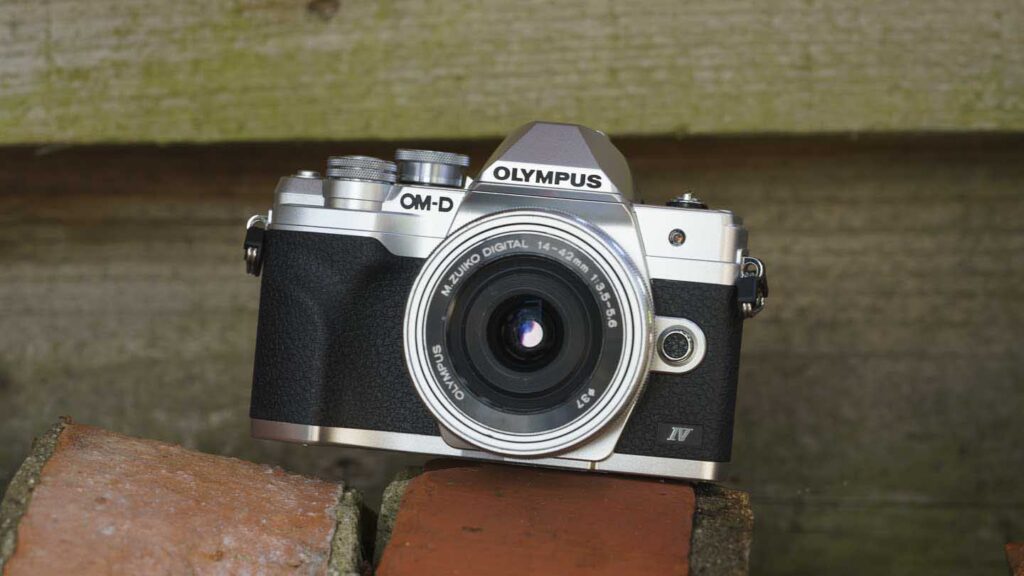
Olympus OM-D E-M10 Mark IV
Specification
- Camera type: Micro Four Thirds mirrorless
- Announced: 4th August 2020
- Sensor: Four Thirds Type 20.3Mp Live MOS
- Processing engines: TruePic VIII
- Sensitivity range: ISO 80-25,600
- Viewfinder: 2,360,000-dot electronic with 1.23x magnification and 19.2mm eye point
- Stabilisation: 5-axis with up to 4.5EV shutter speed compensation
- Screen: 3-inch 1,037,000-dot tilting touchscreen
- Focus modes: Manual focus, Single AF, Continuous AF, Single AF + MF, AF Tracking, Super Spot AF, Face Detection AF
- Exposure modes: Programme, Aperture priority, Shutter priority, Manual, Bulb, Time, i-Auto, Scene Modes, Art Filter, Movie, Live Time, Live Composite, Advanced Photo Modes (Live Composite, Live Bulb, Multiple Exposure, HDR Backlight, Silent, Panorama, Keystone Compensation, AE bracketing, AF bracketing)
- Autofocus system: Contrast detection with up to 121 points
- Autofocus point selection modes: All target, Group target (9-areas), Single target
- Exposure metering: 324 zones Multi-pattern Sensing System with ESP, Spot, Centre weighted, Highlight and Shadow mode
- Art filers: Pop Art, Soft Focus, Pale & Light Colour, Light Tone, Grainy Film, Pin Hole, Diorama, Cross Process, Gentle Sepia, Dramatic Tone, Key Line, Water colour, Vintage, Partial Colour, Bleach Bypass, Instant Film
- Shutter speed: 1/16,000-60sec, Bulb to 30mins
- Maximum continuous shooting rate: High: 15 fps Low: 6.3 fps, Max. number of frames: High 42 raw files or 49 (LF) JPGs, Low: 945 raw files or until the card is full with (LF) JPGs
- Video resolution: 4K (3840 x 2160) / 30p, 25p, 24p / IPB (approx. 102 Mbps) Full HD (1920 x 1080) / 30p, 25p, 24p (MOV) Full HD (1920 x 1080) / 60p, 50p / IPB (F,N) / (MOV) HD (1280 x 720) / 60p, 50p, 30p, 25p, 24p (MOV)
- Time lapse: 4k, 1080p, 720p
- Flash: Built-in GN 7.2 (ISO200), hotshoe for external flash
- Connectivity: Wi-Fi, Bluetooth
- Multiple exposure: 2 frames with or without autogain
- Storage: SDHC/SDXC UHS-II
- Dimensions (WxHxD): 121.7×84.4x49mm
- Weight: 383g including battery and SD card
Olympus has long made some of the best travel cameras and built the OM-D E-M10 series with travellers in mind. In the Mark IV there are new features that suit both experienced and novice photographers alike.
On the rear, the tilting screen makes it easier to shoot over crowds or down low for more creative compositions. Meanwhile, the high-resolution electronic viewfinder provides an alternative to this when the sun comes out and affects its visibility.
Built-in Wi-Fi connectivity also lets you show your friends back home what they’re missing. The electronic shutter allows you to use shutter speeds of up to 1/16,000sec – useful if using fast-aperture prime lenses in brighter conditions.
The camera’s size and light weight also make it an obvious choice for those travelling. You should be able to fit it into your carry on luggage without issue. But what really swings it for the Micro Four Thirds system is the choice of compact optics alongside.
Although the partnership of the OM-D E-M10 III with the 14-42mm f/3.5-5.6 and 40-150mm f/4-5.6 lenses provides a very useful 28-300mm focal range, you could realistically also pack a fast prime lens and a pancake option too without it weighing you down.
The OM-D E-M10 Mark IV is perfect for those after a handsome camera, who want to use a range of lenses without being weighed down.
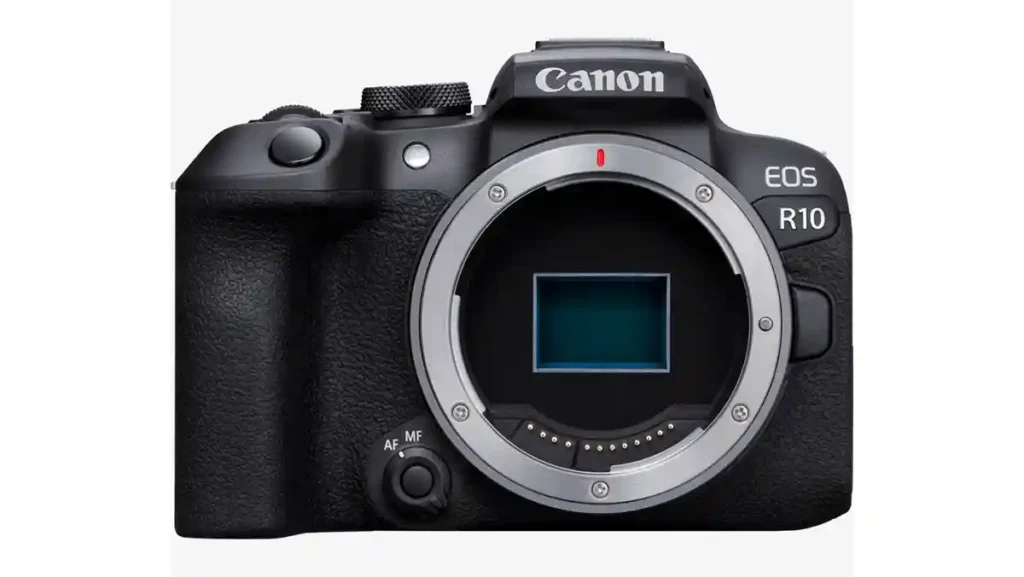
Canon EOS R10
Specifications
- Camera type: Mirrorless
- Announced: 24th May 2022
- Sensor: 24.2Mp APS-C format (22.3 x 14.9mm) CMOS
- Processor: Digic X
- Lens mount: Canon RF
- Sensitivity range: ISO 100-32,000 expandable to ISO 51,200
- AF system: Dual Pixel CMOS II AF phase detection with up to 4503 positions and 651 automatically selectable points
- Subject detection and tracking: Humans (Eyes/Face/Head/Body), Animals (Dogs, Cats and Birds) or Vehicles (Racing cars or Motor bikes)
- Viewfinder: 0.39-type 2,360,000-dots OLED EVF
- Screen: Touch-sensitive vari-angle 2.95-inch LCD with 1.04 million dots
- Video resolution: 4K (3840 x 2160) at up to 60p with 64% crop, 4K (3840 x 2160) at up to 30p from 6K, Full HD: (1920 x 1080) at up to 120p
- Max continuous shooting rate: Mechanical shutter: 15fps for up to 460 Jpegs or 29 raw files, Electronic shutter: 23fps for 70 Jpegs or 21 raw files
- Shutter speed range: Mechanical: 30-1/4000 sec, Bulb, Electronic: 30-1/16000 sec
- Built-in flash: GN 6m @ ISO 100
- Battery: Li-ion LP-E17, Viewfinder: Approx. 260 shots, Screen: Approx 430 shots
- Dimensions (W x H x D): 122.5 x 87.8 x 83.4mm
- Weight: 429g including battery and memory card
Oneo of the new mirrorless APS-C format camera added to Canon’s EOS R system in May 2022, the Canon EOS R10 is aimed at enthusiast photographers who want a camera for travel photography.
Although it sits below the EOS R7 in Canon’s mirrorless camera line-up, the Canon R10 has a lot of features in common with the flagship model. For example, although its sensor has a lower resolution with 24.2MP rather than 32.5MP, it features the same Dual Pixel CMOS AF II technology. This means that the Canon R10 uses phase detection focusing and every pixel is capable of being used by the focusing system. As a result, you can focus anywhere across the image.
It also shoots 4K video and boasts a bright, vari-angle touchscreen, which makes it perfect for filming your holidays. Yes there’s is a crop if you shoot 4K 60p video, but it can also shoot uncropped 4K video at 30p which is down-sampled from 6K, plus you still get phase detection focusing.
Panasonic Lumix G100
Specification
- Camera type: Mirrorless
- Announced: 24th June 2020
- Sensor: 20.3Mp Four Thirds type CMOS
- Lens mount: Micro Four Thirds
- Screen: 3-inch 1,840,000-dot vari-angle touchscreen
- Viewfinder: 3,480,000-dot electronic viewfinder
- Key video specifications: 4K (3840×2160) at 24,25,30p and 100Mbps, V-Log L and Ozo Audio by Nokia
- Weight: 310g body only, 352g with SD card and battery, 412g with the 12-32mm lens
- Dimensions (WxHxD): 115.6×82.5×54.2mm
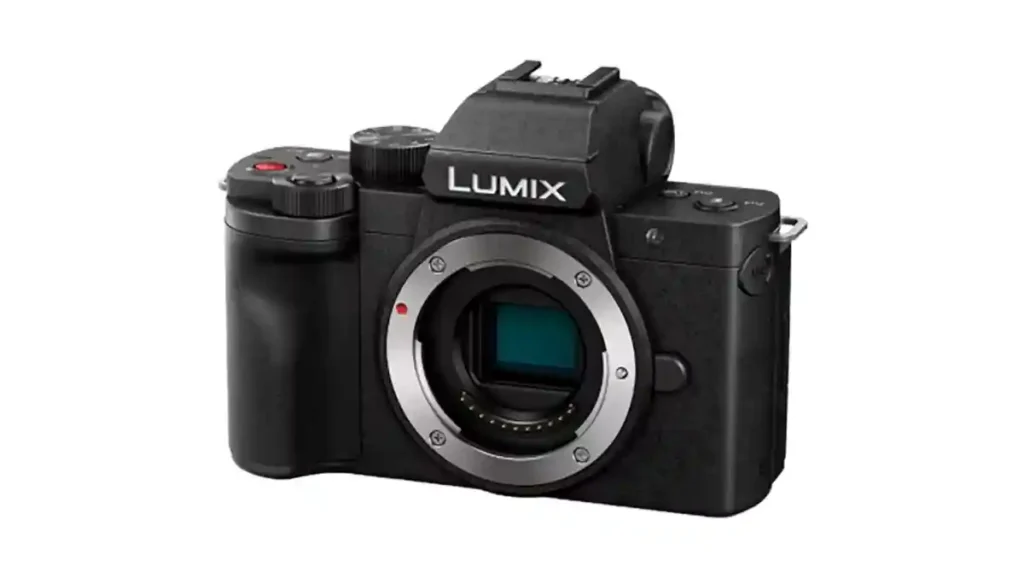
The Panasonic Lumix G100 is designed as an entry-level vlogging camera and it fits that bill very well, but its compact size and advanced feature set also makes it one of the best travel camera options.
The G100 has a bigger sensor than competing compact cameras like the Canon PowerShot G7 X Mark III, and it benefits from accepting interchangeable lenses, which makes it a bit more versatile.
While it was billed as a vlogging camera, Panasonic is keen to stress that the Lumix G100 can also be used for stills, offering a 20.3Mp Four Thirds type sensor plus a built-in viewfinder.
Further good news is that the Panasonic G100 has 5-axis hybrid image stabilisation. This combines an in-camera electronic stabilisation system with lens-based stabilisation when a stabilised lens is used.
Overall, it provides a good level of control with the ability to restrict depth of field without being too bulky.
Panasonic TZ200
Specifications
- Sensor: 20.1MP 1inch-type CMOS
- Lens: 26-390mm(equivalent) f/3.3-6.4
- Viewfinder: Electronic
- Screen: 3in, 1,240,000-million dot touchscreen
- Dimensions: 111.2 x 66.4 x 45.2mm
- Weight: Approx. 340g (with battery and card)
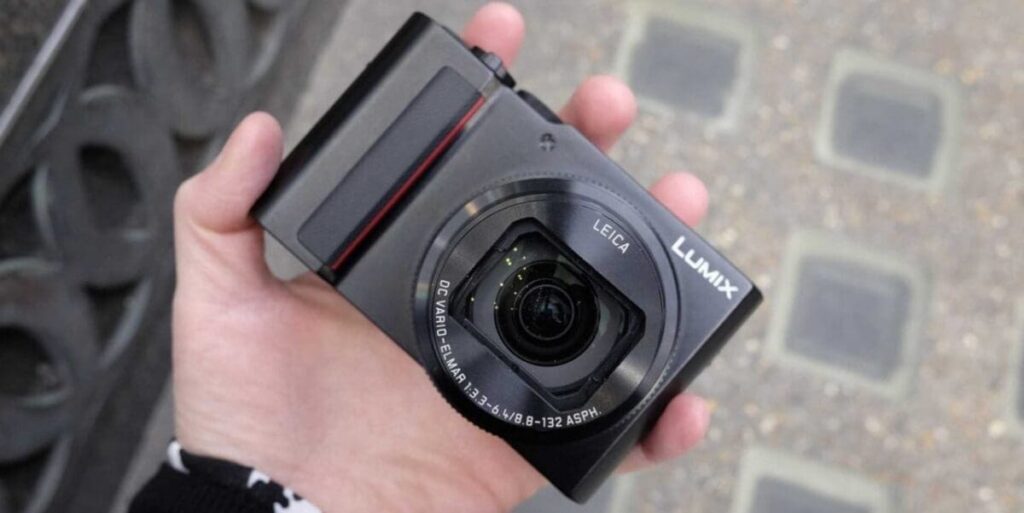
One of the limitations of superzoom compact cameras has been that, in order to offer such an extensive zoom range, their sensors have been small, which in turn affects image quality. The TZ200, however, really does give you the best of both worlds, blending a 1inch-type sensor with a 26-390mm(equivalent) zoom lens, all inside a pocketable body.
This combination makes it ideal for travelling photographers who don’t want a bulky camera, although its benefits don’t stop there. With 4K video, you can record all your adventures in excellent detail, while the high-resolution touchscreen on the rear allows you to quickly focus on the subjects of your choosing.
And, when the sun comes out, you can switch to using the integrated electronic viewfinder for a clearer view. It’s no surprise to find the TZ200 is pricier than many other compacts – but you’re getting what you pay for.
The TZ200 is ideal for those wanting a pocket-friendly camera with a long zoom and fine image quality.
Nikon Z50
Specifications
- Camera type: Mirrorless
- Sensor: 20.88Mp APS-C / DX (23.5×15.7mm) CMOS
- Processing engine: Expeed 6
- Lens mount: Nikon Z mount
- Sensitivity range: ISO 100-51,200; expands to 204,800
- Viewfinder: 0.39-inch 2,360,000-dot OLED electronic viewfinder
- Screen: Tilting 3.2–inch 1,040,000-dot touchscreen
- Autofocus: Hybrid (phase and contrast detection) AF with 209 AF points, Eye AF and Subject Tracking. Firmware V.20 adds Eye-detection AF for Animals as well as humans
- Continuous Shooting: 11fps with continuous AF and exposure metering
- Video: 4K at 30fps and Full-HD at 120fps
- Storage: SD/SDHC/SDXC UHS-I
- Connectivity: Snapbridge 2.6; Wi-Fi, Bluetooth
- Dimensions (W x H x D): 126.5 x 93.5 x 60 mm / 5 x 3.7 x 2.4-inches
- Weight: 450g / 15.9oz with battery and memory card but without body cap, 395g /14oz body only
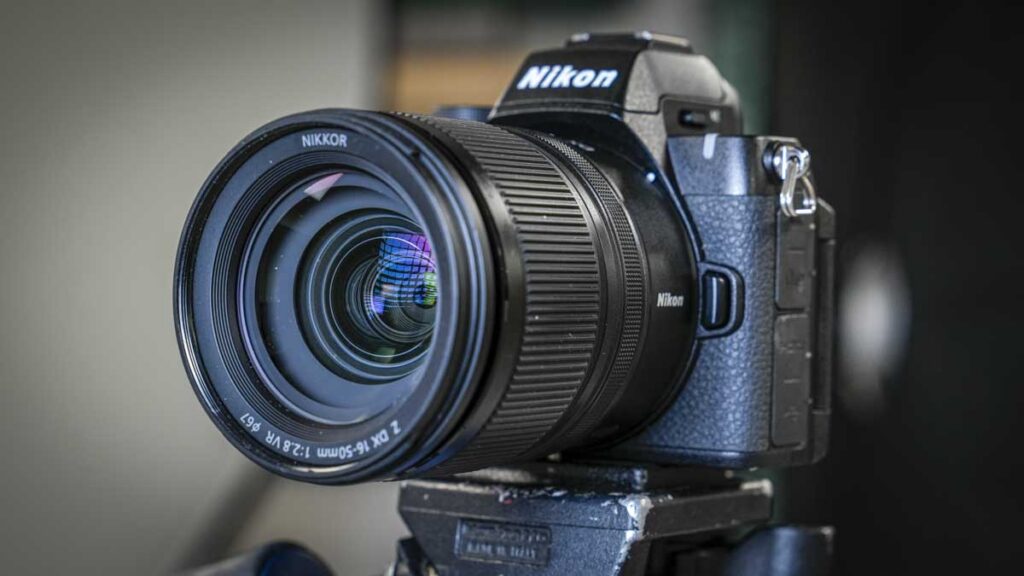
Not all travel photographers want a full-frame camera. The Nikon Z50 offers a compelling alternative for those who want an APS-C format mirrorless camera, and it has plenty to offer experienced photographers thanks to a solid build and a comprehensive feature set.
Inside the Nikon Z50 is a new 20.88Mp APS-C format sensor which is paired with the Expeed 6 processing engine. Together, these enable a native sensitivity range for stills of ISO 100-51,200 with expansion settings going all the way up to ISO 204,800. Meanwhile, the video range is ISO 100-25,600.
Thanks to the Expeed 6 processing engine, the Z50 can shoot at up to 11 frames per second with continuous autofocusing and exposure metering. This rate is achieved in Continuous High Plus mode while the maximum rate in Continuous High mode is 5fps.
Its autofocus system is excellent and is capable of capturing fast-moving subjects in pin-sharp focus, even in gloomy conditions. Further good news is that the Z50 has both Subject Tracking and Eye AF modes. Eye AF is a must-have feature at the moment and it’s incredibly useful for portraits and travel photography.
Subject Tracking works in Auto-area AF mode and it’s useful for subjects that move erratically. Pressing the OK button in Auto-area AF mode activates a tracking point which is visible on the screen and in the viewfinder.
When the Z50’s Face Detection system is activated, it spots faces very quickly. If it identifies more than one face, it puts a box around the face it’s going to prioritise with an arrow indicating the navigation key that’s required to jump to another face. It’s super-easy to use.
We love how the Z50 feels in the hand and it makes a tidy little unit with the 16-50mm pancake lens. Stash the 50-250mm f/4.5-6.3 lens in a bag, and you’ve got a really versatile kit.
Sony A7R IV
Specifications
- Camera type: Full-frame mirrorless
- Announced: 16th July 2019
- Sensor: 61MP BSI full-frame sensor
- Lens mount: Sony FE
- Autofocus system: Hybrid with 567 phase detection + 425 contrast detection AF points
- Continuous Shooting: 10fps burst shooting with full AF / AE Tracking
- Video: 4K video with S-Log2/3, HDR
- Sensitivity range: Still images: ISO 100-32000 (expandable to ISO 50 to ISO 102400) Movies: ISO 100-32000
- Viewfinder: 0.5 type 5,760,000-dot OLED
- Screen: Tilting 3-inch 1,440,000-dot touchscreen
- Storage: 2x SD/SDHC/SDXC UHS-II
- Battery: Rechargeable NP-FZ100 battery supplied, Life Stills: 530 shots (viewfinder) / 670 shots (LCD), Movies: 90mins (viewfinder) / 105mins (LCD)
- Dimensions (WxHxD): 128.9 x 96.4 x 77.5mm
- Weight: 665 g / 1lb 7.5oz with battery and SD card
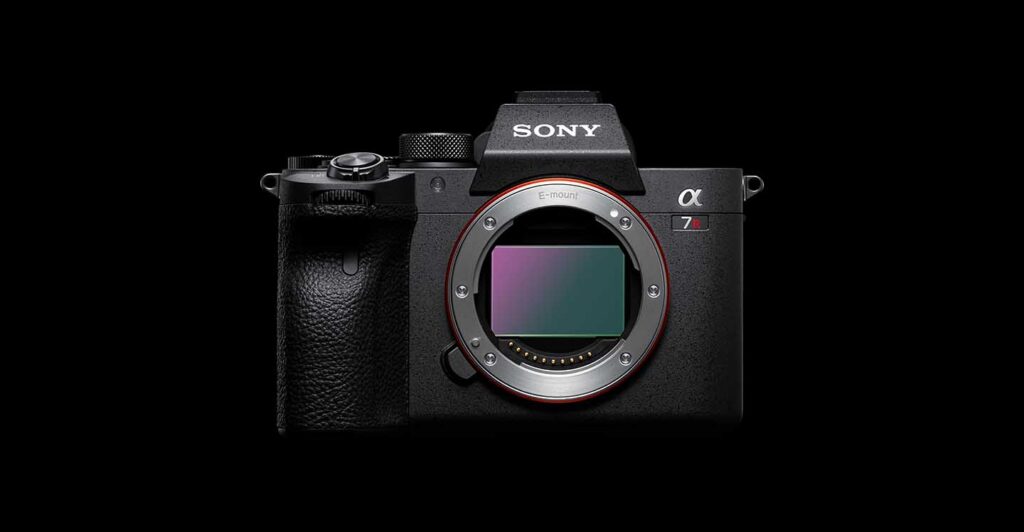
Thanks to its mirrorless design and Sony’s camera-shrinking prowess, the Sony Alpha 7R IV, like other Sony A7-series cameras, is much smaller than the average full-frame DSLR. And while a large sensor often still calls for large lenses, some like Sony’s 35mm f/2.8 that are perfectly suited to travel.
Of course, you may wish to mount one of Sony’s zoom lenses, but the 35mm optic is a great choice for street, landscape and documentary style photography.
And while the A7R IV might be a high-resolution camera, it has a fast and accurate autofocus system which means you’ll be able to capture the action of your travels. This is paired with 4K video recording, complete with the S-Log profile to capture a wide range of tones.
A key advantage of the full-frame sensor becomes apparent when shooting travel portraits as it enables the background to be attractively blurred. Meanwhile, Sony’s Eye AF system makes sure that the most critical part of your subject is sharp.
Naturally, there’s Wi-Fi connectivity built-in should you wish to share images via your mobile phone.
The Sony A7R IV, though pricey, is one of the best travel cameras for experienced photographers looking for a high-end full-frame body that can be kept small.
Sony RX100 VII
Specifications
- Camera type: Compact
- Sensor: 20.1Mp 1-inch type (13.2mm x 8.8mm) Exmor RS CMOS
- Lens: ZEISS Vario-Sonnar T* 9-72mmm (24-200mm equivalent) f/2.8-4.5
- Autofocus: 357 focal-plane phase-detection and 425 contrast-detection AF points
- Burst Mode: 90fps in JPEG or Raw format in Single Burst Shooting mode
- Video: 4K in-body movie recording with full pixel readout
- Viewfinder: 0.39-inch 2,359,296-dot OLED (pop-up)
- Screen: Tilting 3-inch 921,600-dot TFT touchscreen (up 180-degrees, down 90-degrees)
- Storage: SD/SDHC/SDXC
- Dimensions (WxHxD): 101.6 x 58.1 x 42.8 mm / 4 x 2 3/8 x 1 11/16-inch
- Weight: 302g / 10.7oz with battery and SD card or 275g / 9.8oz body only
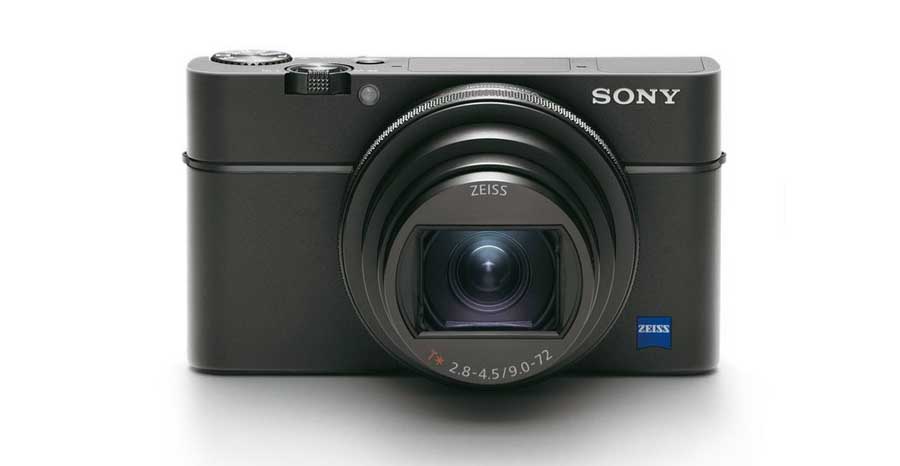
There are some great little cameras in the Sony RX100-series, and the RX100 VII is arguably the best of all of them.
The Sony RX100 VII is the seventh camera in Sony’s RX100 series of compact cameras with a 1-inch type sensor. In many respects it’s very similar to the Sony RX100 VI, having the same effective focal length (24-200mm), a pop-up electronic viewfinder and a touch-enabled tilting screen, but it also has a new 20.1Mp sensor and an updated Bionz X processing engine.
Sony has also given the RX100 VII a 3.5mm mic port, a more advanced autofocus (AF) system, additional video features and a top continuous shooting speed of 90fps.
At 101.6 x 58.1 x 42.8 mm (4 x 2 3/8 x 1 11/16 inches) the RX100 VII is the same size as the VI, and it’s perfect for slipping in a jacket pocket or small bag. It also has a largely metal construction, which should mean its pretty hard-wearing.
Perhaps the most exciting upgrade the RX100 VII makes, however, is with the autofocus system. The RX100 VI is no slouch in this area, but the RX100 VII has 357 phase detection points and 425 contrast detection points, plus Real-time Tracking AF and Real-time Eye AF for humans and animals. In addition, the Real-time Eye AF for Humans works in video mode.
The Sony RX100 VII’s autofocus system really makes it an attractive camera for a wide range of people and shooting applications, particularly anyone looking to record the fun and games of a holiday.
Insta360 GO 2
Specifications
- Shooting Modes: Video, Pro Video, Photo, HDR Video, Timeshift, Timelapse, Nightlapse, Slow Motion
- Video: 2560×1440 at 50fps, 30fps / 1920×1080 at 50fps, 30fps
- Recording Limit: Pro Video: 10min / Video: 15min / FPV: 30min
- Waterproof: IPX8 (down to 4m / 13ft)
- Internal Storage: 32GB
- Connectivity: BlueTooth / Wi-Fi
- Weight: 26.5g / 0.93oz (charge Case 63.5g / 2.24oz)
- Dimensions: 52.9 x 23.6 x 20.7mm / 2.08 x 0.93 x 0.81in
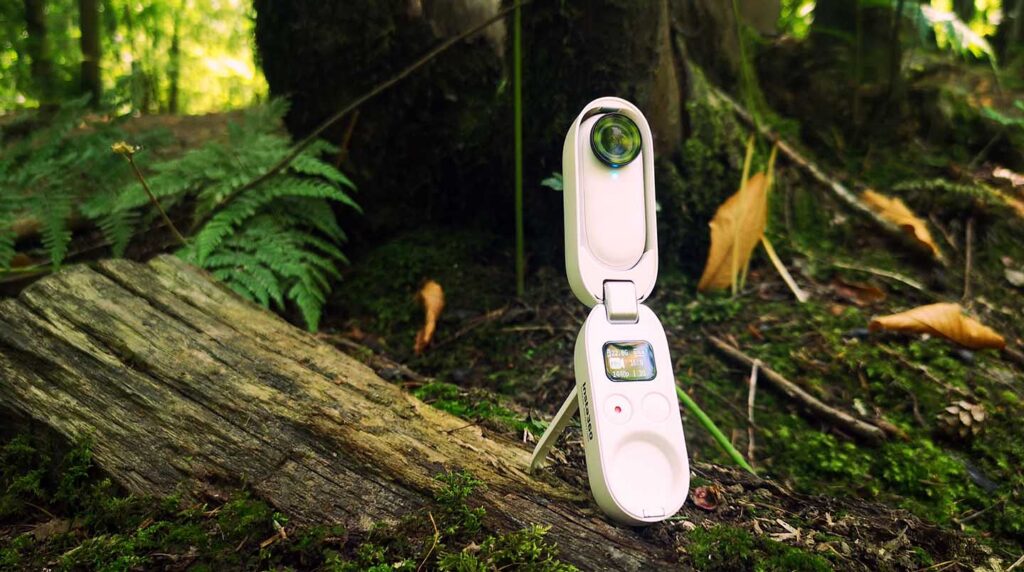
Does it offer the same image quality as the other options on this list of the best travel cameras? No. But what the Insta360 GO 2 brings to the table is the smallest, lightest camera body you can buy. It’s the first camera classed as a pocket camera that truly fits the bill. And it’s image quality is also very good!
The camera comes with a range of mounts that let you wear it, clip it and more. Inside, the camera also boasts Insta360’s superb FlowState 2.0 stabilisation technology which completely smooths out your movements. Shooting modes include Video, Pro Video, Photo, HDR Video, Timeshift, Timelapse, Nightlapse and Slow Motion.