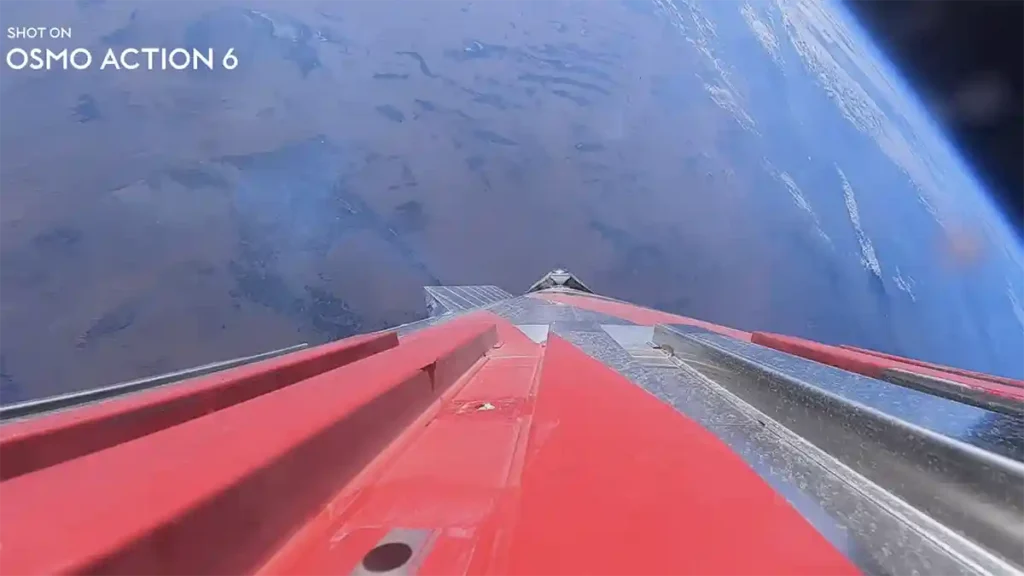

Action cameras get strapped to some improbable things, but this is a first. On 19 August, twelve DJI Osmo Action 6 cameras were mounted on LandSpace’s Zhuque-3 reusable rocket for China’s first successful land-based orbital launch and recovery — and they came back working. You can watch the unedited single-shot footage of the entire journey on DJI’s YouTube channel.
The detail that matters: no modifications
The remarkable part is not that cameras flew on a rocket. It is that these were stock consumer cameras, mounted without any special modification to the cameras themselves.
Consider what that means in practice. On the way up, the cameras endured the vibration and acoustic loading of a launch — which is violent enough to shake instruments apart — followed by the pressure and temperature swings of climbing out of the atmosphere. On the way back down, atmospheric re-entry generated temperatures reported at around 500°C before the booster settled into a precision vertical landing.
Aerospace payloads are normally built for exactly those conditions at enormous expense, in ruggedised housings, with redundant systems. LandSpace bolted on something you can buy in a camera shop.
Why this is more than a stunt
There is obvious marketing value here for DJI, and we should say so plainly. But there is a genuine engineering point underneath it.
Rocket launches have historically been documented by long lenses from the ground and a handful of purpose-built onboard cameras. Mounting twelve consumer units at different critical positions gave LandSpace multiple simultaneous first-person perspectives at a fraction of the cost and complexity — and produced footage the public can actually watch, rather than telemetry only engineers can read.
That is the same logic that has quietly transformed documentary and sports filming over the past decade: when a capable camera becomes cheap and small enough, you stop rationing angles and start covering everything.
For the rest of us, it is also a reasonable proxy for durability claims. Manufacturers routinely quote drop tests and freeze ratings; surviving a launch and a 500°C re-entry is a rather more emphatic demonstration. Whether your Action 6 will survive being dropped on a rock is still the more relevant question — but it is hard to argue the thermal tolerance is marginal.
The unedited one-shot is worth watching in full: liftoff, the climb through the atmosphere, and the descent to a vertical landing, in a single continuous take.
What happened: the details
Date: 19 August 2026. Vehicle: LandSpace Zhuque-3 reusable rocket. Milestone: China’s first successful land-based orbital launch and recovery. Cameras: twelve DJI Osmo Action 6 units, mounted at different critical positions on the rocket, with no special modifications to the cameras. Conditions survived: launch vibration and acoustic loading, ascent through the atmosphere, and a reported 500°C return to Earth, followed by a precision vertical landing. Footage: an unedited single-shot recording of the full journey, published on DJI’s YouTube channel.