
From today, 27 August 2026, plug-in solar panels are legal to buy and use across Great Britain. Plug one into an ordinary socket and it feeds power into your building — no electrician, no installation cost. The government reckons a household could save up to £110 a year. For anyone running a studio, the sums are more interesting than that, because a studio’s electricity demand peaks in daylight.
Here is what the law says, what the kit can actually do, and the one thing you must check before buying.
What has changed
The change comes through SI 2026 No. 848, in force today, alongside SI 2026/896 covering permitted development in England. Together they create a new route: a certified plug-in solar device may be connected to a domestic socket circuit by the householder.
It builds on BS 7671 Amendment 4, in force since April, which finally gave the wiring regulations a category for microgeneration up to 800W — previously such systems were neither explicitly permitted nor prohibited, which in practice meant insurers refused claims and the safe answer was “don’t”. Engineering Recommendation G98 Issue 2 Amendment 1, approved by Ofgem, sets the network rules including the one-device-per-household limit.
Notably, the government says the UK safety specification is more stringent than Germany’s, where around half a million devices were plugged in last year.
Energy Secretary Miatta Fahnbulleh described plug-in solar as a simple, affordable way for households to take control of their bills and start saving straight away, framing it as giving more families the ability to power their homes with clean homegrown energy.
What 800W actually does
The government’s own illustration is useful: in full sun, an 800W kit will run a typical fridge, a television, a Wi-Fi router, a laptop, a phone charger and an Xbox S simultaneously. That is up to 20% of an average home’s electricity use, and it comes without drawing anything from the grid.
The rules, plainly:
800W AC maximum at the inverter (800VA / 3.5A). Up to 2,000W of panels across a maximum of four — the inverter clips output above 800W, so you over-produce at midday in June and hold useful output in poor light, which suits British weather. Above 960W of panels, manufacturers must advise considering a professional assessment.
One device per household. Not one per socket. Direct into a socket only — extension leads and adaptors are prohibited. The whole kit must be certified as one product: panels, inverter, cables, plug and mounting as a complete package. A UKCA mark on the inverter alone is not enough, and assembling compatible parts yourself does not create a compliant kit.
Batteries are excluded. Any system that stores power still needs a hardwired installation by a CPS-registered electrician. Northern Ireland is not covered — it has separate network and product requirements.
The one thing to check before you buy
The law removing the prohibition and a compliant product existing are two different things.
A kit is only lawful once the complete product appears as Compliant on the ENA Type Test Register, which is now live for manufacturers to submit devices. You can check it yourself at ENA Connect Direct — go to Live Device Register, then Filters on the right-hand side, then Type, then Plug-in Solar. It is public and needs no login.
The picture has moved quickly. Independent checks found no compliant entries on 6 August, none on 17 August, and the first appearing in the final week before the law took effect. At the most recent check, the register listed twenty-three plug-in solar entries, of which seven — all from a single manufacturer, UKSOL Ltd — carried Compliant status. The remainder, including entries from EcoFlow, Octopus Energy, FoxESS, Perlight, InstaGroup, TSUNESS, Segen, Modular and Anker, were non-compliant. The ENA notes those can be re-assessed once supporting test information is updated, so expect this to change week by week.
One important nuance, and the ENA is explicit about it: the association does not “approve” products in general terms — it assesses them for compliance with network requirements. As David Boyer, its Director of Electricity Systems, puts it, this is a major step forward for incorporating microgeneration safely onto the grid, with operators continuing to work with government, Ofgem and manufacturers as the registration process evolves.
The ENA also makes a point worth repeating: network operators are responsible for the safety of your connection to the grid, but cannot assess domestic wiring beyond that point. If you are installing anything in a commercial studio, that is a good argument for having an electrician look at the circuit you are plugging into, even though the law does not require one.
The safety warning nobody else is leading with
On the same day the law changed, the Institution of Engineering and Technology issued a warning: not every home’s electrical installation is suitable for plug-in solar, and you cannot reliably tell by looking.
The issue goes beyond the older fuse boxes mentioned in the government’s own guidance. It concerns the type of RCD — the residual current device that disconnects power fast enough to save a life. Not all RCDs work the same way, and some older types are not suitable for use with plug-in solar. Simply having an RCD does not mean your installation is ready.
The reason is worth understanding, because it explains why this is not scaremongering. Domestic wiring has always been designed around electricity flowing one way — from the installation out to appliances. Plug-in solar introduces a second source of power into those circuits, so the flow becomes bidirectional. The existing installation and its safety devices have to be suitable for that arrangement, and many were never designed with it in mind.
IET research conducted in the days before launch suggests most people are in no position to judge. Only a quarter know what type of RCD is in their home; more than a third do not know what an RCD is at all; and just 11% know both what they have and how to test it. Yet 39% say they would feel confident assessing their home’s suitability themselves.
The misuse findings are more troubling. More than a third say they only sometimes, rarely or never read safety instructions with a new electrical product. And almost one in four say that if the cable would not reach a socket, they would use an extension lead or multiway adaptor — the one thing the regulations explicitly prohibit.
Mark Coles, Head of Technical Regulations at the IET, warns that consumers should not assume a system is suitable for every home simply because it plugs into a socket, adding that whether the installation has the right protection in place is not something most householders can reasonably be expected to assess themselves. The IET’s advice is unambiguous: speak to a competent electrician and have your installation checked before buying or connecting.
Our view is that this is sensible rather than alarmist,
Frequently asked questions
Is it legal now? In Great Britain, yes, from 27 August 2026 — provided the kit is a complete certified product listed as Compliant on the ENA register. Northern Ireland is separate.
Do I need an electrician? Not for the socket route with a certified kit. The hardwired route — still available, and the only option for battery systems — does require a CPS-registered electrician.
Do I need planning permission? Usually not. Microgeneration up to 800W on a wall or balcony is generally permitted development under SI 2026/896. Listed buildings and conservation areas have additional restrictions — check with your local planning authority.
What if I rent, or my studio is leasehold? You need written consent from the landlord, building owner or freeholder for the mounting. The government explicitly flags this and encourages decision-makers to consider each case on its merits, but the consent is theirs to give.
Do I get paid for exported power? No. There are no Smart Export Guarantee payments on this route. Every penny of saving comes from self-consumption — power you use as it is generated. Anything exported is given away.
Can I add a battery? Not under this framework. Batteries and battery-integrated products are expressly excluded.
Can I install two kits? No. One plug-in solar device per household.
Do I need to tell my network operator? Yes — notification under G98 to your Distribution Network Operator. It is free and takes minutes. Check your DNO’s stated process for timing.
What about insurance? Tell your insurer. A fixed installation changes both the fixture load and the liability position, and undeclared alterations are a common reason claims fail.
Can I take it with me? Yes — a genuine advantage over rooftop solar. These are not permanent installations.
Why this matters if you run a studio
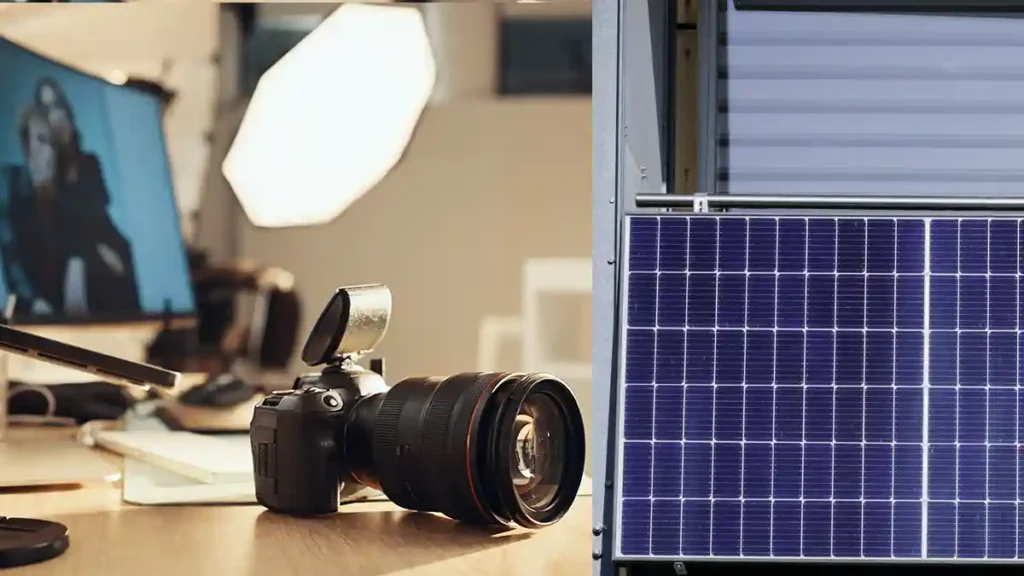
Here is the part that interests us. A photography or video studio draws its heaviest load in daylight: continuous LED lighting, editing workstations, monitors, chargers, and in summer, cooling. That profile matches solar generation better than almost any domestic use case, where most consumption happens after dark.
Because there is no export payment, the entire economic case rests on self-consumption — and a studio consumes what it generates, when it generates it. The government’s £110 figure is a domestic estimate; a studio running through daylight hours should capture a higher proportion of what it produces.
Be realistic, though. 800W is roughly a fifth of a typical rooftop array. It will not power a strobe pack. What it will do is offset the baseline draw that runs whether you are shooting or not — and if your building can take proper rooftop solar, that remains the better investment, saving up to £480 a year. Plug-in comes into its own precisely where rooftop cannot go: rented units, leasehold studios, buildings you do not own, and spaces you may leave in three years.
Where to buy, and what happens next
Currys, B&Q, Screwfix and Amazon worked with government on the rollout, and Amazon, Argos, Currys and Wickes have all committed to stocking. Argos says it is offering panels now; Currys is working to make them available through its website and larger stores as soon as possible; Wickes expects to be selling online in the coming weeks.
The wider context is a solar market already running hot. MCS figures show almost 150,000 certified solar installations in the first six months of 2026 — up 17% on the previous record start to a year, and equivalent to one every 74 seconds. Battery installations have nearly doubled, at 36,000.
More products will clear certification in the coming weeks, and we will update this guide as they do. In the meantime, the single most useful thing you can do before parting with money is check the ENA register yourself.