
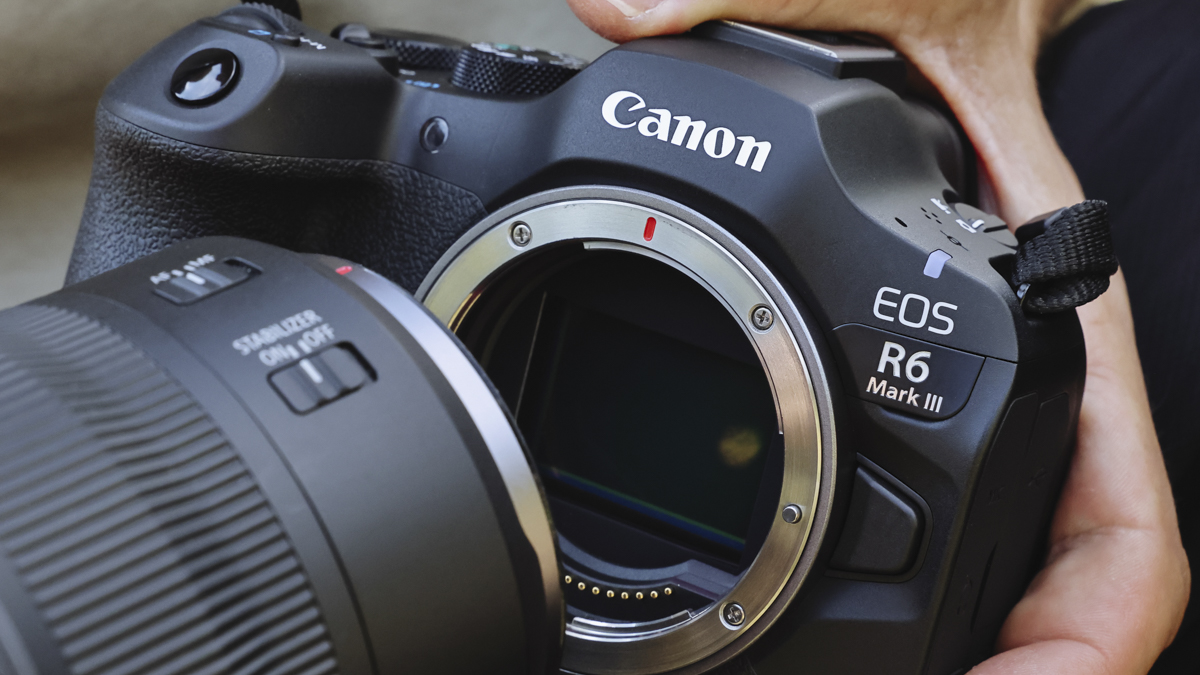


Canon’s latest camera is the EOS R6 III, the follow up to their highly-acclaimed Mark II model released back in 2022. Equipped with a new 32MP full-frame CMOS sensor and 40fps burst rate, it is aimed at photographers and videographers who need high burst rates and fast readout speeds. This is a significant step up from the Mark II’s 24-megapixel sensor, which was capable of producing some great images for it’s time.
But the new Mark III has gained some brilliant quality-of-life updates which have turned a seemingly simple camera into a dual hybrid powerhouse. And while Canon cameras have proved themselves worthy of handling both photo and video for many years, the latest entry in their catalogue is a genuine hybrid champion.
With the R6 Mark III, there’s no longer any real need to own a separate dedicated video and photo camera. As mentioned, the 33% increase in megapixels does a lot for those wanting to maintain professional workflow efficiency without any of the trade-offs. Simply put, the Mark III is a powerful and versatile all-in-one solution. Of course, that’s not to say that a dedicated video or photo camera won’t offer advantages for highly specialized needs in certain situations.
For example, a professional photographer may well end up working with clients with certain requirements. Say, a wedding portrait that is planned to be framed beyond its original size would demand a higher megapixel count. In that scenario, a high-end model specifically designed for stills may be needed, with Canons like the EOS 5DS and 45-megapixel EOS R5 springing to mind. For a scenario like this, these cameras would undoubtedly take the edge.
However, the R6’s new 32-megapixel sensor does strike an excellent balance between great detail for professionals and manageable file sizes, which is particularly important for those who may not have the most powerful desktop hardware. And for most clients, it will more than satisfy those wanting high-quality prints at perhaps a more competitive price.
Rest assured that there are more than enough pixels at play here to produce large, high-fidelity prints with no visible noise. Additionally, there’s also the added benefit of cropping flexibility. With greater detail, the images can now be cropped significantly without losing any quality.
This is crucial for professionals like wedding photographers who may have clients that can be picky about their favourite shot, and may want an enhanced, tighter crop around the image. It will also come in handy when needing to print large photos without any blemishes.
In terms of video, high-end cinema cameras such as the Canon C-series will still take the pick for having features not found in the R6 lineup, such as built-in neutral density filters, professional audio inputs (XLR), genlock for multi-camera setups, and different form factors better suited for cinema rigs.
As for the build quality of the Mark III, the R6, much like its predecessors, is still weather-sealed, though for the most part this is as far as the basic durability goes. In that sense, top-tier professional DSLRs, such as the EOS-1D X series or a dedicated cinema camera is more likely to be more robust in severe weather conditions or intensive daily use.
Additionally, the Mark III benefits from a completely new dual card slot which can accommodate both standard SD cards and CFexpress Type B. Of course, support for the latter offers a major leap in efficiency, as CFexpress Type B is one of the fastest memory card formats available today.
This is thanks to the PCI Express (PCIe) interface which provides much faster reading and writing speeds, again making it ideal for those looking for a hybrid camera with longevity. As for the battery side, this is where creators wanting to benefit from an improved battery may be left slightly disappointed. Of course, how long the battery lasts will vary significantly based on how you plan to use it and what settings you are using.
Generally, though, it is fair to say that the Canon EOS R6 Mark III’s battery life is slightly worse than its predecessor, the Mark II. While the Mark III does use the latest LP-E6P battery (which has high-amperage for advanced features), the camera’s increased processing demands for new features like 7K RAW recording and a higher resolution sensor result in a shorter battery life per charge compared to the Mark II.
And according to some sources, the R6 Mark III generally captures around 12% less shots per charge than the R6 Mark II because of these features, all of which require more power draw. And while the LP-E6P battery does allow for a stronger continuous current and better communication with the camera body, this does not translate to longer life – it simply enables the Mark III’s more powerful components to function better.
Going back to the video side, the upgrades in this area will still satisfy those who need to shoot both professional, high-end video projects as well as more casual ones. While the R6 Mark III can still shoot at 12 frames per second with the mechanical shutter and 40 frames per second with the electronic shutter, the R6 III now has an increased buffer which will support higher RAW specifications.
This upgrade is particularly important for sport photographers as well as those needing to capture fast movement and action such as wildlife photographers. The Mark III also offers 7K Open Gate recording, 4K at 120 frames per second, and 10-bit C-Log 3 internal recording. Suffice to say, the opportunity to capture video files in such a large format is yet another argument for the Mark III.
But perhaps the most impressive feature in the video department is its ability to output 6K RAW video via HDMI to an external device, which puts the Mark III in the same league as other entry-level cinema cameras like the Blackmagic Pocket Cinema for example.
In conclusion, Canon have not only designed another great camera, but they have effectively eliminated the need for photographers and videographers to own dedicated cameras for stills and video. There is no doubt that the R6 can finally live up to its reputation as a hybrid powerhouse, and that it could well end up replacing a two-camera kit. However, for highly specialized productions with higher technical requirements, dedicated gear may still provide some of the aforementioned advantages.
Leave a Reply
You must be logged in to post a comment.