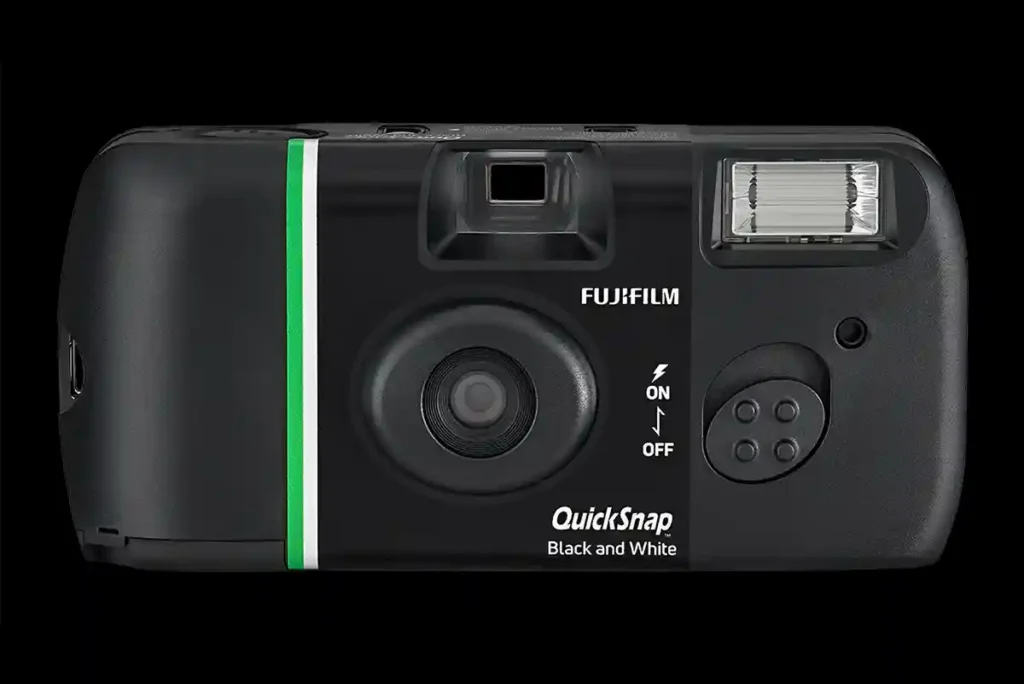

Forty years after the QuickSnap arrived and quietly made film photography something anyone could do, Fujifilm is marking the anniversary by doing something it has never done before: putting black and white film in a single-use camera. The QuickSnap Black and White is a first for the line, and it arrives alongside the QuickSnap Active, a tougher waterproof model replacing the existing version. Full details are in Fujifilm’s official announcement.
The timing is no accident. Disposable cameras have found an unlikely second life among younger photographers, and Fujifilm’s framing leans into exactly why. Bing Liem, division president of Fujifilm North America’s Imaging Division, argues that one-time use cameras offer something distinct — intentionality — describing a dedicated device used solely for image-making as a departure from the constant alerts of everything else we carry. It’s marketing, but it isn’t wrong: the appeal of a 27-shot camera with no screen is precisely that it asks one thing of you.
For the black and white model, that translates to ISO 400 monochrome negative film in a familiar plastic shell — a fixed-focus 32mm lens at f/10, a 1/140 sec shutter, and a switchable built-in flash good for around 10 feet. Fujifilm says it’s tuned for rich contrast, tone and textured grain, and crucially it develops in standard C-41 chemistry, so any lab that handles colour negative can process it. That last detail matters more than it sounds: traditional black and white film needs dedicated processing, which is exactly the friction that puts casual shooters off.
One intriguing gap: Fujifilm hasn’t said whose film is inside. The company’s only black and white emulsion currently in production is Neopan 100 Acros II, which is ISO 100, so this isn’t that. Whether it’s a proprietary stock made for the camera or sourced from a third party is unclear, and we’d be curious to know — it’s the sort of thing that will matter to anyone judging the results.
The QuickSnap Active, meanwhile, replaces the current waterproof QuickSnap with a more rugged protective housing and wrist strap, rated to around 10 metres and loaded with ISO 800 colour negative film. There’s no flash on this one, which is a fair trade for the sealing. Both cameras carry 27 exposures on 35mm film, and neither includes processing.
For a format many wrote off entirely, a monochrome disposable feels like a genuinely good idea — a low-stakes, low-cost way to try black and white without committing to a camera, a lab relationship or a learning curve. We’d happily run a roll through one.
Fujifilm QuickSnap Black and White: Specifications
Film: ISO 400 135 black and white negative, 27 exposures, 35mm.
Lens: 32mm fixed focus, f/10.
Shutter: 1/140 sec.
Flash: built-in, range approximately 10 feet (3m), with on/off switch.
Processing: C-41 chemistry (not included).
Note: Fujifilm has not specified the film emulsion used.
Fujifilm QuickSnap Active: Specifications
Film: ISO 800 135 colour negative, 27 exposures, 35mm. Waterproofing: integrated protective housing, rated to approximately 10 metres (35 feet); wrist strap included. Flash: none. Processing: C-41 chemistry (not included). Replaces the existing waterproof QuickSnap.
Price and availability
Both cameras are expected in autumn 2026. The QuickSnap Black and White carries a manufacturer’s suggested price of $22.90 (CA$34.99) and the QuickSnap Active $24.75 (CA$36.99). UK pricing and on-sale dates have not yet been confirmed — we’ll update this story when they are. A QuickSnap Hand Strap accessory is also being released separately.