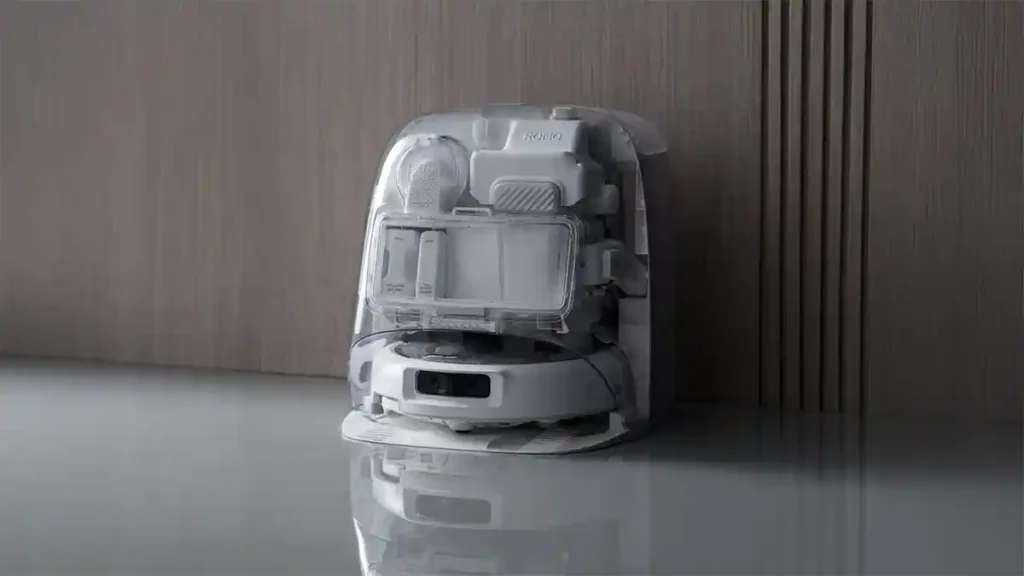

Dust is the quiet enemy of every studio. It settles on backdrops, finds its way onto sensors, shows up on a white cyc under a hard key, and turns a clean product shot into twenty minutes of spot removal. DJI has announced the ROMO 2 at IFA, and while a robot vacuum is not obvious Camera Jabber territory, keeping a studio floor clean is a genuinely unglamorous part of the job. Details are on the DJI website.
What DJI brings to a vacuum cleaner
The reason DJI’s move into robot vacuums is more interesting than it sounds is that the underlying problem is one it has already solved elsewhere. A drone that avoids obstacles autonomously and a vacuum that avoids furniture are doing the same job with the same sensors, and DJI has been refining that for a decade.
The ROMO 2 claims millimetre-level obstacle sensing capable of detecting objects as thin as 2mm, including glass and mirrors — which is precisely where cheaper robot vacuums fail, since transparent and reflective surfaces confuse most sensing systems. In a studio full of light stands, cable runs, C-stand legs, backdrop supports and modifier feet, that matters rather more than it does in a sitting room.
There is also a LiDAR-guided robotic arm with a 123-degree swing carrying a mopping pad, reaching 7.8cm wider than the machine’s own path and getting under furniture as low as 4.5cm. Edges and corners are where dust actually accumulates, and where every previous generation of robot vacuum has quietly given up.
The specifications
Suction rises to 36,000 Pa, up from 25,000 Pa on the first ROMO, and DJI has added a pressure plate that lowers during vacuuming to create a semi-seal against the floor — sensible engineering, since suction power is wasted if air simply leaks around the edges. Dual tangle-free side brushes overlap to cover the full floor area.
It climbs single steps up to 4cm and double steps up to 8.5cm, which covers most thresholds. AI handles spill detection and cleaning strategy, building dirt heatmaps rather than running fixed patterns.
The base station self-cleans using four high-pressure water jets against a stain-resistant nanocrystalline surface, with a 16mm waste suction port, and DJI claims up to 365 days of maintenance-free operation. Charging is 55W, filling the battery in two and a half hours. Noise energy is reduced by up to 85%, down to 38dBA while mopping — quiet enough to run during an edit, if not during a take.
The privacy angle is worth noting
DJI has given unusual prominence to data handling here, and given the company’s regulatory position in the United States that is no accident. The ROMO 2 offers an optional Local Data Mode, the camera and microphone can be disabled entirely through the app, and shared personal data can be deleted at any time.
For a device with a camera that maps your premises, that is a reasonable set of controls to offer — and if the premises in question is a working studio with client property in it, more relevant than it might first appear.
Our take
Nobody buys a robot vacuum for photographic reasons, and we are not going to pretend otherwise. But a studio that stays clean between shoots is a studio where you spend less time retouching dust and less time wiping a backdrop, and the obstacle sensing here is the first version of this technology that sounds genuinely capable of navigating a room full of stands without knocking one over.
The price is the sticking point. This is firmly a premium product, and at that money you are paying for engineering rather than convenience.
DJI ROMO 2: Specifications
Models: ROMO A2 (white base station) and ROMO P2 (translucent base station).
Suction: up to 36,000 Pa, with a lowering pressure plate creating a semi-seal against the floor.
Obstacle avoidance: millimetre-level sensing, detecting objects as thin as 2mm including glass and mirrors.
Robotic arm: LiDAR-guided, 123° swing, reaching 7.8cm wider than the cleaning path and mopping 4.5cm further under furniture.
Brushes: dual tangle-free side brushes with overlapping coverage.
Climbing: single-step obstacles up to 4cm, double-step up to 8.5cm.
AI: spill detection, cleaning strategy planning and dirt heatmaps.
Base station: self-washing with four high-pressure jets, stain-resistant nanocrystalline surface, 16mm waste suction port, up to 365 days maintenance-free.
Charging: 55W, full charge in approximately 2.5 hours.
Noise: up to 85% noise energy reduction, as low as 38dBA while mopping.
Privacy: optional Local Data Mode; camera and microphone can be disabled via the app; shared data deletable at any time.
DJI ROMO 2: Price and availability
The ROMO A2 starts at €1,199 and the ROMO P2 at €1,299, available through the DJI Store and authorised retail partners. DJI has confirmed that UK pricing will be announced in due course — we will update this story once it is available.