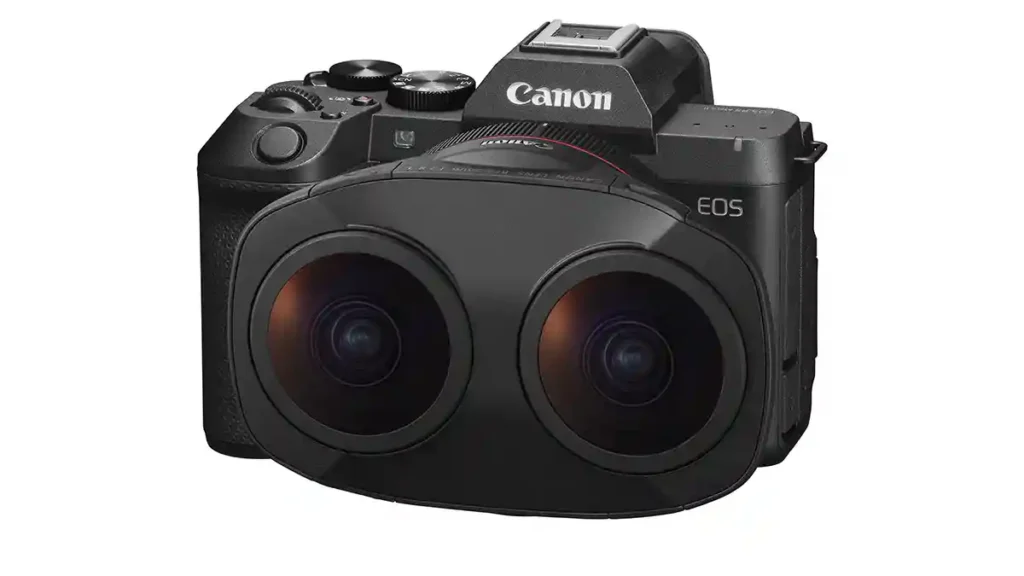

Alongside the EOS R8 Mark II, Canon has announced something quieter but arguably more interesting: Dual Pixel 3D, a technology that turns a single ordinary photograph into a three-dimensional image or an editable 3D model — no special rig, no dual lenses, no multiple exposures. Details are on Canon’s site.
What it does
Dual Pixel 3D uses a free Windows desktop application, the Dual Pixel 3D Converter, to turn images into 3D content. It works on Dual Pixel RAW files from selected EOS cameras, and on JPEGs containing depth information captured by the new EOS R8 Mark II. From a single frame it can produce a 3D image with depth, or a 3D model in OBJ or GLB format that opens in standard 3D software.
Within the app you can dial the depth effect up or down, and isolate the main subject to remove or replace the background before exporting. That is a genuinely useful set of controls, and the OBJ/GLB output is the significant part — those are standard interchange formats, so a model created this way drops straight into a 3D or game engine workflow.
How it works, and why the single frame matters
The clever bit is that it exploits hardware Canon already has. Every pixel on a Dual Pixel CMOS sensor contains two photodiodes, normally read together for the image or separately for phase-detection autofocus. Those two photodiodes see the scene from very slightly different viewpoints — and that tiny parallax is exactly the information a stereo system uses to judge depth.
Canon’s algorithms convert that phase-difference data into 3D shape information, then wrap the camera’s full-quality image over it as a surface texture. Because it all comes from one exposure, there is no need to shoot multiple frames or move the camera — which means it can work on a moving subject, and slots into an existing workflow without changing how you shoot.
Why it matters
3D and photogrammetry normally mean either specialist stereo kit or shooting dozens of overlapping frames and stitching them in software. Getting a usable 3D model from a single photograph removes an enormous amount of friction, and opens the door for photographers who would never otherwise touch 3D — product shooters wanting a spinnable model, creators making AR content, anyone producing assets for a game or a website.
The honest caveats are worth stating. Canon notes that specific shooting conditions are needed for accurate depth — the right depth of field, clear subject-background separation, adequate subject depth and surface texture — so this will not turn every snapshot into a clean model. Depth from a single sensor’s twin photodiodes is a small baseline, so it suits subjects at moderate distance rather than sweeping scenes. And it is Windows-only at launch, which will frustrate the many photographers on Mac.
Still, as a way to generate 3D from the camera you already own, with no extra kit, it is a genuinely novel piece of engineering — and a smart use of a sensor design Canon has been building for over a decade.
Canon Dual Pixel 3D: what to know
What it is: a technology generating 3D images and models from a single photograph, via the free Dual Pixel 3D Converter app for Windows. Inputs: Dual Pixel RAW files from selected EOS cameras, and JPEGs with depth information from the EOS R8 Mark II. Outputs: 3D images with depth; 3D models in OBJ and GLB formats. Controls: adjustable depth strength; subject isolation with background removal or replacement. How it works: uses the two independently readable photodiodes in each Dual Pixel CMOS AF pixel to derive depth from a single exposure. Requirements: specific shooting conditions needed for accurate depth (depth of field, subject/background separation, subject depth, surface texture); compatible cameras and lenses to be listed by Canon at launch. Availability: the app is available to download from 3 October 2026, free of charge initially.