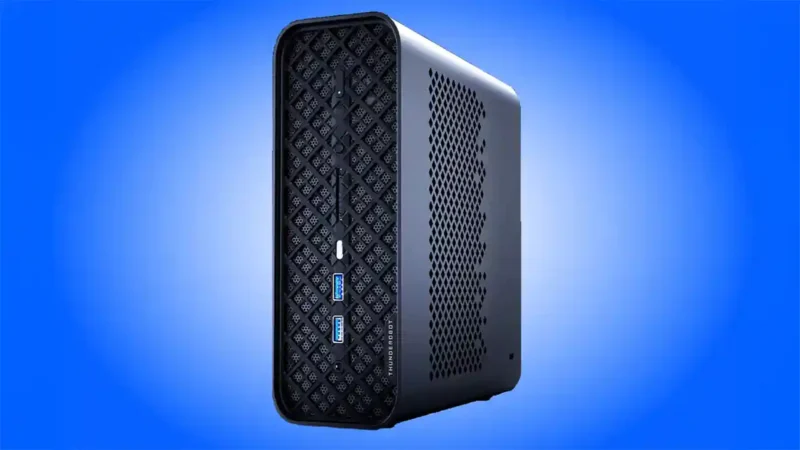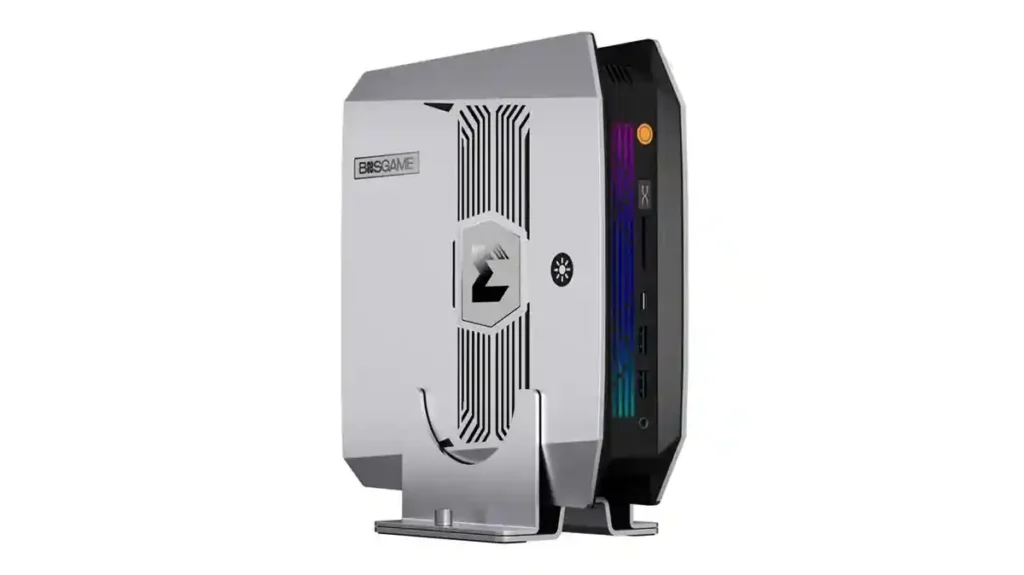

Among the growing pile of mini PCs built around AMD’s Ryzen AI Max+ 395, the Bosgame M5 has one feature none of its rivals bothered with: a full-size SD card reader on the front. For a photographer, that single port changes how the machine fits into a working day — card out of the camera, straight into the front of the computer, no dongle, no hub, no hunting through a bag. You’ll find it on the official Bosgame product page.
It sounds trivial until you consider that the GMKtec EVO-X2, Beelink GTR9 Pro, Minisforum MS-S1 Max and most of the rest of this class all expect you to carry a reader. Bosgame has fitted an SD 4.0 slot, and placed it on the front panel next to the power button and performance switch, which is precisely where you want it.
What it does for photo and video work
Underneath, it is the familiar high-end package: 16 Zen 5 cores and 32 threads up to 5.1GHz, the Radeon 8060S integrated GPU with 40 RDNA 3.5 compute units, and up to 128GB of LPDDR5X memory dynamically shared with the graphics. That combination handles Lightroom Classic’s AI Denoise, large layered Photoshop files and 4K timelines in Premiere Pro or DaVinci Resolve without complaint.
The detail worth knowing for video editors is hardware encode and decode support for H.264, H.265, AV1 and VP9. That is what makes the difference between a timeline that scrubs smoothly and one that stutters, and it accelerates exports significantly compared with CPU-only processing.
Storage is sensible: a 2TB PCIe Gen4 SSD as standard with two M.2 Gen4 slots, so it is expandable and replaceable. Connectivity runs to two USB4 Type-C ports, three USB 3.2 Gen2, two USB 2.0, HDMI 2.1 and DisplayPort 1.4 for 8K output, and Wi-Fi 7.
Where it falls short
Two things count against it for our purposes. Networking is a single 2.5Gb Ethernet port — no 10GbE, and no second port either, where the Minisforum and Beelink machines offer two. If your library lives on a NAS, that is the constraint that matters.
There is also no OCuLink, so external graphics must go through USB4, and reviewers have noted the absence of VESA mounting. The memory is soldered LPDDR5X, as it is across this entire class, so there is no upgrade path.
It is also worth being clear that this is not a new machine — it launched in 2025 — and prices have fallen accordingly, which is arguably the best reason to look at it now. As a quiet, powerful editing box that reads your cards without an adapter, it makes a genuinely practical case.
Bosgame M5 AI: Specifications
Processor: AMD Ryzen AI Max+ 395 (16 cores / 32 threads, Zen 5, up to 5.1GHz). Graphics: AMD Radeon 8060S (RDNA 3.5, 40 compute units, up to 2900MHz); hardware encode/decode for H.264, H.265, AV1 and VP9. AI: XDNA 2 NPU rated at 50 TOPS, 126 TOPS platform total. Memory: 96GB or 128GB LPDDR5X (8000MHz), soldered, dynamically shared with the GPU. Storage: 2TB PCIe Gen4 NVMe SSD supplied; two M.2 PCIe Gen4 slots. Card reader: full-size SD 4.0 slot on the front panel. Ports: 2x USB4 Type-C, 3x USB 3.2 Gen2 Type-A, 2x USB 2.0 Type-A, HDMI 2.1 (8K/60), DisplayPort 1.4 (8K/60), 2x 3.5mm audio. Networking: 2.5Gb Ethernet, Wi-Fi 7, Bluetooth. Other: triple-mode performance switch, anodised metal chassis, aluminium stand included. Omissions: no OCuLink, no VESA mount, single Ethernet port.
Bosgame M5 AI: Price and availability
The M5 is available now direct from Bosgame in 96GB and 128GB configurations. Pricing has fallen considerably since launch, with European stock reported from around €1,281 and US listings in the $1,500 to $1,850 range depending on configuration and promotion. UK pricing varies by retailer — check current pricing before purchase.