
Pre-launch. ACEMAGIC has published a specification but has not confirmed pricing or a release date. Treat the pricing indication below with caution until the company confirms it.
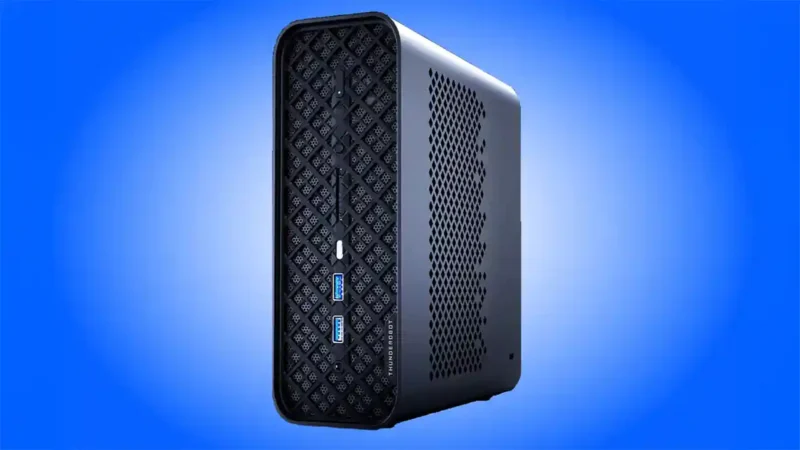
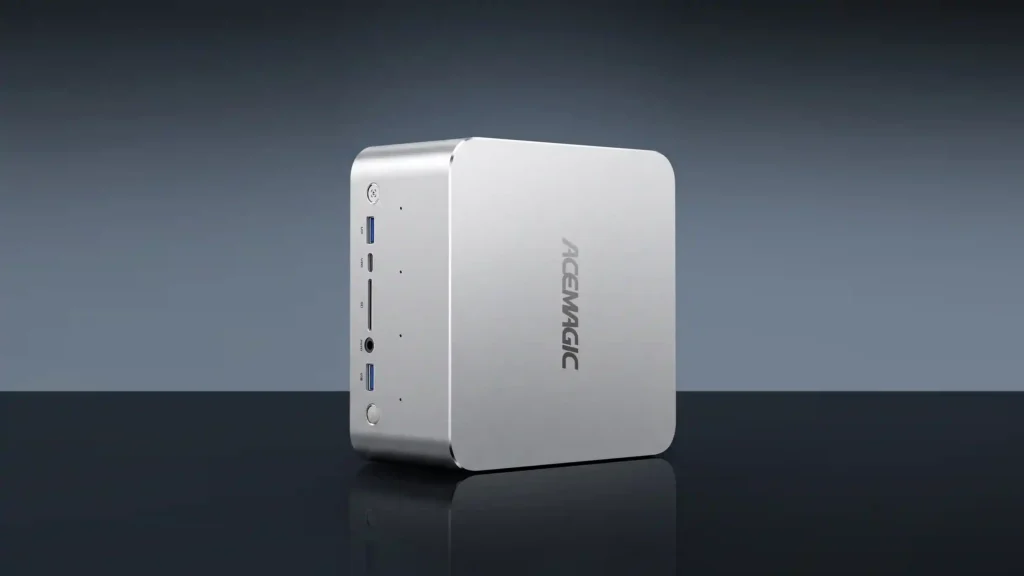
ACEMAGIC already sells a Strix Halo machine — the M1A Pro+, a near-cube with three drive slots. The F9A is the more interesting one for editors, because it adds the port the M1A Pro+ lacks: OCuLink, for connecting a genuine desktop graphics card. It arrives in a two-litre CNC-machined aluminium chassis, and details are on the official ACEMAGIC F9A page.
Expansion is the point
The integrated Radeon 8060S handles Lightroom Classic, Photoshop and mainstream 4K editing in Premiere Pro or DaVinci Resolve without complaint. Where it runs out of road is sustained colour grading, GPU-bound noise reduction and effects-heavy renders.
OCuLink is the proper answer to that. It carries PCIe 4.0 x4 straight to an external graphics enclosure, which is considerably more bandwidth than USB4 or Thunderbolt manages, so a desktop card behaves close to one fitted internally. Buy the machine now, add real GPU power when a job demands it.
Alongside it are two USB4 ports at 40Gbps, giving fast external SSD connections or a second route to an eGPU, plus HDMI 2.1 and dual 2.5GbE networking. There is a dedicated Copilot button on the chassis, which will either please you or not.
Small, and properly cooled
At 158 x 158 x 85mm the F9A is genuinely compact — two litres against the M1A Pro+’s near-cube, and smaller than the ZOTAC or Minisforum machines. The CNC aluminium construction matters more than aesthetics here: the Ryzen AI Max+ 395 draws 120W sustained and peaks around 140W, and how well a chassis dissipates that determines whether the chip holds its speed through a long export or throttles halfway.
Memory runs to 128GB of LPDDR5X-8000, unified across CPU, GPU and NPU, with two M.2 PCIe 4.0 slots for storage. That is one fewer drive slot than the M1A Pro+, which is the trade you make for the smaller footprint — worth thinking about if you had planned separate scratch, project and archive drives.
AI performance is the class standard at 126 TOPS combined, with 50 TOPS from the XDNA 2 NPU.
The price is the question
ACEMAGIC has not announced pricing, and this is where we would counsel patience. An initial pre-launch listing suggested up to around $4,999 for the maximum configuration, which has not been confirmed and would be extraordinary — AMD’s own Ryzen AI Halo developer platform starts at $3,999, and most 128GB machines in this class sit between $1,800 and $2,400.
If the F9A arrives anywhere near that indicative figure it will be very hard to recommend over the AOOSTAR GEM12 Pro at $1,799, which also has OCuLink. If it lands in the normal range for this class, the combination of a small aluminium chassis, OCuLink and dual USB4 makes it a genuinely appealing option.
Networking is dual 2.5GbE rather than 10GbE, so as with most of this class it is not the machine for editing 4K directly off a NAS. We will update this story when ACEMAGIC confirms pricing and availability.
ACEMAGIC F9A: Specifications
Processor: AMD Ryzen AI Max+ 395 (16 cores / 32 threads, Zen 5, up to 5.1GHz). Graphics: AMD Radeon 8060S, 40 RDNA 3.5 compute units. AI: up to 126 TOPS combined; XDNA 2 NPU up to 50 TOPS. Memory: up to 128GB LPDDR5X-8000, unified, soldered. Storage: two M.2 PCIe 4.0 slots. Expansion: OCuLink for external graphics, plus 2x USB4 at 40Gbps. Display: HDMI 2.1. Networking: dual 2.5GbE, Wi-Fi 7. Chassis: two litres, CNC-machined aluminium, 158 x 158 x 85mm. Other: dedicated Copilot button.
ACEMAGIC F9A: Price and availability
The F9A is in its pre-launch phase and ACEMAGIC has not announced official pricing or a release date. An early listing indicated a figure of up to around $4,999 for the maximum configuration, which remains unconfirmed and would sit well above comparable machines. UK pricing and availability are yet to be announced.