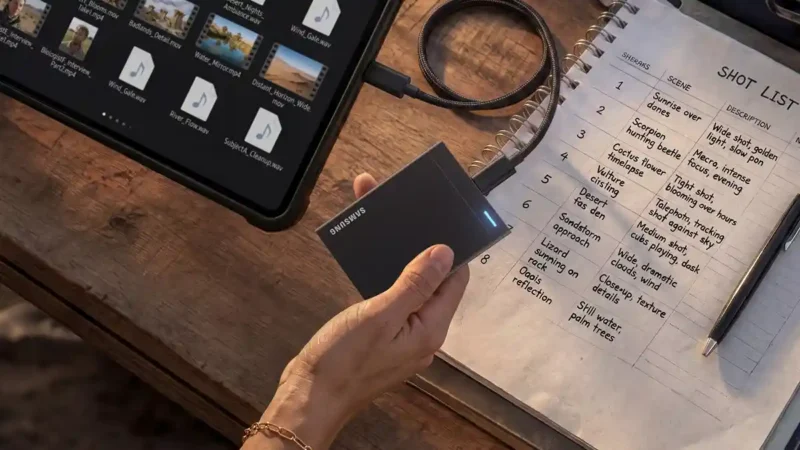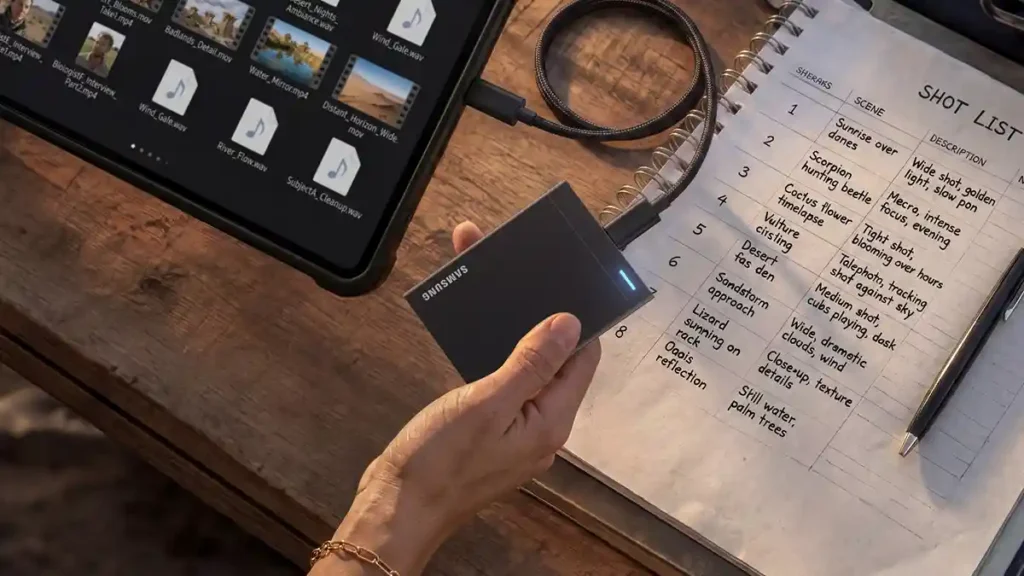

Samsung has launched two new portable SSDs, the P9 and P7, and the significant part is the interface: both use USB4. For photographers and video editors offloading cards in the field, that is the specification that determines how long you stand about waiting. Details are on Samsung’s site.
Why USB4 matters for offloading
Most portable SSDs still use USB 3.2 Gen 2 at 10Gbps, or Gen 2×2 at 20Gbps. USB4 doubles that ceiling again to 40Gbps, matching Thunderbolt bandwidth — and crucially, USB4 is compatible with Thunderbolt 3 and 4 ports, so it works across Mac and Windows without the historical Thunderbolt-only limitation.
The practical difference shows up on a big shoot. A day of 8K footage from something like the GoPro MISSION 1 PRO, or a wedding’s worth of RAW files, can run to several hundred gigabytes. At USB 3.2 speeds that is a coffee break; at USB4 it is closer to a few minutes. When you are backing up in a car park before driving home, that gap matters more than any benchmark.
It also makes editing directly from the drive genuinely viable rather than merely possible — fast enough to scrub a 4K timeline without first copying everything to internal storage.
The Gamescom framing
Samsung announced these at Gamescom, and the marketing is aimed at gamers loading titles from external storage. Do not let that put you off: the underlying hardware is the same, and the requirements overlap almost exactly. Sustained read and write speed, thermal behaviour under long transfers, and a compact rugged enclosure serve a DIT and a console gamer equally well.
If anything, the gaming pitch tends to mean better sustained performance than drives optimised purely for burst speeds, since game loading punishes drives that throttle.
What we would check
Two things decide whether a portable SSD is good for photography rather than merely fast on paper. The first is sustained write speed — the figure quoted on the box is a burst number, and what matters when you dump 400GB is whether it holds up after the cache fills. The second is thermal throttling, since a small metal enclosure moving data at 40Gbps gets warm, and slows down when it does.
We would also want to confirm capacities, endurance ratings and whether hardware encryption is included, none of which are covered in the launch materials we have seen.
Samsung’s portable SSDs have a strong track record — the T-series has been a default recommendation for years — so the fundamentals are likely sound. This looks like a sensible pair for anyone whose offload workflow has become the bottleneck.
Samsung P9 and P7 Portable SSD: Specifications
Interface: USB4, offering up to 40Gbps and compatibility with Thunderbolt 3 and 4 ports.
Models: P9 (flagship) and P7.
Announced: 26 August 2026 at Gamescom.
Note: full capacity options, sustained transfer speeds, endurance ratings, encryption support and dimensions were not detailed in the launch materials we have seen — check Samsung’s product pages for the complete specification.
Samsung P9 and P7 Portable SSD: Price and availability
Samsung announced both drives on 26 August 2026. UK pricing and availability were not confirmed in the launch materials — we will update this story once they are announced.