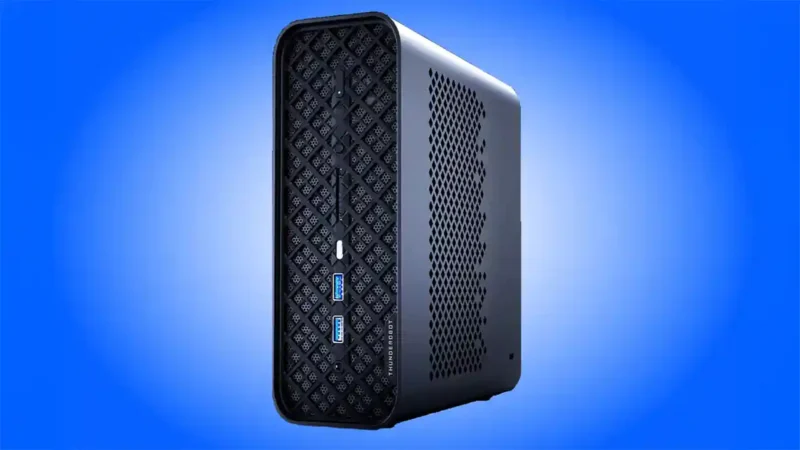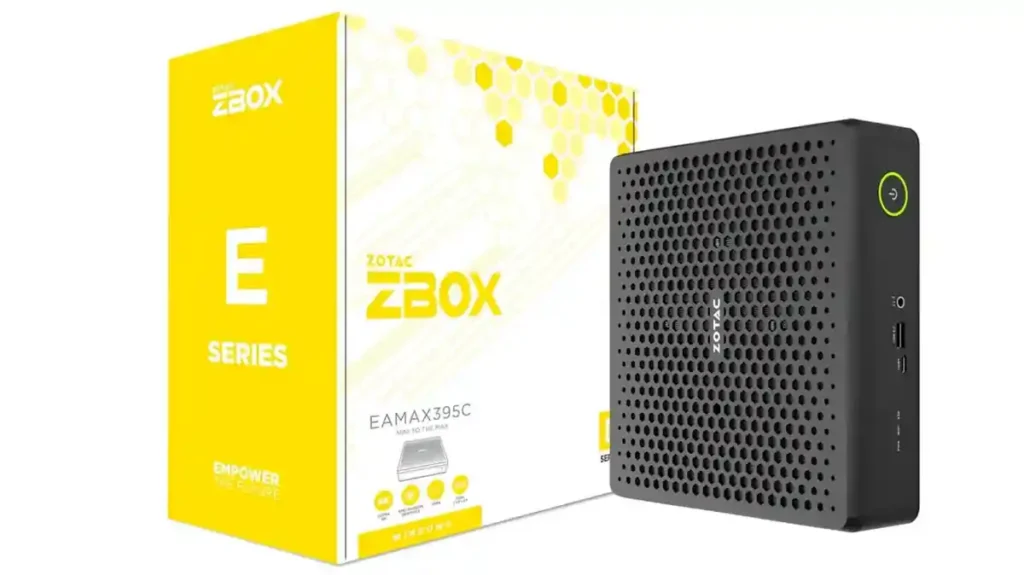

Almost every Ryzen AI Max+ 395 mini PC we have covered comes from a brand that did not exist in Western retail five years ago. ZOTAC is different — a company photographers and video editors have likely bought a graphics card from, with proper distribution and a support structure behind it. Its ZBOX MAGNUS EAMAX395C brings the same Strix Halo silicon to a 2.65-litre chassis, and for anyone nervous about buying a £2,000 editing machine direct from a factory in Shenzhen, that matters. Details are on ZOTAC’s site.
Four displays, and why that is the headline here
The specification that stands out for editors is the display output. The EAMAX395C drives up to four screens through two HDMI 2.1 ports, two DisplayPort 1.4 outputs and DisplayPort over USB4 — more native display connectivity than any machine in this class we have looked at.
For a colour grading suite that is genuinely useful: a primary display for the timeline, a reference monitor for the grade, a scopes display, and a fourth for your media browser or client feed. Most mini PCs force you into USB-C adapters and daisy chains to achieve that, with all the reliability problems that brings. Here it is native.
The rest of the package
Underneath sits the familiar Strix Halo arrangement: 16 Zen 5 cores and 32 threads to 5.1GHz, Radeon 8060S graphics with 40 RDNA 3.5 compute units, and 128GB of LPDDR5X-8000 unified memory on the top SKU. That handles Lightroom Classic’s AI Denoise, large layered Photoshop files and 4K timelines in Premiere Pro or DaVinci Resolve comfortably, with a large pool of memory assignable to the GPU for local AI work.
The chassis measures 210 x 203 x 62.2mm and runs from a 240W external adapter. Networking is dual 2.5GbE with Wi-Fi 7 and Bluetooth 5.4. Front I/O gives you one USB 3.2 Gen 2 Type-A and one USB4 Type-C, with four USB 3.2 Gen 1 Type-A ports at the rear.
ZOTAC sells it barebones or fully configured, and this is the useful part: memory is soldered as it is across the whole Strix Halo class, but storage is yours to specify. Buying barebones and fitting your own NVMe drives is almost always cheaper than paying manufacturer storage prices, and for anyone running large media libraries that saving is meaningful.
Two things to weigh
Networking is dual 2.5GbE rather than 10GbE, so if your photo library lives on a NAS and you want to edit 4K directly from it, the Beelink GTR9 Pro or Minisforum MS-S1 Max remain the better choices. There is no OCuLink either, so external graphics must run over USB4.
More significantly, ZOTAC has still not published pricing. The machine was announced in January and the specification sheet is complete, but no price has appeared — which, given how much memory prices have risen, may be deliberate. Until that changes it is hard to judge against rivals with published figures.
Lower-tier EAMAX390C and EAMAX385C variants are also offered with Radeon 8050S graphics and 32GB of memory, which will suit anyone who wants the platform without the local-AI ambitions.
ZOTAC ZBOX MAGNUS EAMAX395C: Specifications
Processor: AMD Ryzen AI Max+ 395 (16 cores / 32 threads, Zen 5, up to 5.1GHz)
Graphics: AMD Radeon 8060S, 40 RDNA 3.5 compute units
Memory: 128GB LPDDR5X-8000, onboard/soldered
Storage: user-supplied on barebones configurations
Display: up to four screens via 2x HDMI 2.1, 2x DisplayPort 1.4 and DisplayPort over USB4
Networking: dual 2.5GbE, Wi-Fi 7, Bluetooth 5.4
Front ports: 1x USB 3.2 Gen 2 Type-A, 1x USB4 Type-C
Rear ports: 4x USB 3.2 Gen 1 Type-A
Audio: digital audio over HDMI plus analogue stereo in and out
Chassis: 2.65 litres, 210 x 203 x 62.2mm
Power: 240W (20V) external adapter
Variants: EAMAX390C and EAMAX385C with Radeon 8050S graphics and 32GB memory
ZOTAC ZBOX MAGNUS EAMAX395C: Price and availability
ZOTAC announced the MAGNUS EAMAX series in January 2026, offered as barebones or fully configured systems. Pricing has not been published — we will update this story once ZOTAC confirms it.